


BANGALORE GLOBAL HQ CLINICAL TRAINING ACADEMY
DHA Training Center in Bangalore: Expert Clinical Mentorship, CBT Simulation Labs & Complete Dubai Healthcare Licensure
Premier DHA exam training academy in Koramangala, Bengaluru. Featuring 25 Prometric CBT simulation workstations, primary source verification with KSMC/KNC/RGUHS, and specialized coaching for nurses and pharmacists.
Dedicated 25-Terminal CBT Simulation Lab
98.4% Verified First-Attempt Pass Rate
3,245+ Verified Licensures Managed
KNC & KSMC Primary Source Verification
Official DHA Training Pre-Assessment
Confidential evaluation for nurses, pharmacists, doctors & allied health.
Section 1: Bangalore’s Clinical Healthcare Epicenter & The Dubai Licensure Corridor
Connecting Karnataka’s foremost clinical institutions with premier hospital systems and quaternary networks across the Emirate of Dubai.
Bengaluru has earned global acclaim as South Asia’s preeminent capital for advanced quaternary healthcare, tertiary medical education, and biomedical innovation. Clinicians throughout Karnataka develop extraordinary clinical acumen across internationally accredited institutions such as Manipal Hospital, Narayana Health City, St. John’s Medical College Hospital, Apollo Hospitals Bannerghatta, Fortis Hospital, and Bangalore Medical College and Research Institute (BMCRI). Operating across these high-volume facilities, Karnataka’s medical professionals manage complex clinical pathologies, emergency trauma resuscitations, multi-organ support modalities, advanced hemodialysis regimens, and specialized cardiovascular interventions.
This intensive bedside proficiency makes Bangalore clinicians highly sought after across Dubai’s burgeoning healthcare economy. Dubai’s healthcare architecture—anchored by sovereign health clusters including Dubai Health Authority government hospitals (Rashid Hospital, Dubai Hospital, Latifa Women and Children Hospital), academic medical networks like Mohammed Bin Rashid University of Medicine and Health Sciences (MBRU), and elite private hospital groups including Aster DM Healthcare, Mediclinic Middle East, NMC Healthcare, and Saudi German Health—actively recruits Indian physicians, registered nurses, and pharmacists to staff its specialized departments. Dubai provides healthcare professionals with tax-exempt earnings, advanced medical technology, international clinical research collaboration, and exceptional lifestyle stability.
However, securing clinical appointment in Dubai requires holding an active Dubai Health Authority (DHA) Eligibility Letter or Professional License. The regulatory journey is exacting: strict Primary Source Verification via DataFlow Group, rigorous evaluation of clinical experience under the UAE Unified Healthcare Professional Qualification Requirements (PQR), and successful clearance of the computerized Prometric assessment. Operating from our permanent corporate headquarters in Koramangala, Overseas Healthcare Consultant (OHC) acts as South Asia’s definitive institutional bridge, navigating clinicians through every regulatory checkpoint with uncompromised integrity.

Section 2: Dedicated Scope of Coaching: Governance Standards for Nurses and Pharmacists
Ethical service boundaries separating clinical classroom instruction from specialized regulatory credentialing facilitation.
In strict adherence to corporate governance directives, Overseas Healthcare Consultant maintains a transparent, ethical boundary regarding our educational training programs. We firmly reject the generic model of commercial agencies that claim to tutor every clinical subspecialty with superficial, non-expert instructors. Instead, OHC enforces a disciplined, two-tier service architecture:
Intensive Clinical Coaching Exclusively for Nurses & Pharmacists
Comprehensive, instructor-led classroom masterclasses, clinical vignette deconstruction tutorials, computerized Prometric simulation testing drills, and interactive diagnostic reviews are delivered strictly and exclusively for Registered Nurses (RN) and Clinical/Hospital Pharmacists. Our faculty comprises experienced clinical nurse educators and senior pharmacotherapy specialists who provide immersive instruction on Saunders NCLEX-RN curricula, British National Formulary (BNF 86/87) protocols, and complex clinical dosage calculations.
Comprehensive Regulatory Facilitation for Physicians, Dentists & Allied Health
For medical practitioners (General Practitioners, Medical Specialists, and Surgical Consultants), dental surgeons, and allied healthcare professionals (Medical Laboratory Technologists, Radiographers, Physiotherapists), OHC provides authoritative regulatory facilitation. This includes preliminary eligibility audits under the UAE Unified Healthcare Professional Qualification Requirements (PQR), DataFlow Primary Source Verification document compilation, Sheryan portal onboarding, official Eligibility ID processing, and curated reading syllabus roadmaps. Medical doctors receive syllabus blueprints and recommended literature guides without classroom tutoring, ensuring ethical and realistic regulatory expectations.
Section 3: Koramangala CBT Simulation Laboratory & Computerized Testing Environment
South Asia’s premier 25-workstation computer simulation facility replicating authentic Prometric testing conditions.
Computer-Based Testing (CBT) introduces distinct psychological and cognitive demands that cannot be mastered through passive textbook reading or smartphone apps. Candidates who excel in paper-based examinations frequently experience severe time management difficulties, eye fatigue, and decision paralysis when confronted with a high-resolution computerized testing interface with an active countdown timer. At our Koramangala headquarters, OHC has built a dedicated, proctored Prometric CBT Simulation Laboratory featuring 25 dual-monitor testing terminals designed to eliminate these obstacles:
Workstation Hardware & Layout Mirroring
Each terminal is configured with identical ergonomic displays, standardized keyboard layouts, and software interfaces replicating the Prometric testing workstation. Candidates experience the exact screen divisions: question stem pane, answer radio buttons, navigation panel, electronic question flagging tool, and on-screen basic calculator.
Timed Workstation Conditioning (72-Second Pacing)
The DHA nursing examination requires solving 150 questions within 180 minutes, allowing an average of only 72 seconds per clinical scenario. Our simulation engine trains candidates to rapidly scan the scenario, identify discriminating laboratory markers or patient vitals, eliminate two obvious distractors within 20 seconds, and select the guideline-concordant answer. Candidates who train in our lab develop subconscious pacing discipline that prevents panic during the final testing hour.
Proctored Testing Realism & Stress Inoculation
Mock examinations are conducted in absolute silence under live invigilation. Candidates must store personal belongings, adhere to biometric workstation check-in protocols, and navigate timed unscheduled breaks. This psychological conditioning completely desensitizes clinicians to test-day anxiety, transforming unfamiliar testing environments into routine clinical exercises.

Section 4: High-Yield Clinical Calculations & Pharmacotherapy Formularies
Rigorous mathematical deconstruction covering nursing fluid titrations and advanced clinical biopharmaceutics.
Mathematical calculations represent 10% to 15% of the total questions on DHA nursing and pharmacy examinations. Because Prometric algorithms apply heavy discriminatory weighting to mathematical precision, failing calculation questions severely damages a candidate’s scaled score. OHC provides dedicated masterclasses on high-yield clinical formulas:
Nursing Intravenous Flow Rates, Pediatric Dosages & Burn Resuscitation
Nurses master dimensional analysis and algebraic conversion formulas through repetitive clinical drills:
- Intravenous Infusion Drop Rate Formula: Flow Rate (drops per minute, gtt/min) = [Total Volume to Infuse (mL) multiplied by Drop Factor (gtt/mL)] divided by Infusion Time (minutes). Candidates solve scenarios using both microdrip tubing (60 gtt/mL) and standard macrodrip calibrations (10, 15, or 20 gtt/mL).
- Pediatric Weight-Based Medication Dosing: Total Daily Dosage (mg) = Child Weight (kg) multiplied by Recommended Dose (mg/kg/day) divided into equal dosing intervals (every 6 hours, every 8 hours, or every 12 hours). Candidates learn to cross-check calculated volumes against stock suspension concentrations to detect prescribing overdoses.
- Parkland Burn Fluid Resuscitation Formula: Total 24-Hour Lactated Ringer’s Volume (mL) = 4 mL multiplied by Patient Weight (kg) multiplied by Total Body Surface Area (% TBSA) second- and third-degree burns. Candidates apply the Rule of Nines for adult anatomical surface estimation and memorize the critical infusion timing: administering 50% of the calculated fluid during the first 8 hours post-burn, and the remaining 50% over the subsequent 16 hours.
- Holiday-Segar 4-2-1 Maintenance Fluid Method: Calculating hourly pediatric maintenance hydration: 100 mL/kg/day (4 mL/kg/hr) for the first 10 kg; 50 mL/kg/day (2 mL/kg/hr) for the second 10 kg (11 to 20 kg); and 20 mL/kg/day (1 mL/kg/hr) for each kilogram above 20 kg.
- Regular Insulin Infusion Titration Protocols: Calculating continuous IV regular insulin infusion units/hour and monitoring serum potassium levels during diabetic ketoacidosis (DKA) management.
Clinical Pharmacist Cockcroft-Gault CrCl, Alligation & TPN Calculations
Pharmacist candidates are drilled on precision biopharmaceutics and clinical dispensing mathematics:
- Cockcroft-Gault Equation for Creatinine Clearance: CrCl (mL/min) = [(140 minus Age) multiplied by Weight (kg)] divided by [72 multiplied by Serum Creatinine (mg/dL)], multiplied by 0.85 for female patients. Candidates learn when to apply Actual Body Weight (ABW), Ideal Body Weight (IBW: 50 kg + 2.3 kg per inch over 5 feet for males; 45.5 kg + 2.3 kg per inch for females), and Adjusted Body Weight (AdjBW = IBW + 0.4 multiplied by [ABW minus IBW]) in obese patients.
- Alligation Alternate Compounding: Cross-calculation grids for compounding specific target concentrations by combining high-strength and low-strength stock preparations (e.g., preparing 70% ethyl alcohol from 95% stock and sterile water).
- Total Parenteral Nutrition (TPN) Osmolarity: Calculating milliosmoles per liter (mOsm/L) for dextrose monohydrate (5 mOsm/g, 3.4 kcal/g), amino acids (10 mOsm/g, 4 kcal/g), and intravenous lipid emulsions (10% emulsion at 1.1 kcal/mL; 20% emulsion at 2.0 kcal/mL), strictly enforcing the 900 mOsm/L ceiling for peripheral vein infusion.
- Therapeutic Drug Monitoring (TDM) Windows: Memorizing target serum trough concentrations for vancomycin (15 to 20 mcg/mL for severe sepsis and MRSA), digoxin (0.5 to 0.9 ng/mL for systolic heart failure), gentamicin (trough under 1 mcg/mL to prevent nephrotoxicity), and total phenytoin (10 to 20 mcg/mL).
Section 5: Specialized Cadres Matrix: Nursing, Pharmacy, Medicine & Allied Health
Tailored preparation pathways respecting the regulatory and clinical diversity of Karnataka’s healthcare professionals.

Registered Nurses
Intensive CBT coaching, Saunders NCLEX-RN syllabus, 25-terminal computer simulation labs, and 72-second pacing drills.

Clinical Pharmacists
Pharmacotherapy masterclasses, Cockcroft-Gault dosing drills, BNF protocols, and Dubai controlled drug dispensing standards.

Medical Doctors
Specialized PQR credential evaluation, DataFlow PSV filing, KSMC liaison, and Prometric exam scheduling (no classroom tutoring).

Allied Health Cadres
Full regulatory support for MLT, Radiographers, and Physiotherapists under the UAE Unified PQR guidelines.
Section 6: Regulatory Verification with Karnataka Councils & DHA Sheryan Standards
Direct institutional coordination bridging KSMC, KNC, and RGUHS with Dubai Health Authority digital systems.
Achieving DHA licensure requires establishing a completely verified regulatory paper trail connecting Karnataka’s state licensing bodies to the Government of Dubai’s Sheryan digital infrastructure. Under the UAE Unified PQR framework, every academic qualification, state council registration, and clinical experience certificate undergoes independent Primary Source Verification (PSV) conducted by DataFlow Group. Minor administrative discrepancies between Karnataka documentation and Dubai application fields result in immediate file stagnation.
Karnataka State Medical Council (KSMC) Good Standing Protocols
For medical practitioners registered with the Karnataka State Medical Council in Malleshwaram, an active Certificate of Good Standing (CGS) is mandatory. KSMC mandates an online application submission accompanied by valid permanent registration certificates, continuing medical education (CME) credit compliance documentation, identity verifications, and administrative submission clearance. The electronic CGS must be transmitted within its strict validity window (typically 3 to 6 months) directly to DataFlow. OHC coordinates the verification lifecycle, verifying that council records match university degrees and hospital employment records precisely.
Karnataka Nursing Council (KNC) Foreign Verification Guidelines
Registered Nurses registered with the Karnataka Nursing Council near Gandhinagar must undergo the foreign verification process for overseas migration. KNC requires official verification challan submissions, original registration books, verification forms, and institutional endorsement letters. OHC guides nurses through the exact submission protocols, ensuring the Good Standing Certificate is issued smoothly and accepted by DataFlow without delays.
Rajiv Gandhi University of Health Sciences (RGUHS) Primary Source Verification
RGUHS in Jayanagar confers medical, nursing, dental, and pharmaceutical degrees across Karnataka. When DataFlow initiates primary source verification, university evaluation registrars inspect permanent archive registers, graduation rolls, and consolidated mark cards. Discrepancies in candidate name spellings, college affiliation records, or internship completion dates cause prolonged verification holds. OHC’s local liaison desk actively tracks RGUHS institutional queues, resolving registrar queries immediately.
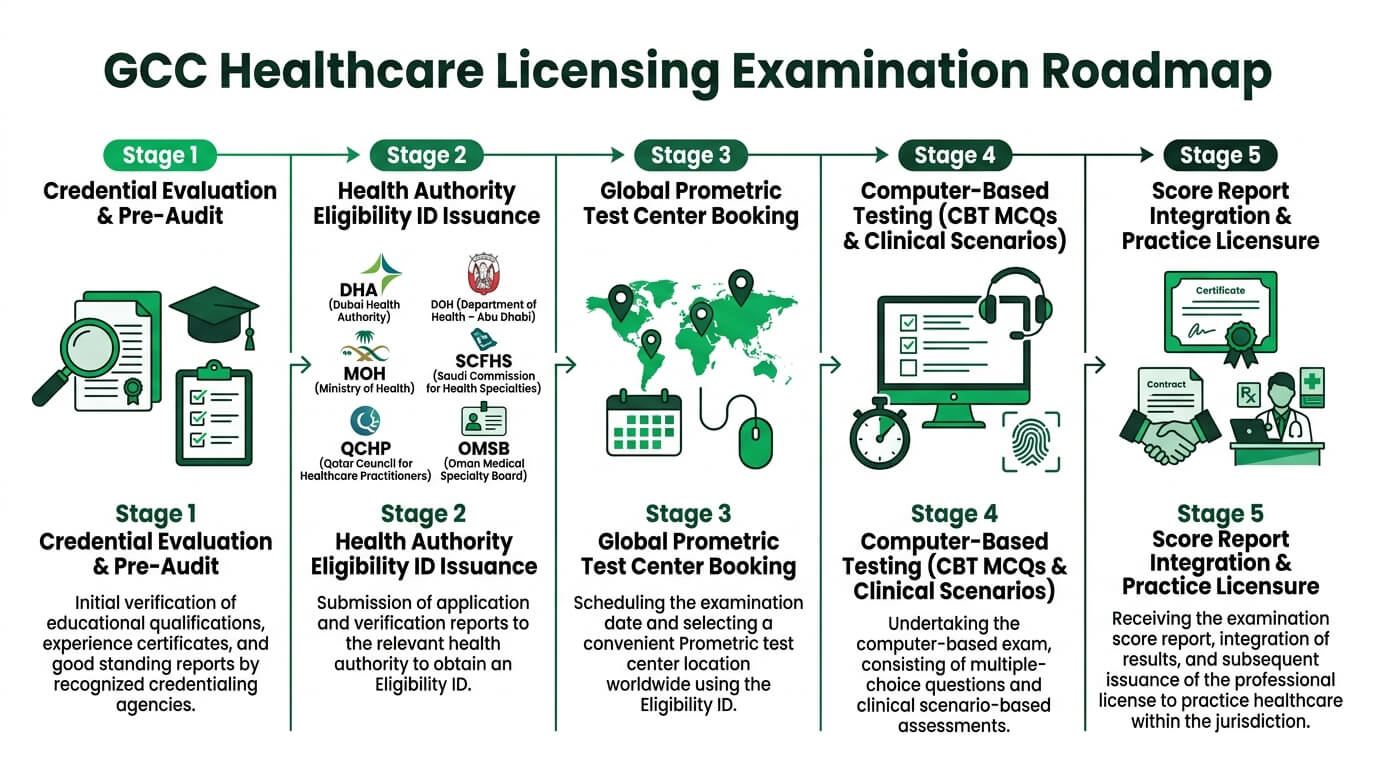
Section 7: OHC Koramangala 6-Stage Bangalore DHA Pathway
A predictable, fully audited 6-stage roadmap delivering candidates from Bangalore profile review to official Dubai healthcare appointment.
Profile Audit
Senior advisors evaluate Karnataka degrees, council status, hospital bed-strength, and accreditation against Dubai PQR criteria.
DataFlow PSV
Comprehensive preparation of documents and active liaison with RGUHS, KSMC, KNC, and Bangalore hospital HR departments.
Sheryan Filing
Flawless electronic dossier submission on the official Dubai Health Authority Sheryan system, securing formal DHA credential approval.
CBT Simulation
Intensive Prometric coaching (for nurses and pharmacists) alongside timed CBT drills in our 25-terminal computer lab.
Prometric Exam
Scheduling test appointments at authorized Prometric centers in Bangalore (Whitefield or central districts) upon scoring 80%+ on mocks.
DHA Eligibility
Converting passing examination scores into an official DHA Eligibility Letter and matching candidates with Dubai hospital recruiters.
Section 8: Verified Candidate Reviews, Local Center Directions & Koramangala Access
Authentic clinical feedback from certified alumni and detailed transit navigation from Bengaluru’s foremost healthcare corridors.
“The 25-terminal computer simulation lab in Koramangala was pivotal for my success. Practicing in the actual dual-screen Prometric environment eliminated all test anxiety. I mastered the 72-second pacing per clinical scenario, and the continuous ECG strip interpretation drills helped me score 89% on my first attempt!”
“Most online mock tests only give you static PDFs. At OHC Koramangala’s CBT lab, I practiced on the actual Prometric interface with timed calculator pop-ups and split-screen lab values. Their Cockcroft-Gault dosing masterclasses and alligation calculations made the math section effortless. Cleared first try with 91%!”
“As an emergency nurse doing rotating 12-hour shifts, sitting in front of a computer screen for 3 hours was exhausting. The physical workstation ergonomics, noise-canceling headsets, and mock invigilation at OHC Koramangala conditioned my mental endurance. Passed my DHA exam comfortably with 85%!”
“The structured 6-stage roadmap and hands-on Prometric software navigation at Koramangala took away all the guesswork. Being able to practice flagging uncertain questions and returning during the final 30 minutes was the key strategy that got me through. Truly Bangalore’s premier healthcare testing academy.”
Bangalore Healthcare Geography & Transit Access to Koramangala
Overseas Healthcare Consultant’s global headquarters is situated at #3/7-3, No.5, 1st Floor, 3rd Cross, Koramangala 2nd Block Extension, Madiwala Post, Bengaluru, Karnataka 560068. Our central geographic positioning in South Bangalore provides rapid, direct transportation access for clinicians traveling from major medical belts across Greater Bengaluru:
- From St. John’s Medical College & Hospital: Located just 1.5 kilometers away, reachable in under 5 minutes via 80 Feet Road Koramangala. St. John’s residents and nursing staff frequently attend our evening briefing sessions after clinical duties.
- From NIMHANS, Kidwai Memorial Oncology & Jayadeva Cardiology: Situated approximately 3.5 kilometers away via Hosur Road and Dairy Circle, accessible in 10 to 12 minutes.
- From Manipal Hospital (HAL Airport Road) & Domlur: Direct connectivity via the 100 Feet Road and Inner Ring Road flyover, reaching our Koramangala campus in approximately 15 minutes.
- From Narayana Health City & Bommasandra Industrial Hub: Seamless expressway transit via the Electronic City Elevated Tollway, descending directly into Silk Board junction and Koramangala.
- From Central Medical Hubs (BMCRI, Victoria Hospital, Bowring Hospital): Accessible via Lalbagh Fort Road, Dairy Circle, and Hosur Road within 20 minutes.
- Public Transit & Parking: Our academy is serviced by frequent BMTC bus routes stopping at Koramangala Water Tank, BDA Complex, and Sony World Junction, with direct feeder connectivity from nearby Namma Metro Green and Purple line stations, complemented by dedicated visitor parking.
Section 9: Clinical & Regulatory FAQs for DHA Training in Bangalore
Authoritative answers to fundamental clinical, simulation laboratory, and regulatory questions for Dubai Health Authority licensure.
1. How does OHC Koramangala’s physical CBT Simulation Lab differ from online practice question banks?
2. What specific workstation hardware and display ergonomics are featured in the 25-terminal Bangalore lab?
3. How does the 72-second pacing simulation drill prevent candidate failure during the 180-minute DHA exam?
4. Can working nurses in Bangalore book individual evening or weekend workstation slots in the simulation laboratory?
5. What software navigation features are mirrored in OHC’s Prometric CBT testing interface?
6. Are un-proctored or invigilated full-length 150-question diagnostic mock exams conducted on-site?
7. How does OHC train nurses to deconstruct complex multi-tiered ABCDE clinical triage vignettes?
8. What pharmaceutical calculation and therapeutic drug monitoring (TDM) modules are practiced in the lab?
9. Why is physical test simulation crucial for clinicians who have only taken Indian university written exams?
10. How does OHC Koramangala handle post-mock diagnostic error analysis for nurses and pharmacists?
11. What is the recommended number of full-length CBT simulation sessions before sitting the actual DHA exam?
12. How does the training center synchronize physical lab simulations with DataFlow PSV processing?
13. Does OHC provide noise-canceling headsets and biometric check-in simulations during proctored mocks?
14. How are pediatric weight-based calculations and IV drop-rate formulas taught in hands-on workshops?
15. What support is available if a candidate struggles with computer interface fatigue during 3-hour tests?
16. How do healthcare candidates in Bangalore register for an on-site simulation workstation evaluation?
Begin Your Dubai Healthcare Licensure Journey in Bangalore
Join South Asia’s preeminent healthcare licensing academy in Koramangala. Benefit from our 25-workstation Prometric simulation laboratory, expert coaching for nurses and pharmacists, and end-to-end DataFlow PSV credentialing.
Overseas Healthcare Consultant (OHC) – Global Corporate Headquarters
#3/7-3, No.5, 1st Floor, 3rd Cross, Koramangala 2nd Block Extension, Madiwala Post, Bengaluru, Karnataka 560068, India
Operational Hours: Monday through Saturday, 9:00 AM to 6:30 PM IST. Prior appointment recommended for in-person credential reviews.