


•
Arabian Gulf Region
Healthcare Jobs in Gulf Countries: GCC Hospital Vacancies, Licensing Pathways & Medical Careers
Unified regional gateway to verified hospital vacancies, licensing clearance, and clinical career progression across UAE, Saudi Arabia, Oman, Qatar, Bahrain, and Kuwait. Access expert DataFlow verification, Prometric coaching, and institutional placements with OHC Bengaluru.
100% Tax-Free Earnings & Gratuity
Unified GCC Licensing Framework
DataFlow TrueProfile Portability
Direct Hospital Matching & Visas
Apply for Gulf Healthcare Jobs
Confidential evaluation for doctors, nurses, pharmacists & allied health.
6 GCC Nations
UAE, Saudi Arabia, Oman, Qatar, Bahrain & Kuwait hospital placement networks.
Unified PQR
Multi-authority qualification evaluation under standardized GCC benchmarks.
DataFlow PSV
Primary Source Verification with TrueProfile cross-border transfer portability.
CBT Coaching
Dedicated Prometric exam prep exclusively for Nurses & Pharmacists.
Direct Placements
Verified hospital interviews with public health systems and top private groups.
Core Professional, Financial and Lifestyle Advantages of Healthcare Careers in the Arabian Gulf
Electing to practice medicine, nursing, pharmacy, or allied healthcare across the Gulf Cooperation Council unlocks unprecedented career trajectories, tax-free earnings, and modern family living in the safest urban environments in the world.
100% Tax-Free Earnings
Zero personal income tax with full earnings retention and statutory end-of-service gratuity.
National Vision Programs
Multi-billion healthcare infrastructure investments driving massive regional clinical demand.
JCI Quaternary Centers
Work alongside distinguished international clinicians in cutting-edge academic facilities.
Family Visa Sponsorship
Subsidized housing, premium international schooling, and stable resident lifestyle.
Financial Growth
100% Tax-Free Compensation Packages and Statutory Gratuity +
100% Tax-Free Compensation Packages and Statutory Gratuity
A primary financial advantage of practicing medicine, nursing, pharmacy, or allied healthcare across the Arabian Gulf is the complete absence of personal income taxation, capital gains levies, and municipal withholding deductions. Clinicians retain their entire gross compensation package, creating an exceptional environment for personal savings, family wealth preservation, and long-term financial security.
In accordance with statutory labor regulations across GCC member nations, all expatriate healthcare employees are legally entitled to end-of-service gratuity upon completing their employment contracts. In addition to basic remuneration, hospital institutions routinely provide comprehensive corporate benefits packages that include fully furnished family residential accommodations or generous housing allowances, annual round-trip flight allowances for clinicians and their eligible dependents, comprehensive private health insurance coverage, and education support for school-age children.
Clinical Modernization
Healthcare Infrastructure Expansion Under Sovereign National Vision Programs +
Healthcare Infrastructure Expansion Under Sovereign National Vision Programs
Across the Arabian Gulf, visionary state development blueprints—such as Saudi Vision 2030, UAE Vision 2031, Qatar National Vision 2030, and Oman Vision 2040—are channeling substantial capital into modernizing national healthcare infrastructure. These sovereign programs prioritize preventive medicine, genomic sequencing, specialized tertiary oncology, robotic surgical suites, and comprehensive digital health records.
International practitioners join multidisciplinary hospital teams equipped with the world’s most advanced diagnostic and therapeutic tools, including intraoperative MRI suites, hybrid cardiovascular catheterization laboratories, da Vinci robotic surgical systems, and cutting-edge linear accelerators for stereotactic radiotherapy. Moreover, continuing medical education (CME) frameworks established across GCC regulatory bodies ensure clinicians regularly participate in accredited symposia, research grand rounds, and clinical workshops to maintain international practice benchmarks.
Clinical Excellence
Renowned Quaternary Institutions, Academic Medical Complexes & JCI-Accredited Hospitals +
Renowned Quaternary Institutions, Academic Medical Complexes & JCI-Accredited Hospitals
The Gulf region features an extraordinary concentration of tertiary and quaternary hospitals that maintain prestigious international accreditations from Joint Commission International (JCI), the College of American Pathologists (CAP), and the Australian Council on Healthcare Standards (ACHS). Clinicians practicing in premier institutions collaborate daily with distinguished medical leaders trained in North America, Europe, Australia, and premier Asian teaching hospitals.
This collaborative environment exposes healthcare professionals to complex clinical pathologies, specialized surgical subdisciplines, rare genetic conditions, and advanced organ transplantation programs. Working within internationally accredited clinical environments substantially enhances a practitioner’s curriculum vitae, establishing robust foundations for global career advancement and research recognition.
Resident Privileges
Safe Family-Centric Lifestyle, Subsidized Housing & Premium Resident Privileges +
Safe Family-Centric Lifestyle, Subsidized Housing & Premium Resident Privileges
Relocating to the Gulf region offers exceptional personal safety, family-oriented lifestyle amenities, and modern infrastructure. Gulf cities such as Dubai, Abu Dhabi, Riyadh, Doha, and Muscat consistently rank among the safest urban centers globally, distinguished by negligible crime rates, pristine public spaces, and sophisticated international communities.
Hospital employers provide modern, secure residential housing located in master-planned communities or generous allowances enabling professionals to rent spacious apartments or villas near schools and recreational centers. Expatriate healthcare practitioners receive full family visa sponsorship privileges, permitting them to sponsor spouses and dependent children with complete legal stability. Furthermore, world-class international schools offering British, American, International Baccalaureate (IB), and CBSE curricula ensure uninterrupted, high-standard education for children.
Institutional Healthcare Infrastructure Across UAE, Saudi Arabia, Oman, Qatar, Bahrain, and Kuwait
A comprehensive operational guide to public health systems, sovereign medical cities, university hospitals, and private conglomerates across all six GCC member states.
United Arab Emirates
UAE: DHA Dubai, DOH/SEHA Abu Dhabi, MOHAP & Private Conglomerates +
UAE: DHA Dubai, DOH/SEHA Abu Dhabi, MOHAP & Private Conglomerates
The United Arab Emirates operates a tri-partite regulatory structure that delivers world-class clinical care across its seven emirates:
Dubai (DHA): Governed by the Dubai Health Authority, clinical facilities include flagship public institutions like Rashid Hospital (regional trauma center), Dubai Hospital, and Latifa Women and Children Hospital, alongside prestigious private healthcare groups such as Aster DM Healthcare, Mediclinic Middle East, Prime Hospital, American Hospital Dubai, and Saudi German Health.
Abu Dhabi (DOH / PureHealth): Regulated by the Department of Health Abu Dhabi, clinical delivery is anchored by the SEHA public hospital network (Sheikh Shakhbout Medical City in partnership with Mayo Clinic, Sheikh Khalifa Medical City, Tawam Hospital) and premier quaternary private facilities including Cleveland Clinic Abu Dhabi and Burjeel Medical City.
Northern Emirates (MOHAP): The Ministry of Health and Prevention oversees healthcare licensing and public hospitals across Sharjah, Ajman, Ras Al Khaimah, Fujairah, and Umm Al Quwain, supported by expanding private facilities such as Zulekha Hospital and Thumbay University Hospital.
Saudi Arabia
Saudi Arabia: MOH Health Clusters, Sovereign Medical Cities & Leading Private Groups +
Saudi Arabia: MOH Health Clusters, Sovereign Medical Cities & Leading Private Groups
Saudi Arabia represents the largest healthcare market in the Middle East, undergoing historic restructuring into regional accountable care organizations known as Health Clusters under Vision 2030:
Ministry of Health (MOH) Health Clusters: Over twenty geographical health clusters spanning Riyadh, Makkah, Eastern Province, Madinah, and Asir integrating primary health clinics, general hospitals, and tertiary referral centers.
Sovereign Medical Cities & Specialized Centers: Quaternary centers of excellence including King Faisal Specialist Hospital & Research Centre (KFSH&RC), King Fahad Medical City (KFMC) in Riyadh, King Abdulaziz Medical City (KAMC – National Guard Health Affairs), and Prince Sultan Military Medical City (PSMMC).
Private Healthcare Networks: Leading corporate hospital operators such as Dr. Sulaiman Al Habib Medical Group, Mouwasat Medical Services, Dallah Healthcare, Saudi German Health, and Al Hammadi Hospitals, providing extensive inpatient and specialized surgical capacity.
Sultanate of Oman
Oman: Ministry of Health (MOH) Referral Centers, SQUH & Private Hospital Networks +
Oman: Ministry of Health (MOH) Referral Centers, SQUH & Private Hospital Networks
The Sultanate of Oman provides high-quality healthcare characterized by extensive state hospital networks and expanding private quaternary facilities:
MOH Tertiary Referral Centers: Apex public referral complexes including Royal Hospital Muscat (national oncology, cardiology, and genetics referral hub), Khoula Hospital (national neurosurgery, orthopedics, and burn trauma center), and Al Nahdha Hospital.
Autonomous Academic Facilities: Sultanate apex teaching centers including Sultan Qaboos University Hospital (SQUH) and Armed Forces Hospital Al Khoudh, dedicated to advanced subspecialty medicine and clinical research.
Private Hospital Operators: Well-established private medical networks such as Aster Al Raffah Hospitals, Muscat Private Hospital, Badr Al Samaa Group, Starcare Hospitals, and Burjeel Hospital Al Khuwair.
State of Qatar
Qatar: Hamad Medical Corporation (HMC), PHCC, Sidra Medicine & Private Tertiary Facilities +
Qatar: Hamad Medical Corporation (HMC), PHCC, Sidra Medicine & Private Tertiary Facilities
The State of Qatar delivers highly centralized, world-class healthcare governed by the Ministry of Public Health (MOPH) Department of Healthcare Professions (DHP):
Hamad Medical Corporation (HMC): The sovereign public health provider managing twelve specialized hospitals, including Hamad General Hospital, Heart Hospital, National Center for Cancer Care & Research (NCCCR), and the Women’s Wellness and Research Center (WWRC).
Primary Health Care Corporation (PHCC): Operating over thirty community health and wellness centers across Qatar focused on preventive medicine, chronic disease management, and family healthcare.
Academic & Private Centers: Sidra Medicine (quaternary academic women and children hospital affiliated with Weill Cornell Medicine-Qatar), alongside expanding private quaternary centers including The View Hospital (affiliated with Cedars-Sinai), Al Ahli Hospital, and Aster Hospital Doha.
Bahrain & Kuwait
Bahrain & Kuwait: National Health Authorities & Tertiary Medical Centers +
Bahrain & Kuwait: National Health Authorities & Tertiary Medical Centers
Healthcare delivery in Bahrain and Kuwait combines established sovereign health ministries with expanding private specialized medical networks:
Kingdom of Bahrain: Regulated by the National Health Regulatory Authority (NHRA), clinical care is delivered through public complexes such as Salmaniya Medical Complex and King Hamad University Hospital (KHUH), complemented by private tertiary hospitals including Bahrain Specialist Hospital, American Mission Hospital, and Royal Bahrain Hospital.
State of Kuwait: Regulated by the Kuwait Ministry of Health (MOH), inpatient healthcare is anchored by major public tertiary complexes including Mubarak Al-Kabeer Hospital, Amiri Hospital, and Jaber Al-Ahmad Al-Sabah Hospital, alongside prominent private institutions such as Al Salam International Hospital, Dar Al Shifa Hospital, and Taiba Hospital.
In-Demand Clinical Disciplines Across Arabian Gulf Hospitals and Specialized Medical Centers
Active institutional recruitment across all medical, surgical, nursing, pharmacy, and diagnostic imaging disciplines across the Gulf.

Physicians & Surgeons
Consultant & Specialist roles across Emergency, ICU, Cardiology, OB/GYN, Pediatrics, and Orthopedics.
MD / MS / Board Certified

Registered Staff Nurses
Acute inpatient care across ICU, NICU, Emergency, Operating Theaters, and Surgical units.
BSc Nursing + 2 Yrs Exp

Clinical & Hospital Pharmacists
Inpatient clinical rounds, sterile compounding, oncology pharmacotherapy, and automated dispensing.
BPharm / PharmD + 2 Yrs

Allied Health Professionals
Diagnostic Radiography (MRI/CT), Medical Lab Technology (MLT), Physiotherapy, and Respiratory Care.
BSc Allied Health + 2 Yrs
Medical Doctors
Consultant, Senior Specialist, Specialist, and Resident Physicians +
Consultant, Senior Specialist, Specialist, and Resident Physicians
Medical doctor appointments across the Gulf are classified into structured practitioner tiers based on international postgraduate qualifications, completed residency programs, and years of post-qualification clinical experience:
Emergency Medicine and Trauma Surgery: Urgent clinical demand for fellowship-trained resuscitation specialists and acute trauma surgeons across regional Level-1 trauma centers.
Critical Care Medicine (Adult and Pediatric): Intensive care intensivists skilled in advanced mechanical ventilation, extracorporeal membrane oxygenation (ECMO), and hemodynamic monitoring.
Cardiology and Interventional Cardiology: Specialists adept in percutaneous coronary interventions (PCI), electrophysiology, and structural heart procedures.
Obstetrics and Gynecology: High clinical demand for consultants and specialists proficient in high-risk feto-maternal medicine, complex operative obstetrics, and laparoscopic gynecological surgery.
Pediatrics and Neonatology: Specialists in extreme preterm neonatal care (NICU Level-3/4) and pediatric intensive care management.
Orthopedic Surgery, Neurology, and Neurosurgery: Subspecialists managing spine surgery, joint replacement, stroke interventions, and complex neuro-trauma.
Nursing Cadre
Registered Staff Nurses: Intensive Care, Critical Care, Neonatal, Emergency, and Surgical Wards +
Registered Staff Nurses: Intensive Care, Critical Care, Neonatal, Emergency, and Surgical Wards
Registered nurses form the clinical backbone of healthcare delivery across Gulf hospitals. Qualified candidates must hold a four-year Bachelor of Science in Nursing (BSc Nursing) degree, an active home-country nursing council registration, and a minimum of two years of verified acute inpatient hospital experience.
Adult Intensive Care Unit (ICU): Management of multi-organ failure, invasive arterial lines, central lines, continuous renal replacement therapy (CRRT), and ventilator weaning.
Neonatal Intensive Care Unit (NICU): Specialized care of critically ill neonates, surfactant administration, and incubator micro-environments.
Emergency Department (ED): Triage assessment, acute clinical stabilization, cardiac arrest protocols, and rapid trauma management.
Operating Room (OR / OT) & PACU: Perioperative scrub and circulating nurses proficient in robotic surgery, orthopedic instrumentation, and post-anesthesia recovery.
Medical-Surgical & Oncology Wards: Comprehensive inpatient nursing care, chemotherapeutic administration protocols, and wound care management.
Pharmacy Cadre
Hospital, Clinical, and Ward Dispensing Pharmacist Roles +
Hospital, Clinical, and Ward Dispensing Pharmacist Roles
Hospital and clinical pharmacists ensure pharmacological safety, rational drug therapy, and precision medication distribution across Gulf healthcare facilities. Candidates must hold a recognized Bachelor of Pharmacy (BPharm) or Doctor of Pharmacy (PharmD) degree with at least two years of post-registration clinical experience.
Clinical Pharmacists: Conducting inpatient ward rounds alongside medical teams, evaluating patient medication regimens, adjusting antibiotic stewardship protocols, and monitoring renal dosing.
Inpatient Hospital Pharmacists: Operating unit-dose distribution systems, automated medication dispensing cabinets (Pyxis/Omnicell), and total parenteral nutrition (TPN) compounding.
Oncology Compounding Pharmacists: Sterile preparation of cytotoxic chemotherapy regimens inside cleanroom biosafety cabinets adhering to international USP 797/800 standards.
Allied Health
Allied Health Professionals: Diagnostic Imaging, Clinical Laboratory, and Specialized Rehabilitation +
Allied Health Professionals: Diagnostic Imaging, Clinical Laboratory, and Specialized Rehabilitation
Allied healthcare professionals provide essential diagnostic, therapeutic, and rehabilitative support across Gulf hospital networks. Candidates must possess accredited bachelor degrees in their clinical discipline and two years of hospital practice.
Medical Imaging & Radiography: Radiographers and radiologic technologists proficient in multislice computed tomography (CT), high-field magnetic resonance imaging (MRI), and interventional catheterization suites.
Medical Laboratory Technology (MLT): Clinical laboratory scientists skilled in automated biochemistry, molecular PCR diagnostics, hematology, and blood bank transfusion protocols.
Physiotherapy & Physical Rehabilitation: Therapists specializing in neuro-rehabilitation, orthopedic post-surgical mobilization, and sports medicine recovery.
Respiratory Therapy: Specialists managing advanced mechanical ventilators, arterial blood gas sampling, and respiratory airway care in adult and pediatric ICUs.
Unified GCC Regulatory Standards and Professional Credentialing Framework
Standardized qualification evaluation tiers, licensing benchmarks, and clinical titling across Arabian Gulf health ministries.
| Country / Authority | Primary Regulatory Board | Document Verification | Assessment Mode | Reciprocity Eligibility |
|---|---|---|---|---|
| United Arab Emirates | DHA (Dubai), DOH (Abu Dhabi), MOHAP | DataFlow PSV / TrueProfile | Prometric CBT / Oral Exam | Reciprocal within UAE & GCC with 2+ Yrs Practice |
| Kingdom of Saudi Arabia | SCFHS (Mumaris+ Portal) | DataFlow Group PSV | Prometric CBT Exam | Exemptions for Tier-1 Boards & Active GCC Licenses |
| Sultanate of Oman | Ministry of Health (MOH) & OMSB | DataFlow Group PSV | OMSB Prometric CBT + Viva | Recognizes Verified GCC PSV & Experience |
| State of Qatar | MOPH DHP (formerly QCHP) | DataFlow Group PSV | DHP Prometric CBT | Direct Conversion with Good Standing from DHA/DOH/SCFHS |
| Kingdom of Bahrain | NHRA Bahrain | DataFlow Group PSV | Prometric CBT / Licensure | GCC Licensure Reciprocity Protocols |
| State of Kuwait | Kuwait Ministry of Health (MOH) | Direct / Ministry Verification | MOH Technical Interview / CBT | GCC Verification Recognition Pathways |
Physician Classification
Physician Classification Tiers: Tier-1, Tier-2, and Tier-3 International Board Benchmarks +
Physician Classification Tiers: Tier-1, Tier-2, and Tier-3 International Board Benchmarks
Under the Unified GCC Healthcare Professional Qualification Requirements (PQR) framework, medical qualifications obtained globally are categorized into three distinct tiers to determine whether a physician qualifies as a Consultant, Senior Specialist, or Specialist:
Tier-1 Qualifications: Highest international postgraduate credentials, including American Board Medical Specialties (ABMS), Certificate of Completion of Training (CCT/CCST) from the United Kingdom, Fellow of the Royal College of Physicians/Surgeons of Canada (FRCPC/FRCSC), and German Facharzt. Holders of Tier-1 credentials qualify directly for Consultant classification with minimal or no additional post-certification experience requirements.
Tier-2 Qualifications: Highly regarded national medical specialty qualifications, including Arab Board of Health Specializations, European national boards, and equivalent recognized master-level clinical certifications. These credentials require structured post-qualification hospital experience (typically three to five years) to attain Specialist or Senior Specialist titling.
Tier-3 Qualifications: Respected postgraduate medical qualifications, including MD/MS/DNB degrees from India and recognized national medical master programs. Candidates holding Tier-3 qualifications require a minimum of three years of verified post-degree clinical practice to qualify for Specialist status and typically eight or more years of continuous clinical practice to be evaluated for Consultant promotion.
Nursing Benchmarks
Registered Nurse Educational Standards and Mandatory Acute Hospital Experience Benchmarks +
Registered Nurse Educational Standards and Mandatory Acute Hospital Experience Benchmarks
Nursing classification standards across the Gulf maintain stringent criteria to ensure clinical delivery meets international patient safety expectations:
Educational Qualification: A recognized four-year Bachelor of Science in Nursing (BSc Nursing) from an accredited university. While some jurisdictions historically accepted three-year General Nursing and Midwifery (GNM) diplomas, modern hospital appointments across major Gulf cities almost exclusively mandate degree-level education.
Clinical Hospital Experience: A minimum of two consecutive years of active, hands-on clinical inpatient nursing experience in a licensed hospital setting comprising at least one hundred inpatient beds. Outpatient clinic experience or employment gaps exceeding six to twelve months are heavily scrutinized.
Registration & Good Standing: Valid, unblemished nursing council registration in the candidate’s home jurisdiction, accompanied by an official Certificate of Good Standing (CGS) issued within the preceding three to six months.
Pharmacy & Allied
Pharmacist and Allied Health Credentialing and Technical Competency Framework +
Pharmacist and Allied Health Credentialing and Technical Competency Framework
Pharmacists and allied health professionals must satisfy comprehensive technical and educational benchmarks prior to license issuance:
Pharmacy Credentialing: Completion of a recognized four-year Bachelor of Pharmacy (BPharm) or six-year Doctor of Pharmacy (PharmD) degree program, coupled with two full years of verified post-registration hospital or community pharmacy dispensing practice.
Allied Health Credentialing: Completion of a formal four-year Bachelor of Science degree in the specific allied health discipline (Medical Imaging, Medical Laboratory Sciences, Physiotherapy, Respiratory Care) from a government-accredited university, verified through institutional transcripts.
Continuous Professional Practice: Regulatory authorities require documentation of uninterrupted clinical practice up to the date of application submission to confirm operational technical competency.
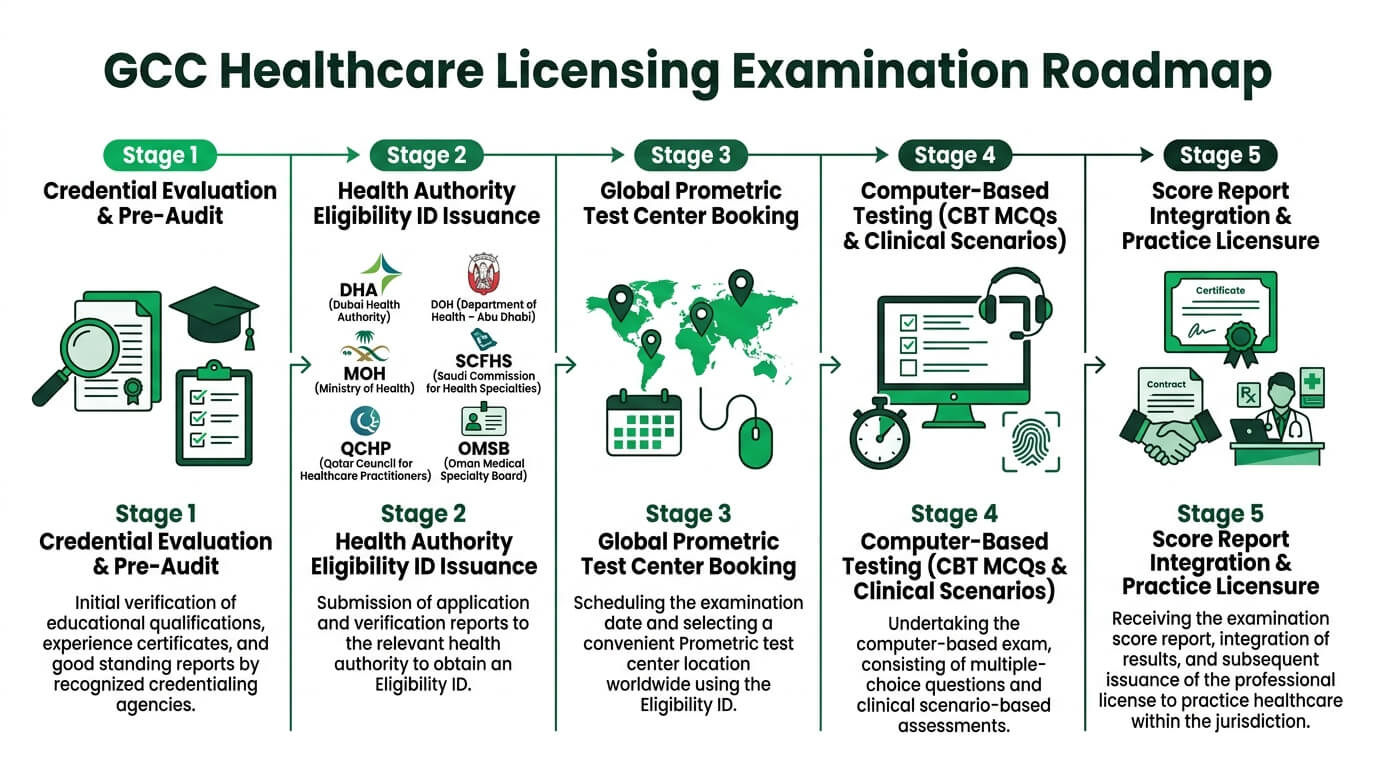
Five-Stage Structured Recruitment and Onboarding Roadmap Across Gulf Member States
A predictable, compliant trajectory from preliminary credential evaluation in Bengaluru to official hospital appointment and visa stamping across the Arabian Gulf.
Eligibility Audit
Evaluation against GCC PQR manuals and identification of exam exemption criteria.
DataFlow PSV
Primary Source Verification via DataFlow Group & portable TrueProfile credentials.
Prometric CBT
Computer-based examination clearance with dedicated coaching for Nurses & Pharmacists.
Interview Match
CV optimization and direct presentation to department directors in top hospitals.
Visa & Onboarding
License activation, security clearance, medical visa stamping, and arrival support.
Step 1
Step 1: Preliminary Credential Auditing and Multi-Jurisdiction Eligibility Pre-Check +
Step 1: Preliminary Credential Auditing and Multi-Jurisdiction Eligibility Pre-Check
The recruitment process commences with a thorough audit of the candidate’s academic degrees, transcripts, council registrations, and clinical experience certificates against the official PQR manuals of target Gulf health authorities (DHA, DOH, SCFHS, MOH Oman, MOPH Qatar). OHC’s Bengaluru regulatory advisory team identifies potential documentation gaps, evaluates eligibility for exam exemptions, and formulates an optimal multi-jurisdiction application strategy.
Step 2
Step 2: Primary Source Verification (PSV) via DataFlow Group & TrueProfile Portability +
Step 2: Primary Source Verification (PSV) via DataFlow Group & TrueProfile Portability
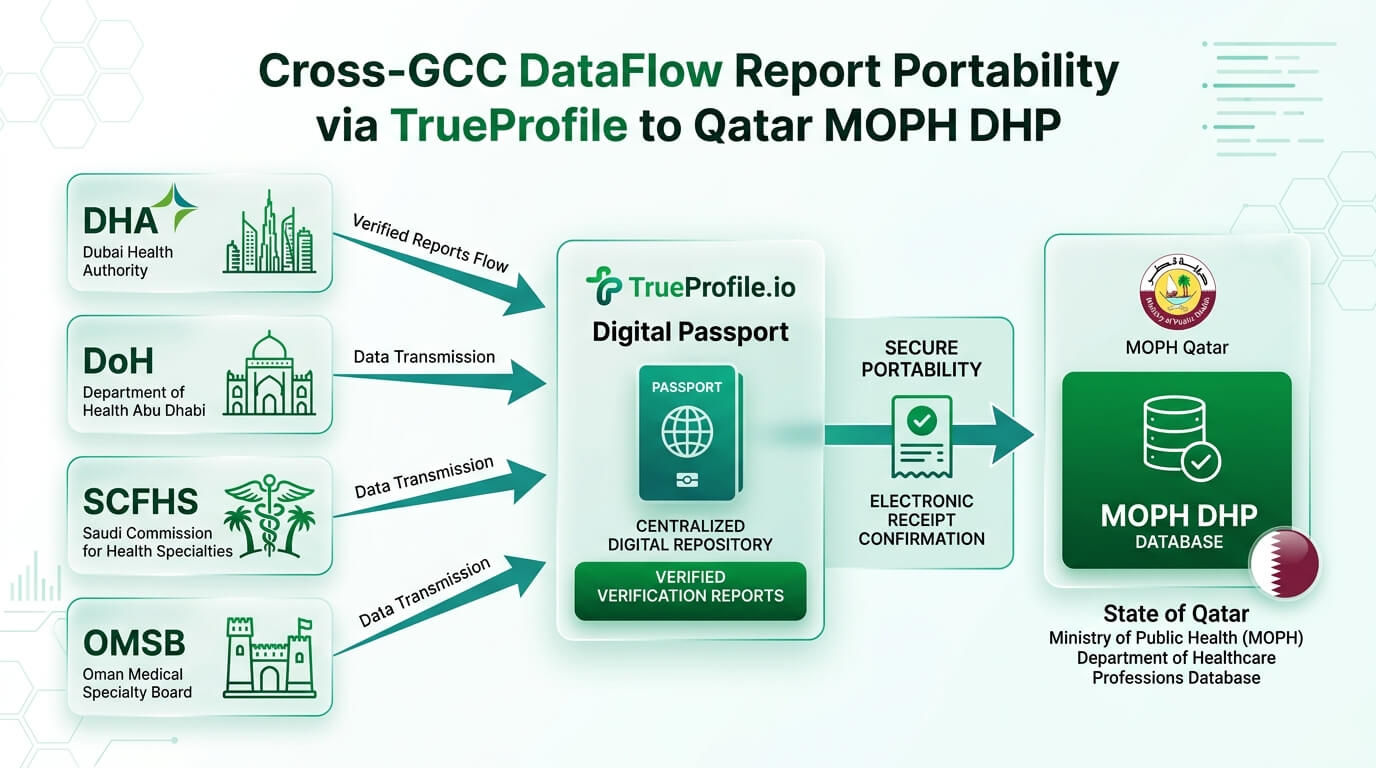
Upon confirming eligibility, the candidate’s credential dossier is submitted to DataFlow Group for official Primary Source Verification. DataFlow contacts the originating universities, medical councils, and former hospital employers directly to verify document authenticity. By utilizing TrueProfile.io portable verification passports, OHC ensures that verified credentials can be transferred seamlessly between different Gulf health authorities without requiring redundant re-verification.
Step 3
Step 3: Computer-Based Prometric Licensing Examination and Specialized Coaching +
Step 3: Computer-Based Prometric Licensing Examination and Specialized Coaching
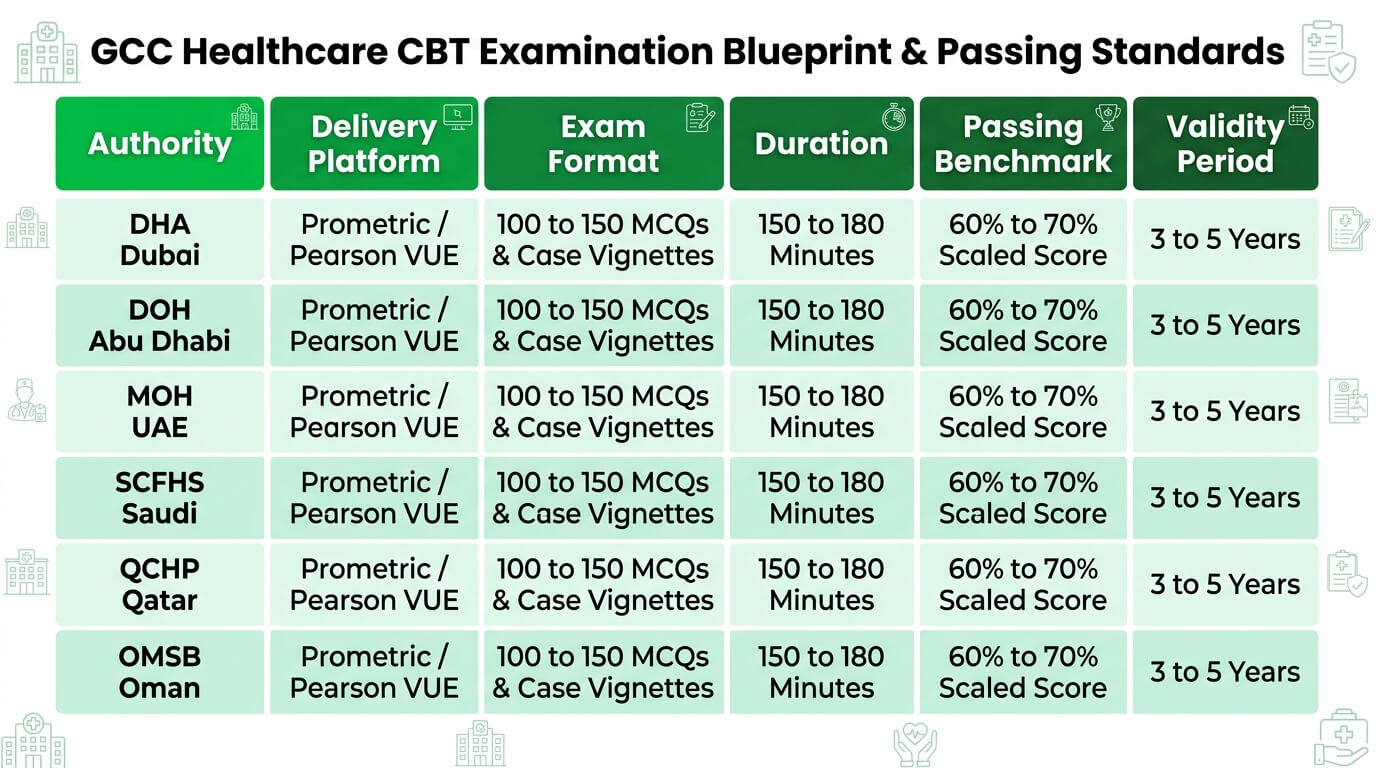
Candidates register for and complete the cadre-specific computer-based assessment (DHA CBT, DOH CBT, MOH Prometric, SCFHS Prometric, OMSB CBT, or MOPH Qatar Prometric) administered at authorized Prometric testing centers worldwide. Overseas Healthcare Consultant delivers specialized, dedicated Prometric exam coaching tailored exclusively for registered nurses and clinical pharmacists, encompassing updated clinical question banks, simulated mock exams, and pharmacotherapy review modules to ensure first-attempt clearance.
Step 4
Step 4: Medical CV Optimization and Multi-Country Hospital Interview Presentation +
Step 4: Medical CV Optimization and Multi-Country Hospital Interview Presentation
With positive DataFlow PSV reports and Prometric exam clearance confirmed, OHC transforms the candidate’s professional dossier into an optimized medical curriculum vitae tailored to GCC hospital leadership standards. OHC presents the candidate’s verified profile directly to clinical department directors, medical administrators, and human resources leadership across leading public and private healthcare networks, coordinating structured virtual clinical interviews.
Step 5
Step 5: Contract Finalization, Official Licensing Clearance, Security Verification & Gulf Onboarding +
Step 5: Contract Finalization, Official Licensing Clearance, Security Verification & Gulf Onboarding
Upon successful interview completion and receipt of a formal institutional employment offer, OHC assists the candidate through contractual review, official regulatory license activation (linking the hospital facility to the practitioner’s regulatory profile), police clearance certification, and medical visa processing. OHC ensures comprehensive relocation guidance to guarantee a seamless transition to the practitioner’s new Gulf hospital post.
Reciprocal License Conversion Between UAE, Saudi Arabia, Oman, Qatar, Bahrain, and Kuwait
Maximizing career mobility across GCC member states through inter-authority agreements, Good Standing protocols, and DataFlow TrueProfile transfers.
Reciprocal Conversion
Inter-GCC Reciprocal Recognition Criteria and Exam Exemption Conditions +
Inter-GCC Reciprocal Recognition Criteria and Exam Exemption Conditions
Healthcare professionals holding an active, unrestricted clinical license from one GCC regulatory authority (such as DHA Dubai or DOH Abu Dhabi) can frequently qualify for computer-based exam exemptions when seeking licensure in another member state (such as Qatar MOPH or Saudi SCFHS), provided specific conditions are met:
Active Clinical Practice: The candidate must have maintained at least two to three years of verified, continuous clinical practice under the issuing GCC authority.
Equivalent Credential Classification: The professional title must align with the corresponding classification tier within the recipient country’s regulatory framework.
Regulatory Discretion: Reciprocal exam exemptions remain subject to final verification and policy approval by the recipient health ministry or statutory licensing council.
DataFlow Transfer
Certificate of Good Standing Protocols and Seamless DataFlow TrueProfile Transfer +
Certificate of Good Standing Protocols and Seamless DataFlow TrueProfile Transfer
When transferring practice between Gulf countries, clinicians must furnish an official Certificate of Good Standing (CGS) issued by their current Gulf licensing authority within the preceding three months, verifying the absence of disciplinary actions or unresolved malpractice claims.
Crucially, primary credentials previously verified by DataFlow Group for one Gulf regulator do not require re-verification when applying to another. Through DataFlow TrueProfile.io transfer protocols, candidates can import verified education, license, and employment records directly into new regulatory applications, drastically reducing processing timelines and administrative complexity.
Candidate Case Studies: Real Healthcare Careers Across GCC Member States
Verified testimonials from physicians, nurses, and allied healthcare professionals placed by Overseas Healthcare Consultant across the Arabian Gulf.
“OHC guided me through DOH Abu Dhabi credential evaluation and DataFlow PSV. Within three months, I cleared my licensing requirements and secured a Specialist Cardiologist appointment at an apex medical complex in the UAE. Truly professional and reliable guidance.”
“As a critical care nurse, passing the SCFHS Prometric exam was daunting. OHC’s dedicated nursing coaching gave me the exact clinical question banks and confidence to clear on my first attempt. Today I practice in a prestigious MOH Health Cluster hospital in Riyadh.”
“OHC handled my MOPH Qatar DHP verification seamlessly. Their team presented my MRI experience directly to hospital leadership in Doha, and I secured a senior appointment in a cutting-edge quaternary facility. Highly recommended!”
“The pharmacist exam coaching provided by OHC was thorough and clinically precise. They helped me transfer my DataFlow report from Dubai to Oman smoothly, opening up fantastic career advancement opportunities.”
Frequently Asked Questions Regarding Healthcare Careers in Gulf Countries
Authoritative clinical, legal, and regulatory answers to common candidate questions regarding licensing, examinations, and recruitment across the GCC.
1. What regulatory bodies govern healthcare licensing across Gulf Cooperation Council (GCC) member states?
Healthcare practice across the Arabian Gulf is regulated by national health ministries and statutory licensing councils within each sovereign jurisdiction: the Dubai Health Authority (DHA), Department of Health Abu Dhabi (DOH), and Ministry of Health and Prevention (MOHAP) across the United Arab Emirates; the Saudi Commission for Health Specialties (SCFHS) in the Kingdom of Saudi Arabia; the Ministry of Health (MOH) and Oman Medical Specialty Board (OMSB) in the Sultanate of Oman; the Ministry of Public Health (MOPH) Department of Healthcare Professions (DHP) in the State of Qatar; the National Health Regulatory Authority (NHRA) in the Kingdom of Bahrain; and the Ministry of Health (MOH) in the State of Kuwait.
2. How does the Unified GCC Healthcare Professional Qualification Requirements (PQR) framework operate?
The Unified GCC Healthcare Professional Qualification Requirements (PQR) is a standardized regulatory benchmark adopted across Gulf health authorities to evaluate international medical qualifications, residency programs, and clinical practice history. The framework categorizes qualifications into standardized tiers (Tier-1, Tier-2, and Tier-3) to establish standardized criteria for granting clinical practice titles such as Consultant, Senior Specialist, Specialist, General Practitioner, Registered General Nurse, or Clinical Pharmacist across member states.
3. What is the typical end-to-end timeline for obtaining a healthcare license and job placement in the Gulf?
The complete recruitment, credential verification, and licensing cycle across GCC countries typically requires three to five months. Primary Source Verification (PSV) through DataFlow Group generally takes twenty to thirty working days, followed by computer-based Prometric examination scheduling, hospital clinical interviews, credential registration, security clearance, and medical work visa issuance.
4. Can I attend hospital interviews across the Gulf before completing my licensing examination?
Yes. Leading public and private hospital operators across the Gulf—including Saudi MOH Health Clusters, Hamad Medical Corporation, SEHA facilities, Dr. Sulaiman Al Habib, Aster DM Healthcare, and Burjeel Holdings—frequently conduct technical clinical interviews based on evaluated credential dossiers and active DataFlow verification reference numbers. However, official institutional contract issuance and medical visa activation remain contingent upon clearing the mandatory licensing exam or securing formal exam exemption.
5. How are medical doctor qualifications classified across Consultant, Specialist, and Resident tiers in the Gulf?
Physicians are classified based on their postgraduate clinical qualifications and continuous hospital practice duration. Clinicians holding Tier-1 qualifications (such as US Board Certification, UK CCT/CCST, Canadian Royal College Fellowship, or German Facharzt) qualify directly for Consultant or Senior Specialist classification. Clinicians holding recognized Tier-2 and Tier-3 qualifications (such as Arab Boards, European national boards, or Indian MD/MS/DNB) qualify for Specialist classification with required post-qualification clinical experience, typically requiring three to five years of documented hospital practice.
6. Which GCC country offers the most direct licensing pathway for international healthcare professionals?
The optimal pathway depends upon the candidate’s clinical discipline, qualifications, and relocation timeline. The United Arab Emirates (DHA Dubai and DOH Abu Dhabi) offers streamlined digital licensing portals and rapid exam booking. The Kingdom of Saudi Arabia (SCFHS) maintains the largest total volume of hospital openings and rapid institutional recruitment across nationwide Health Clusters. Qatar and Oman offer highly stable, long-term public hospital appointments with excellent institutional benefits.
7. How does cross-GCC healthcare license reciprocity work between UAE, Saudi Arabia, Oman, and Qatar?
Under unified GCC healthcare regulatory accords, clinicians holding an active, unrestricted medical practice license from one GCC regulatory authority (such as DHA, DOH, or SCFHS) who have completed at least two to three years of verified clinical practice under that license can frequently apply for licensure in another member state without being required to re-sit the computer-based Prometric examination, provided they submit an official Certificate of Good Standing.
8. What is the role of DataFlow Group and TrueProfile in verifying credentials for Gulf healthcare practice?
DataFlow Group is the authorized international screening partner conducting Primary Source Verification (PSV) for GCC health authorities. DataFlow contacts graduating universities, health licensing councils, and past hospital employers directly to authenticate degrees, transcripts, registrations, and employment certificates. TrueProfile.io provides a portable digital verification passport, enabling clinicians to own their verified records and transfer them between different Gulf regulators without redundant re-verification.
9. Can I transfer a positive DataFlow report from one Gulf country to another without re-verifying my credentials?
Yes. If you have already completed Primary Source Verification through DataFlow Group for one Gulf regulator (for example, DHA Dubai or SCFHS Saudi Arabia), your verified credentials can be transferred to another regulator (such as OMSB Oman or MOPH Qatar) using the DataFlow report transfer or TrueProfile portal, eliminating the need to pay for or await redundant primary source re-verification of already authenticated records.
10. What statutory benefits, allowances, and compensation structures are standard in Gulf hospital employment?
Hospital employment packages across the Arabian Gulf feature 100% tax-free basic remuneration, fully furnished residential accommodation or generous monthly housing allowances, annual round-trip flight allowances for clinicians and eligible dependents, comprehensive private medical insurance, paid annual leave (typically thirty to forty calendar days), and statutory end-of-service gratuity mandated under national labor laws.
11. What specialized licensing examination coaching does OHC provide for Gulf candidates?
Overseas Healthcare Consultant delivers specialized, high-yield computer-based examination coaching exclusively for Registered Nurses and Pharmacists preparing for DHA, DOH, MOH, SCFHS, OMSB, and Qatar Prometric assessments. Coaching features comprehensive specialty clinical question banks, interactive pharmacology drills, clinical scenario walkthroughs, and timed simulated mock examinations designed to ensure first-attempt clearance.
12. What are the minimum qualification and experience requirements for Registered Nurses in the Gulf?
Registered Staff Nurses must possess a recognized four-year Bachelor of Science in Nursing (BSc Nursing) from an accredited university, active home-country nursing council registration, and a minimum of two consecutive years of verified clinical inpatient nursing experience in a licensed hospital comprising at least one hundred beds. Clinical experience in high-acuity departments—such as ICU, NICU, Emergency, Operating Theaters, and Cath Labs—is in highest demand.
13. Can General Nursing and Midwifery (GNM) diploma holders obtain nursing licenses in Gulf countries?
While diploma-trained nurses historically practiced in select healthcare facilities, modern Gulf licensing regulations across major urban centers in UAE, Saudi Arabia, Qatar, and Oman almost universally mandate a Bachelor of Science in Nursing (BSc Nursing) for Registered Nurse status. Diploma holders are strongly advised to complete an accredited Post-Basic BSc Nursing degree upgrade to satisfy regional credentialing benchmarks.
14. What are the clinical licensing requirements for hospital and clinical pharmacists across the GCC?
Pharmacists must hold a recognized Bachelor of Pharmacy (BPharm) or Doctor of Pharmacy (PharmD) degree from an accredited university, maintain valid pharmacy council registration in their home country, and possess at least two years of continuous clinical hospital or community dispensing experience. Candidates must complete DataFlow PSV and clear the cadre-specific computer-based pharmacy assessment.
15. Are expatriate healthcare professionals eligible for family visa sponsorship across Gulf countries?
Yes. Healthcare professionals holding valid employment residency visas across GCC member states are legally entitled to sponsor their spouse and dependent children for family residence permits. Family residency grants full access to local public services, bank accounts, and enrollment in top-tier international educational institutions.
16. How do I begin my multi-country Gulf healthcare career application with OHC Bengaluru?
You can initiate your cross-GCC qualification evaluation by submitting your complete medical CV, degree certificates, and hospital experience documentation to the specialized advisory team at Overseas Healthcare Consultant. Contact our canonical Bengaluru headquarters directly by calling +91 96328 62282 or messaging our official WhatsApp consultation desk at +91 96328 62330.
Start Your Gulf Healthcare Career Journey Today
Connect with senior healthcare licensing advisors at Overseas Healthcare Consultant Bengaluru. Confidential credential review, DataFlow PSV guidance, and verified hospital interview matching across the Arabian Gulf.