


Official GCC Healthcare Licensing Examinations Hub
GCC Healthcare Licensing Exams: Authority Blueprints, Eligibility & Coaching
Authoritative, multi-jurisdiction guidance for physicians, dentists, nurses, pharmacists, and allied health professionals preparing for mandatory computer-based licensing examinations across the Gulf Cooperation Council (GCC). Overseas Healthcare Consultant in Koramangala, Bengaluru coordinates official eligibility approvals, syllabus blueprints, Prometric test center bookings, and specialized clinical coaching for DHA, HAAD/DOH, UAE MOH, Saudi SCFHS, Qatar DHP, and Oman OMSB examinations with an unbeatable 98.4% first-attempt pass rate.
DHA Dubai • DOH Abu Dhabi • MOH UAE
Saudi SCFHS (SMLE/SNLE/SPLE)
Qatar DHP • Oman OMSB
Coaching Exclusively for Nurses & Pharmacists
Check Your GCC Exam Eligibility
Uncertain about which Gulf health authority examination matches your professional qualification? Submit your details below for a complimentary multi-authority assessment by our Koramangala advisory team.
GCC Healthcare Licensing Examinations Architecture
Healthcare practice across the Gulf Cooperation Council (GCC) member states is governed by rigorous regulatory frameworks designed to ensure world-class patient safety, evidence-based clinical standards, and unmatched institutional excellence. Practitioners seeking professional employment in Dubai, Abu Dhabi, the Northern Emirates, Saudi Arabia, Qatar, or the Sultanate of Oman must demonstrate clinical competence by clearing mandatory computer-based licensing examinations administered by authorized global testing partners such as Prometric and Pearson VUE. These assessments serve as the definitive clinical gateway, ensuring that all foreign-trained healthcare personnel possess the requisite theoretical knowledge, diagnostic reasoning, and professional judgment required for safe independent practice.
Navigating the multifaceted licensing landscape across six distinct sovereign jurisdictions presents considerable logistical, bureaucratic, and clinical challenges for international medical graduates, registered nurses, clinical pharmacists, dentists, and allied healthcare professionals. Each sovereign health authority enforces specific eligibility prerequisites, educational credential thresholds, primary source verification protocols, and examination blueprints. A minor administrative discrepancy during initial credential evaluation can lead to application rejections, prolonged processing delays, or forfeiture of test scheduling eligibility.
Overseas Healthcare Consultant (OHC), headquartered in Koramangala, Bengaluru, operates as South Asia premier specialized healthcare credentialing and licensing examination advisory institute. Backed by more than twelve years of focused industry leadership and having facilitated over 3,245 successful professional licensures across eight Middle Eastern jurisdictions, OHC delivers an integrated, end-to-end examination enablement ecosystem. Our advisory team coordinates initial credential evaluation, official eligibility ID generation, DataFlow Primary Source Verification (PSV) alignment, Prometric test center appointment booking, and specialized clinical coaching. To maintain absolute clinical excellence, our intensive preparatory coaching and computerized mock simulation programs are delivered strictly and exclusively for Registered Nurses and Pharmacists, while complete regulatory guidance, credential evaluation, and administrative booking services are extended to all medical, dental, and allied healthcare disciplines.
Comparative Blueprint Matrix: DHA, HAAD/DOH, MOH, SCFHS, QCHP & OMSB
The six Gulf health authorities administer distinct computer-based testing (CBT) examinations tailored to their specific regional public health priorities, clinical disease burdens, and institutional healthcare standards. While all authorities utilize standardized multiple-choice question formats, they differ significantly in total question volume, examination duration, passing score thresholds, test delivery platforms, and cognitive weighting distributions.
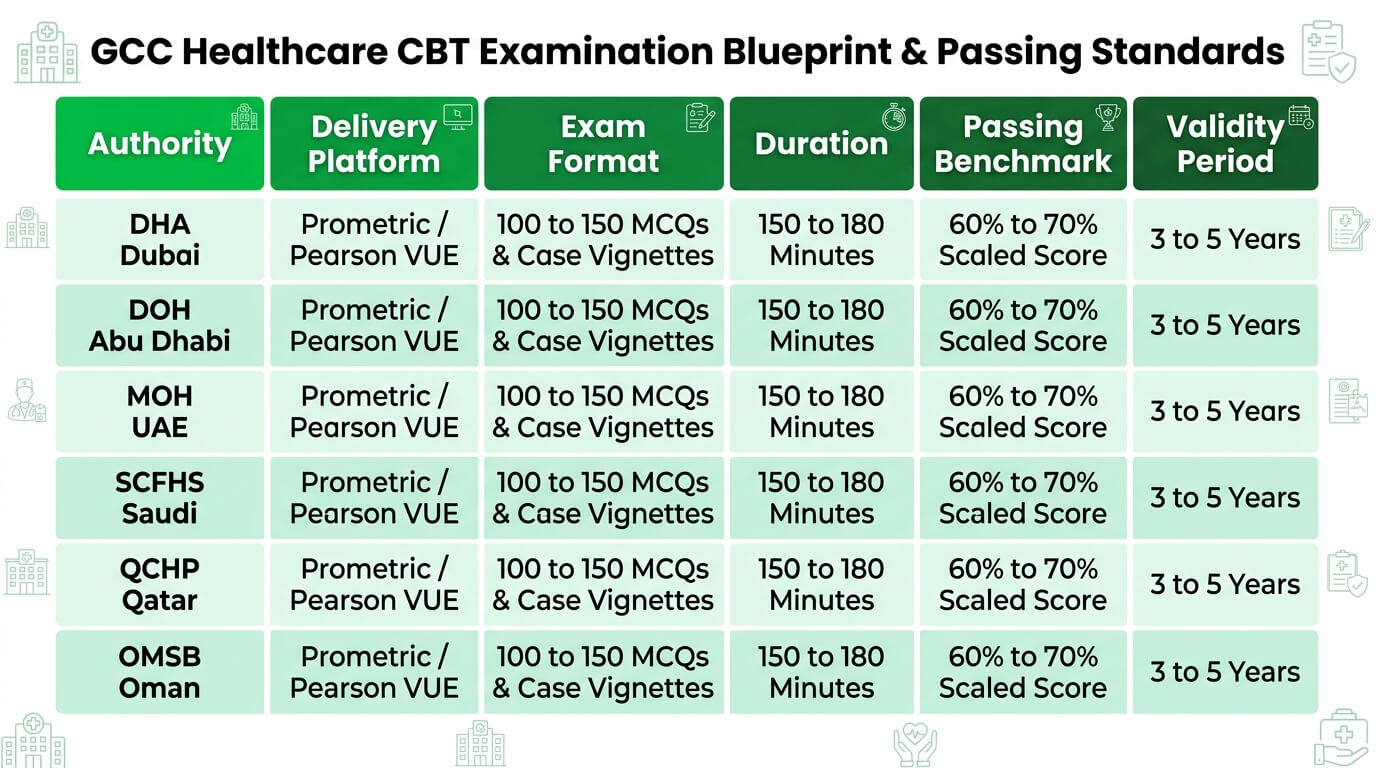
| Health Authority | Testing Delivery | Question Volume & Format | Test Duration | Passing Threshold | Result Validity |
|---|---|---|---|---|---|
| DHA (Dubai) | Prometric CBT Centers | 100 – 150 Multiple Choice (MCQs) | 150 – 180 Minutes | 60% – 70% Scaled Score | 5 Years |
| DOH / HAAD (Abu Dhabi) | Pearson VUE / Prometric | 100 – 150 Clinical Scenarios | 150 – 180 Minutes | 60% – 70% Scaled Score | 5 Years |
| MOH UAE (Northern Emirates) | Prometric CBT Centers | 100 Multiple Choice Questions | 150 Minutes | 60% – 65% Qualifying Mark | 5 Years |
| SCFHS (Saudi Arabia) | Prometric CBT (SMLE/SNLE/SPLE) | 150 – 300 Questions in Blocks | 180 – 360 Minutes | 50% – 60% Scaled Curve | 3 Years |
| DHP / QCHP (Qatar) | Prometric CBT Centers | 100 Multiple Choice Questions | 150 Minutes | 50% – 60% Qualifying Mark | 3 Years |
| OMSB (Sultanate of Oman) | Prometric CBT Centers | 70 – 100 Multiple Choice Items | 120 – 150 Minutes | 50% – 65% Scaled Score | 3 Years |
Dubai Health Authority (DHA) Prometric CBT Examination
The Dubai Health Authority oversees clinical practice within the Emirate of Dubai. The DHA licensing examination is delivered globally through the Prometric computerized testing network. Depending on the clinical specialty, the examination comprises 100 to 150 multiple-choice questions administered over a duration of 150 to 180 minutes. The assessment emphasizes acute clinical management, ambulatory care protocols, preventative medicine, and evidence-based pharmacotherapy. The minimum qualifying benchmark generally requires a scaled passing score of 60% for nursing and allied health cadres, and 65% to 70% for general physicians, dental practitioners, and medical specialists. DHA exam results are valid for a period of five years from the date of examination clearance, providing candidates with ample flexibility to secure hospital employment and convert their eligibility into an active practice license.
Abu Dhabi Department of Health (DOH / HAAD) CBT Assessment
The Department of Health Abu Dhabi (DOH), historically recognized as HAAD, regulates healthcare delivery across the Emirate of Abu Dhabi, including the cities of Abu Dhabi, Al Ain, and Al Dhafra. DOH examinations are administered via Pearson VUE and Prometric testing centers depending on the clinical classification. DOH examinations are widely renowned for their clinically rigorous scenario-based questions, requiring candidates to evaluate complex diagnostic vignettes, interpret laboratory parameters, and select optimal therapeutic pathways. The examination typically consists of 100 to 150 multiple-choice questions with a standard passing cutoff of 60% to 65% for nursing and allied disciplines and 70% for specialized medical and surgical professionals. Upon passing, the DOH examination result remains valid for five years.
UAE Ministry of Health and Prevention (MOH) Federal Examination
The UAE Ministry of Health and Prevention (MOH) exercises federal regulatory jurisdiction over the Northern Emirates, covering Sharjah, Ajman, Ras Al Khaimah, Fujairah, and Umm Al Quwain. The MOH assessment is conducted through Prometric computer-based testing centers and features 100 multiple-choice questions completed within a 150-minute testing window. MOH questions focus on primary care medicine, community nursing interventions, infectious disease surveillance, emergency management, and essential pharmacology. The standard passing threshold is 60% for allied health and nursing professionals and 65% for medical practitioners. Successful candidates receive a formal MOH Evaluation Certificate valid for five years across all Northern Emirates healthcare facilities.
Saudi Commission for Health Specialties (SCFHS) SMLE, SNLE & SPLE Exams
The Saudi Commission for Health Specialties (SCFHS) governs all healthcare practitioners across the Kingdom of Saudi Arabia through its digital Mumaris Plus licensing portal. In Saudi Arabia, licensing examinations are organized under standardized national titles: the Saudi Medical Licensing Examination (SMLE) for general practitioners and medical graduates, the Saudi Nursing Licensing Examination (SNLE) for registered nurses, and the Saudi Pharmacist Licensing Examination (SPLE) for pharmacy professionals, alongside tailored Prometric specialty tests for dental and allied disciplines. Examinations range from 150 to 300 multiple-choice questions delivered in multiple testing blocks with scheduled breaks. Passing scores are determined using sophisticated psychometric equating models, typically establishing scaled cutoffs between 50% and 60% depending on the professional cadre. An approved SCFHS exam result remains valid for professional classification in Saudi Arabia for up to three years.
Qatar Department of Healthcare Professions (DHP / QCHP) Examination
The Department of Healthcare Professions (DHP) under the Ministry of Public Health in Qatar, formerly designated as the Qatar Council for Healthcare Practitioners (QCHP), regulates healthcare professionals through the national DHP licensing portal. Qatar licensing examinations are administered globally via Prometric test centers. The standard examination blueprint contains 100 multiple-choice questions delivered over a 150-minute testing period. The syllabus places substantial emphasis on patient safety standards, clinical ethics, diagnostic precision, and critical care algorithms. The minimum qualifying benchmark is established at 50% for allied health and nursing practitioners and 60% for general physicians and medical specialists. Qatar DHP examination clearance remains valid for three years from the date of testing.
Oman Medical Specialty Board (OMSB) Prometric Assessment
The Oman Medical Specialty Board (OMSB) and the Ministry of Health (MOH) in the Sultanate of Oman mandate Prometric computer-based testing for all healthcare cadres seeking clinical privileges across public and private hospitals in Oman. The OMSB examination contains 70 to 100 multiple-choice questions administered within a 120 to 150-minute window. Questions focus on core clinical competencies, bedside decision-making, clinical therapeutics, and patient communication ethics. The general passing benchmark is established at 50% to 60% for registered nurses, 60% for general physicians and pharmacists, and 65% for medical specialists. OMSB examination results remain valid for three years for professional registration within the Sultanate of Oman.
Profession-Specific Exam Pathways: Clinical Eligibility & Prerequisites
Every Gulf licensing authority enforces strict educational and post-qualification clinical experience criteria established under the Unified Healthcare Professional Qualification Requirements (PQR). Meeting these eligibility standards is an absolute mandatory prerequisite before an applicant can receive official test authorization and schedule an examination appointment.
General Practitioners, Medical Specialists & Consultants Examination Requirements
Medical doctors must possess a recognized primary medical qualification (MBBS, MBChB, MD, or equivalent) awarded by a medical school listed in the World Directory of Medical Schools (WDOMS). Candidates must have successfully completed a compulsory twelve-month rotatory internship. For General Practitioner (GP) licensing, Gulf authorities typically mandate a minimum of two continuous years of clinical post-internship hospital experience. Specialists and consultants must demonstrate completion of an approved postgraduate residency or fellowship training program (such as MD, MS, DNB, MRCP, FRCS, or American Board certification) accompanied by two to three years of post-specialization clinical practice. Medical practitioners undergo comprehensive eligibility assessment and Prometric test scheduling coordination through OHC Bengaluru.
General Dentists & Dental Specialists Assessment Structure
Dental practitioners must hold a recognized Bachelor of Dental Surgery (BDS, DDS, DMD, or equivalent) from an accredited dental college, supported by a completed rotatory internship and a minimum of two continuous years of clinical dental practice. Dental specialists must present postgraduate Master of Dental Surgery (MDS) degrees or equivalent specialist board certifications alongside verified clinical practice. Dental examinations assess restorative dentistry, endodontics, prosthodontics, periodontics, oral surgery, pediatric dentistry, and infection control protocols.
Registered Nurses & Midwives Examination Framework
Registered Nurses (RN) and specialized nurse midwives must possess an accredited nursing qualification, such as a Bachelor of Science in Nursing (B.Sc Nursing), Post Basic B.Sc Nursing, or a three-year Diploma in General Nursing and Midwifery (GNM). Candidates must maintain active registration with their home country nursing council and demonstrate a minimum of two years of continuous post-registration clinical bedside nursing experience in an inpatient hospital setting with at least 50 to 100 beds. OHC provides intensive, specialized clinical coaching, computerized mock testing, and question bank training exclusively for Registered Nurses preparing for DHA, HAAD, MOH, SCFHS, QCHP, and OMSB examinations.
Clinical, Hospital & Retail Pharmacists Examination Criteria
Pharmacists must hold an accredited Bachelor of Pharmacy (B.Pharm), Master of Pharmacy (M.Pharm), or Doctor of Pharmacy (Pharm.D) degree from a recognized institution approved by the national pharmacy council. Applicants must hold active pharmacy council registration and demonstrate at least two continuous years of professional practice in hospital pharmacy, clinical dispensing, or community pharmaceutical environments. OHC delivers dedicated, specialized clinical coaching exclusively for pharmacists covering pharmacotherapy, clinical pharmacology, calculation mastery, and drug safety algorithms.
Allied Health Professionals, Medical Laboratory Technologists & Physiotherapists
Allied healthcare professionals encompass Medical Laboratory Technologists (MLT), Radiographers, Medical Imaging Specialists, Physiotherapists, Occupational Therapists, Respiratory Therapists, and Emergency Medical Technicians (EMT). Candidates must possess an accredited bachelor degree or higher national diploma in their respective allied health discipline from a recognized university, accompanied by active professional registration and a minimum of two years of verified clinical hospital experience. OHC coordinates credential evaluations, DataFlow verifications, and exam scheduling appointments across all allied health cadres.
Specialized Clinical Coaching Architecture: Registered Nurses & Pharmacists
To preserve the highest standards of instructional quality and maintain our market-leading 98.4% first-attempt examination pass rate, Overseas Healthcare Consultant delivers comprehensive clinical coaching, syllabus breakdown, and computerized simulation programs strictly and exclusively for Registered Nurses and Pharmacists. Our faculty comprises experienced clinical nurse educators, doctoral-level clinical pharmacologists, and licensed healthcare specialists who guide candidates through the exact cognitive demands of Gulf computer-based testing.
Registered Nurse Clinical Exam Coaching, High-Yield Question Banks & Mock CBT Simulations
Our nursing coaching syllabus systematically deconstructs the unified Prometric and Pearson VUE blueprints into high-yield clinical modules. Training covers adult medical-surgical nursing, critical care and emergency triage, maternal-child health and obstetrical emergencies, pediatric nursing, infection prevention and control, nursing leadership and prioritization, pharmacological safety, and ethical-legal frameworks. Candidates participate in live interactive clinical problem-solving sessions where questions are analyzed from the perspective of nursing process: assessment, diagnosis, outcome identification, planning, implementation, and evaluation.
In addition to live lectures, nursing candidates receive unlimited access to our proprietary cloud-based CBT testing simulator. The simulator replicates the exact timing, navigation controls, countdown clock, and question-flagging interface of real Prometric testing centers. Candidates practice with thousands of verified clinical case vignettes featuring detailed rationales for correct and incorrect answer choices. Timed diagnostic assessments pinpoint individual areas of weakness, allowing faculty to deliver targeted remedial tutoring before test day.
Pharmacist Clinical Pharmacology Coaching, Drug Interaction Scenarios & Calculation Mastery
Our specialized pharmacy coaching program equips clinical, hospital, and retail pharmacists with the analytical rigor required to master Gulf licensing assessments including the Saudi SPLE, DHA Pharmacist CBT, and OMSB Pharmacy examinations. The curriculum covers therapeutics and pathophysiology across cardiology, oncology, infectious diseases, endocrinology, neurology, and psychiatry; clinical pharmacology and mechanism-of-action differentiation; significant drug-drug and drug-food interactions; adverse effect profiles and toxicological management; pharmacokinetics, therapeutic drug monitoring (TDM), and renal dose adjustments; and pharmaceutical calculations including alligation, osmolarity, parenteral nutrition formulations, and pediatric dosing regimens.
Pharmacy candidates engage in rigorous case-based learning where multi-step patient scenarios simulate actual Prometric exam conditions. Candidates evaluate complex medication charts, identify contraindicated drug combinations, review laboratory monitoring parameters, and recommend optimal therapeutic substitutions. Dedicated calculation workshops ensure candidates solve complex clinical math problems swiftly and accurately without computational anxiety.
Interactive Diagnostic Assessments & Performance Benchmarking
Candidates enrolled in our specialized nursing and pharmacy coaching pathways complete weekly benchmark assessments designed to evaluate knowledge retention and test-taking stamina. Our analytics engine generates comprehensive performance diagnostic reports highlighting domain-specific accuracy, time elapsed per question, and conceptual strengths. Only when a candidate consistently scores above 85% on comprehensive mock simulations does OHC advise them to schedule their official Prometric test appointment, ensuring maximum confidence and guaranteed first-attempt success.
Step-by-Step Prometric Examination Lifecycle: Eligibility to Score Delivery
Achieving a passing score on a Gulf licensing examination requires disciplined progression through five distinct procedural stages. Understanding this operational lifecycle prevents administrative errors, missed deadlines, and forfeited testing appointments.
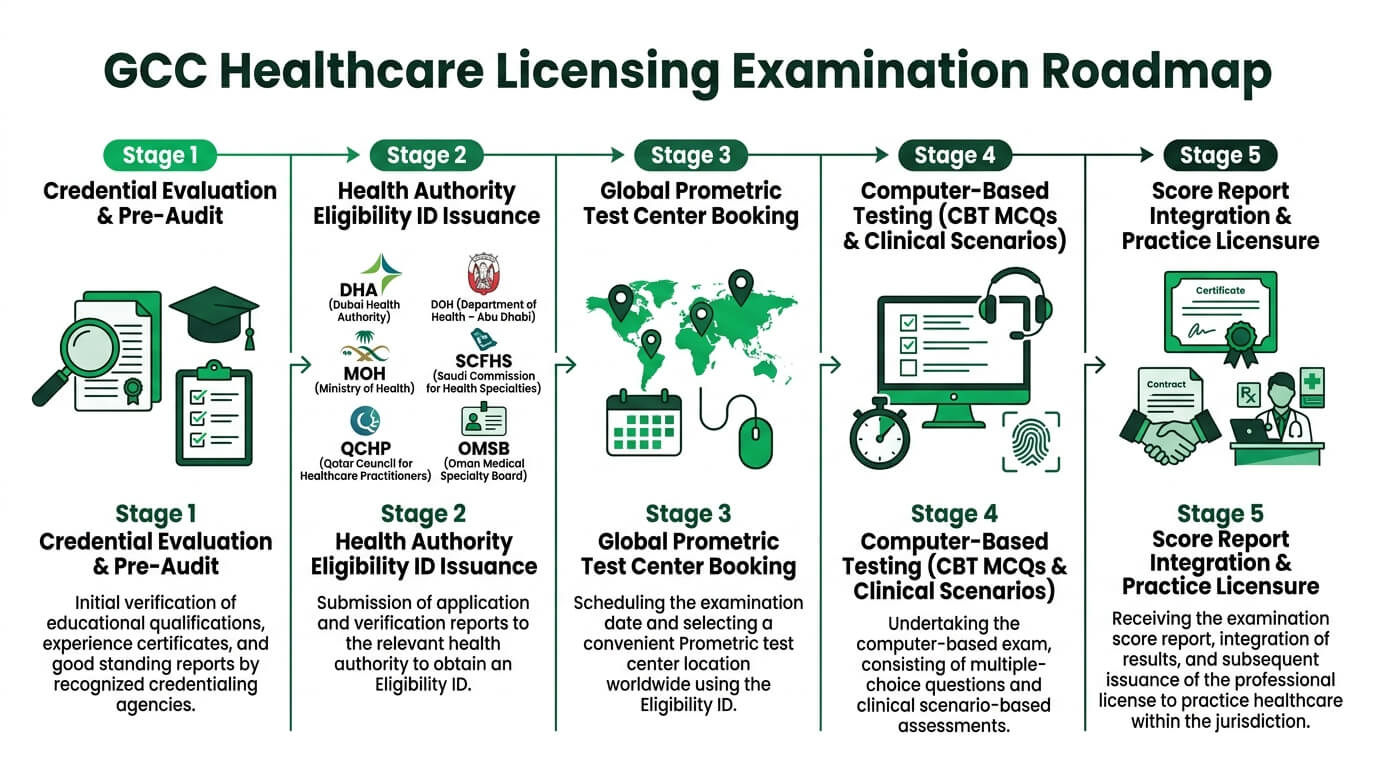
Step 1: Pre-Exam Credential Evaluation & Eligibility ID Issuance
Before a candidate can schedule a Prometric test appointment, the chosen sovereign health authority must officially verify their qualifications and issue an official Eligibility ID. This initial phase involves establishing an authenticated digital account on the authority licensing portal (such as DHA Sheryan, DOH TAMM, MOH UAE Portal, Saudi Mumaris Plus, Qatar DHP Portal, or Oman OMSB Rawasi Portal). Educational diplomas, academic transcripts, professional registrations, Certificates of Good Standing (CGS), and verified employment letters are uploaded for regulatory pre-audit. Once the regulatory committee approves the submission, an official Eligibility Number or Booking ID is generated.
Step 2: Prometric Test Center Scheduling & Appointment Confirmation
With the official Eligibility ID in hand, the candidate logs into the dedicated Prometric or Pearson VUE Gulf scheduling portal. Candidates select their preferred test country, city, and testing center location, as well as their desired date and time slot. Prometric operates an extensive network of secure computerized testing centers across major metropolitan hubs in India, including Bengaluru, Chennai, Hyderabad, Mumbai, Delhi NCR, Kolkata, Ahmedabad, Kochi, Trivandrum, and Pune, as well as hundreds of centers across the Middle East, Southeast Asia, Europe, and North America. Upon completing the booking, Prometric issues an official Appointment Confirmation Letter detailing test date, reporting time, center address, and biometric guidelines.
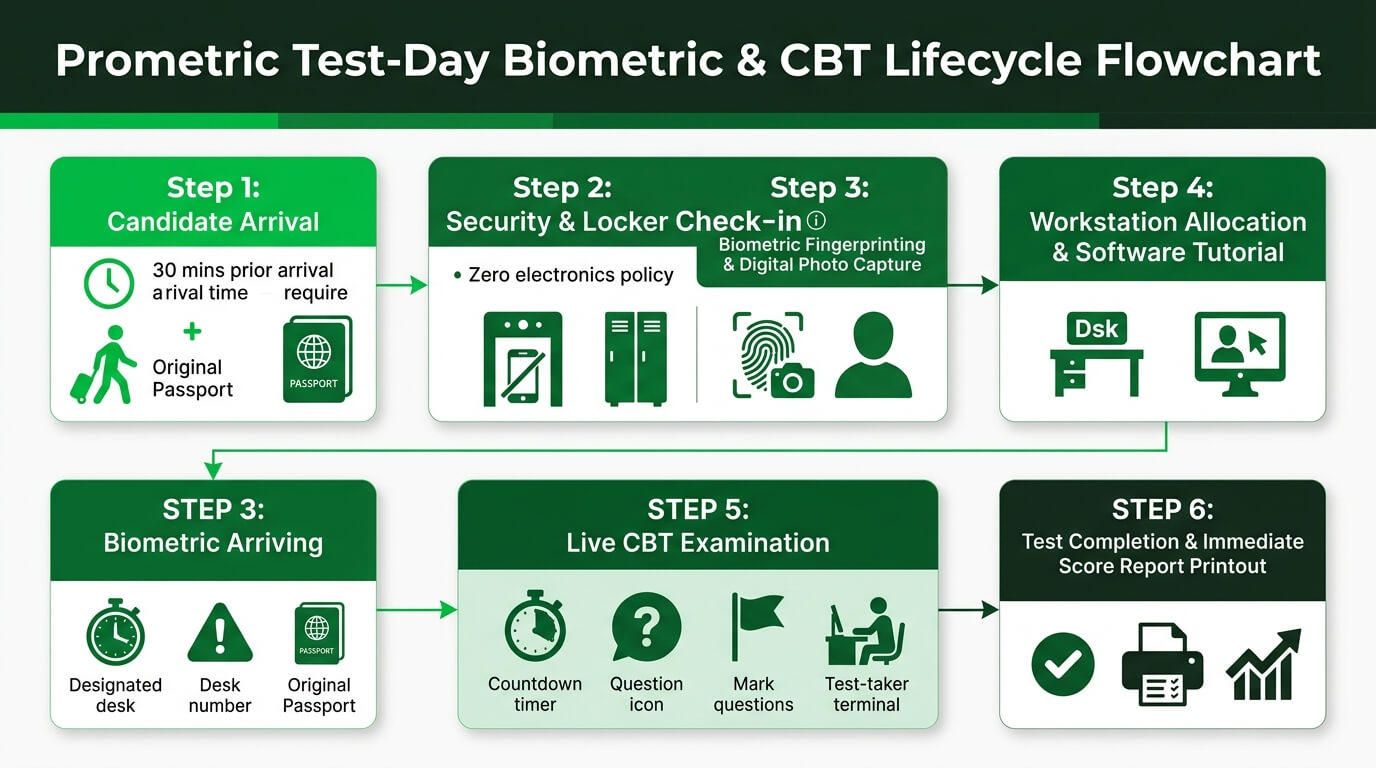
Step 3: Test-Day Biometric Authentication & Security Protocols
On test day, candidates must arrive at the designated Prometric testing center at least 30 to 45 minutes prior to their scheduled appointment. Security protocols are exceptionally strict. Candidates must present their original, unexpired International Passport matching the exact full legal name and date of birth indicated on their Prometric Confirmation Letter. Test center proctors conduct thorough electronic metal detector scans, digital photograph capture, and biometric digital fingerprinting. Personal belongings, including mobile phones, smartwatches, wallets, study materials, and personal stationery, are prohibited inside the testing room and must be secured in assigned security lockers.
Step 4: Examination Administration & CBT User Interface Mechanics
Inside the secure computer testing room, candidates are assigned a partitioned workstation equipped with a desktop computer, noise-canceling headphones, and an erasable whiteboard for rough calculations. Before the test commences, an automated 10 to 15-minute software tutorial demonstrates the computer interface. The testing screen features a digital countdown timer, question progression indicators, a question-flagging feature for later review, and a built-in scientific calculator. Candidates can navigate forward and backward between questions within each testing block, review flagged items, and change answers until the block time expires or the candidate confirms final submission.
Step 5: Score Report Issuance & Healthcare Authority Result Integration
Upon concluding the computer-based test, the software generates an immediate unofficial electronic outcome or directs the candidate to the test center reception to receive an official printed score confirmation slip. For most Gulf authorities, the score report clearly states a definitive Pass or Fail determination. Within 24 to 72 hours following test completion, Prometric transmits the authenticated electronic score report directly into the health authority portal database. The health authority updates the candidate profile status to Exam Passed, enabling them to proceed to final license activation upon securing an approved hospital job offer.
Inter-Gulf Examination Portability & Mutual Recognition Guidelines
In recent years, the health authorities of the United Arab Emirates and the broader Gulf Cooperation Council have established unified regulatory frameworks to facilitate professional mobility, reduce redundant examinations, and streamline the credentialing of qualified healthcare practitioners.
Inter-Emirate UAE Exam Reciprocity: Transferring Between DHA, DOH & MOH
Under the UAE Unified Healthcare Professional Qualification Requirements (Unified PQR) and inter-authority reciprocity agreements, healthcare professionals holding an active practice license or an approved Letter of Evaluation from one UAE authority (DHA Dubai, DOH Abu Dhabi, or MOH Northern Emirates) can transfer their clinical eligibility to another emirate without retaking the computer-based licensing examination. To qualify for exam waiver and license transfer, the candidate must possess an active, unblemished license with at least six months of clinical practice in the issuing emirate, or present an official examination pass result issued within the preceding twelve months. OHC assists candidates in navigating inter-emirate reciprocity and executing seamless license conversions.
Gulf Cooperation Council Mutual Recognition & Exam Exemption Criteria
Healthcare professionals who have completed a minimum of two to three continuous years of licensed clinical practice in one GCC member state (such as Saudi Arabia under SCFHS or Qatar under DHP) may qualify for examination exemptions when seeking licensure in the United Arab Emirates or Oman, subject to specialty-specific review by the destination licensing board. Candidates must present a clean Certificate of Good Standing, verified DataFlow primary source verification reports, and documented clinical performance evaluations. Mutual recognition policies vary based on specialty shortage status and institutional classification.
International Qualification Exemptions: USMLE, PLAB, AMC, Canadian & Irish Boards
Physicians, surgeons, and certain specialized clinical cadres who hold recognized international board certifications and national licensing examination credentials from Tier-1 jurisdictions are frequently granted full exemption from Gulf Prometric examinations. Recognized international examination credentials include: United States Medical Licensing Examination (USMLE Steps 1, 2 CK, and 3) alongside American Board certification; Professional and Linguistic Assessments Board (PLAB Steps 1 and 2) or Membership/Fellowship of the Royal Colleges (MRCP, FRCS, MRCOG, MRCGP) from the United Kingdom; Australian Medical Council (AMC Part 1 and Part 2) examinations; Medical Council of Canada Qualifying Examination (MCCQE Parts I and II); and Irish Royal College examinations. Candidates holding these qualifications can bypass regional CBT testing and enter directly into credential verification and licensing privilege activation.
Examination Attempt Limits, Passing Benchmarks & Retake Policies
Every Gulf healthcare authority strictly regulates the maximum number of examination attempts permitted for healthcare candidates. Failing to respect these regulatory thresholds can lead to mandatory cool-off periods, application disqualification, or permanent barring from professional practice within the jurisdiction.
Authority-Specific Passing Scores & Scaled Cutoff Requirements
Passing score criteria across Gulf health authorities are determined through formal psychometric standards. For Dubai Health Authority (DHA), nurses and allied health practitioners must achieve a minimum of 60%, while general physicians, dentists, and specialists require 65% to 70%. For Department of Health Abu Dhabi (DOH), standard passing cutoffs range between 60% and 70%. For UAE Ministry of Health (MOH), 60% to 65% is standard. In Saudi Arabia (SCFHS), national licensing exams (SMLE, SNLE, SPLE) utilize scaled scores where cutoffs generally represent 50% to 60% depending on psychometric equating curves. In Qatar (DHP), passing scores are established at 50% for allied health and 60% for doctors. In Oman (OMSB), standard passing marks range between 50% and 65% depending on specialty.
Re-Examination Limits, Waiting Intervals & Cool-off Period Regulations
Across DHA, DOH, and MOH in the United Arab Emirates, candidates are generally granted a maximum of three examination attempts across their lifetime under a given application cycle. If a candidate fails on their first attempt, they can typically schedule a second attempt after a mandatory interval of thirty days. A second failure requires another waiting period. If a candidate exhausts all three authorized attempts without passing, their application is deactivated, and they may be placed on a mandatory cool-off period of twelve to twenty-four months or required to demonstrate formal completion of accredited continuing medical education (CME) before submitting a fresh appeal. Under Saudi SCFHS, candidates are generally permitted up to four attempts per calendar year, while Qatar DHP and Oman OMSB restrict candidates to three attempts within a specified registration timeframe.
Strategic Preparation Strategies to Prevent Examination Failures
Attempting a Gulf licensing examination without structured preparation carries substantial financial, logistical, and professional risks. At Overseas Healthcare Consultant, our strategic preparation philosophy emphasizes three non-negotiable principles: First, thorough diagnostic pre-testing to establish a baseline of clinical strengths and knowledge deficits; second, rigorous mastering of the specific authority blueprint through clinical vignettes rather than rote memorization; and third, computerized mock exam conditioning that builds psychological stamina and time management skills under authentic Prometric conditions. This systematic framework is why OHC candidates achieve an outstanding 98.4% first-attempt success rate.
Frequently Asked Questions About GCC Healthcare Licensing Examinations
Authoritative answers to the most critical regulatory, scheduling, blueprint, and preparation inquiries submitted by international healthcare candidates.
1. What are the primary computer-based licensing examinations across the Gulf Cooperation Council?
2. Which healthcare professions are eligible for specialized clinical coaching at OHC?
3. What is the minimum clinical experience required before taking a Gulf licensing exam?
4. Can I take the Gulf Prometric examination in my home country before relocating?
5. How long is a Gulf licensing examination pass result valid?
6. How many examination attempts are allowed if I do not pass on the first attempt?
7. Can an active DHA license be converted to a MOH or DOH license without re-examination?
8. What identification documents are mandatory on the day of the Prometric examination?
9. What is the format and duration of the Saudi Nursing Licensing Examination (SNLE)?
10. What subjects are covered in the Saudi Pharmacist Licensing Examination (SPLE)?
11. Is primary source verification through DataFlow required before taking the exam?
12. Are international examinations such as USMLE, PLAB, or MRCP exempt from Gulf CBT exams?
13. What is the typical passing score percentage for Gulf licensing exams?
14. When will I receive my official Prometric score report after completing the test?
15. Can I reschedule or cancel my Prometric appointment if an emergency arises?
16. How does OHC support healthcare professionals throughout the examination journey?
Candidate Experiences, Verified Outcomes & Bengaluru Support Desk
Over twelve years of continuous clinical licensing support, Overseas Healthcare Consultant has guided thousands of healthcare practitioners from across India and worldwide into successful clinical careers in the Gulf. Below are verified accounts from professionals who achieved first-attempt examination success under our guidance:
“Preparing for the DHA Registered Nurse exam while working intensive hospital night shifts was overwhelming until I connected with OHC in Koramangala. Their specialized nursing coaching program, comprehensive question banks, and realistic mock Prometric simulations gave me immense confidence. I passed my DHA exam on my very first attempt with a score of 84%.”
Sister Deepa Varghese
Senior Critical Care RN • Licensed in Dubai
“OHC handled my SCFHS Mumaris Plus credential evaluation and Prometric SMLE booking flawlessly. As a doctor, having their team verify my documents, coordinate my DataFlow, and guide my exam appointment scheduling removed all administrative stress. Their regulatory knowledge of Saudi healthcare standards is unmatched.”
Dr. Mohammed Rizwan
Specialist Internal Medicine • Appointed in Riyadh
“The OMSB Pharmacist Prometric exam requires deep knowledge of clinical pharmacology and complex calculations. OHC dedicated coaching for pharmacists was the key to my success. The faculty explained high-yield drug interactions and dosage calculations with incredible clarity. I cleared the OMSB exam on my first attempt!”
Sarah Mathew
Clinical Pharmacist • Appointed in Muscat
Visit Overseas Healthcare Consultant in Bengaluru
Healthcare professionals seeking authoritative guidance on Gulf healthcare licensing examinations, credential evaluations, DataFlow verification, and specialized coaching for nurses and pharmacists are invited to visit our physical counseling office in Koramangala, Bengaluru, or connect directly with our advisory specialists via phone or WhatsApp.
Direct Advisory Lines: +91 96328 62282 | +91 96328 62330
Email: info@overseashealthcareconsultant.com
Ready to Begin Your Gulf Healthcare Examination Journey?
Ensure 100% compliance with Gulf health authority eligibility standards and achieve first-attempt Prometric exam success. Connect directly with our senior Gulf licensing consultants today.