


OMSB & MOH OMAN PRIMARY SOURCE VERIFICATION
Oman DataFlow PSV Verification: Primary Source Verification Guide for OMSB & MOH
Authoritative, end-to-end credential verification guidance for healthcare professionals. Seamlessly verify your educational degrees, medical licenses, and hospital employment records directly with international issuing institutions under the regulatory standards of the Oman Medical Specialty Board (OMSB) and Ministry of Health (MOH Oman).
Apply for Oman DataFlow
Request a confidential dossier pre-audit and complete document checklist from our Gulf credentialing specialists.
Section 1: Hero & Verification Architecture
Complete Verification Architecture for Healthcare Professionals
Primary Source Verification (PSV) through the DataFlow Group is an indispensable, legally mandated prerequisite for all foreign-trained healthcare practitioners seeking professional registration and licensure within the Sultanate of Oman. Regulated jointly under the rigorous clinical governance of the Oman Medical Specialty Board (OMSB) and the Directorate General of Private Health Establishments under the Ministry of Health (MOH Oman), the DataFlow screening mechanism serves as the national firewall safeguarding Oman’s healthcare ecosystem. Every educational diploma, undergraduate bachelor degree, postgraduate fellowship, clinical internship, nursing council registration, medical license, and hospital employment record submitted by an international candidate must undergo direct, independent verification conducted directly with the original issuing authorities across the globe.
At Overseas Healthcare Consultant (OHC), we recognize that navigating the intricacies of Primary Source Verification represents one of the most critical and time-sensitive phases in a healthcare professional’s international career journey. Any discrepancy in documentation, an illegible seal, an unrecognized academic institution, an unsigned Letter of Authorization (LOA), or an unaccounted clinical practice gap can lead to an unfavorable report, administrative delays, or outright disqualification by the OMSB Licensing Committee. Our dedicated Gulf verification division delivers comprehensive end-to-end management, conducting meticulous document pre-audits, proactive institutional follow-up, and real-time dossier tracking to guarantee absolute compliance and positive report outcomes.
Whether you are a Registered Nurse preparing for patient care in Muscat, a General Practitioner transitioning into ambulatory medicine, a Medical Specialist appointed to a tertiary teaching hospital, or a Clinical Pharmacist joining an acute healthcare facility, our specialized regulatory advisors streamline every stage of your verification journey. From initial scanning calibration and portal registration to TrueProfile report porting and final OMSB examination eligibility integration, OHC provides unmatched precision, security, and guidance.
Section 2: Clinical Roles & Verification Dossiers
Profession-Specific Verification Pathways: Doctors, Nurses, Pharmacists & Allied Health
The Oman Medical Specialty Board and the Ministry of Health enforce distinct, role-tailored Primary Source Verification dossiers based on clinical accountability, specialized scope of practice, and professional licensing classifications. It is critical for candidates to understand that document requirements are not uniform across medical disciplines. Each healthcare division requires specific evidentiary substantiation to prove academic pedigree, uninterrupted clinical competencies, and ethical standing in the country of origin.
Registered Nurses & Midwives: Educational Credentials & Council Verification
Registered Nurses (Staff Nurses), Assistant Nurses, and Specialized Midwives must submit a verified professional portfolio demonstrating accredited nursing education and active professional registration. Omani healthcare standards mandate that candidates hold a recognized Diploma in General Nursing and Midwifery (GNM) or a Bachelor of Science in Nursing (B.Sc Nursing) awarded by an institution officially accredited by the national nursing council of the awarding jurisdiction. For specialized clinical positions, such as Critical Care, Neonatal Intensive Care (NICU), Perioperative, or Emergency Nursing, candidates must also verify their post-basic diplomas or specialized certifications.
Key nursing dossier requirements include: First, the primary nursing qualification degree or diploma certificate accompanied by year-wise marksheets and official consolidated transcripts. Second, current and valid registration or license from the state or national nursing and midwifery council in the country of origin. Third, a mandatory Certificate of Good Standing (CGS) issued directly by the registered nursing board, certifying no pending disciplinary actions, suspensions, or malpractice sanctions. Fourth, verifiable hospital employment certificates demonstrating continuous clinical bedside experience, typically requiring a minimum of two continuous years of post-registration clinical practice in a recognized inpatient hospital environment. Note that clinical preparational coaching is exclusively provided by OHC for Registered Nurses and Pharmacists to support subsequent Prometric examination success.
Physicians, Surgeons & Specialists: Degree, Internship & Specialty Board Verification
Medical Practitioners, including General Practitioners (GPs), Resident Physicians, Specialist Doctors, and Medical Consultants, undergo the most stringent tier of DataFlow verification. The Oman Medical Specialty Board requires complete chronological substantiation spanning from the foundational primary medical qualification through all tiers of advanced residency and fellowship training.
The verification dossier for medical doctors must encompass: Primary Medical Qualification Certificate (MBBS, MD, MBChB or equivalent) from an institution listed in the World Directory of Medical Schools (WDOMS); Compulsory Rotatory Residential Internship (CRRI) completion certificate proving rotational competencies across internal medicine, general surgery, pediatrics, and obstetrics/gynecology; Postgraduate Master’s Degree (MD, MS, DNB, MRCP, FRCS, American Board, or national equivalent) for specialist and consultant applicants; Sub-specialty fellowship certificates where applicable; Official academic transcripts showing clinical grading and examination clearance; Valid medical license from the state or national medical council; Certificate of Good Standing issued within the mandatory 6-month validity threshold; Comprehensive hospital employment certificates detailing exact clinical designation, department, inpatient bed capacity of the hospital, and surgical logbooks for operative specialties signed by the clinical medical director.
Clinical & Hospital Pharmacists: Pharmacy Council & Degree Verification
Pharmacists seeking licensure under the Ministry of Health or OMSB in the Sultanate of Oman must establish rigorous academic training and professional council standing. The pharmacy dossier requires verification of the core undergraduate qualification, such as a Bachelor of Pharmacy (B.Pharm), Master of Pharmacy (M.Pharm), or Doctor of Pharmacy (Pharm.D), awarded by a recognized university and accredited pharmacy council.
In addition to academic credentials, pharmacists must verify their initial and active pharmacy council registration certificates, a pristine Certificate of Good Standing from the state or national pharmacy council, and structured employment letters verifying a minimum of two years of continuous professional practice in hospital pharmacy, clinical dispensing, or industrial pharmaceutical operations. For hospital pharmacists, documentation verifying experience in sterile compounding, intravenous admixture, pharmacovigilance, and inpatient medication management significantly enhances dossier evaluation by the licensing committee. OHC offers dedicated clinical coaching exclusively for pharmacists preparing for the OMSB Prometric Computer-Based Test.
Allied Health Professionals, Technologists & Physiotherapists Verification
The Directorate General of Private Health Establishments under MOH Oman categorizes allied healthcare professionals across critical diagnostic, rehabilitative, and therapeutic disciplines. This includes Medical Laboratory Technologists, Radiographers and Medical Imaging Specialists, Physiotherapists, Occupational Therapists, Respiratory Therapists, Clinical Psychologists, Optometrists, and Emergency Medical Technicians (Paramedics).
The verification pathway requires submission of the primary bachelor degree or diploma in the respective allied health science discipline, official institutional transcripts, professional council or paramedical board registration where established in the country of origin, Good Standing certification, and employment verification letters validating active technical and clinical diagnostic practice in an accredited hospital or diagnostic center. Allied health professionals must demonstrate compliance with Oman’s specialized clinical competency frameworks.
Section 3: Mandatory Document Inventory & Quality Standards
Mandatory Documentation Dossier for Oman DataFlow Submission
To ensure smooth intake and prevent administrative rejection during initial document ingestion, candidates must assemble a pristine, high-resolution documentation portfolio. Every document must satisfy exact digital scanning, legibility, and legal authentication standards before submission into the Oman DataFlow portal.
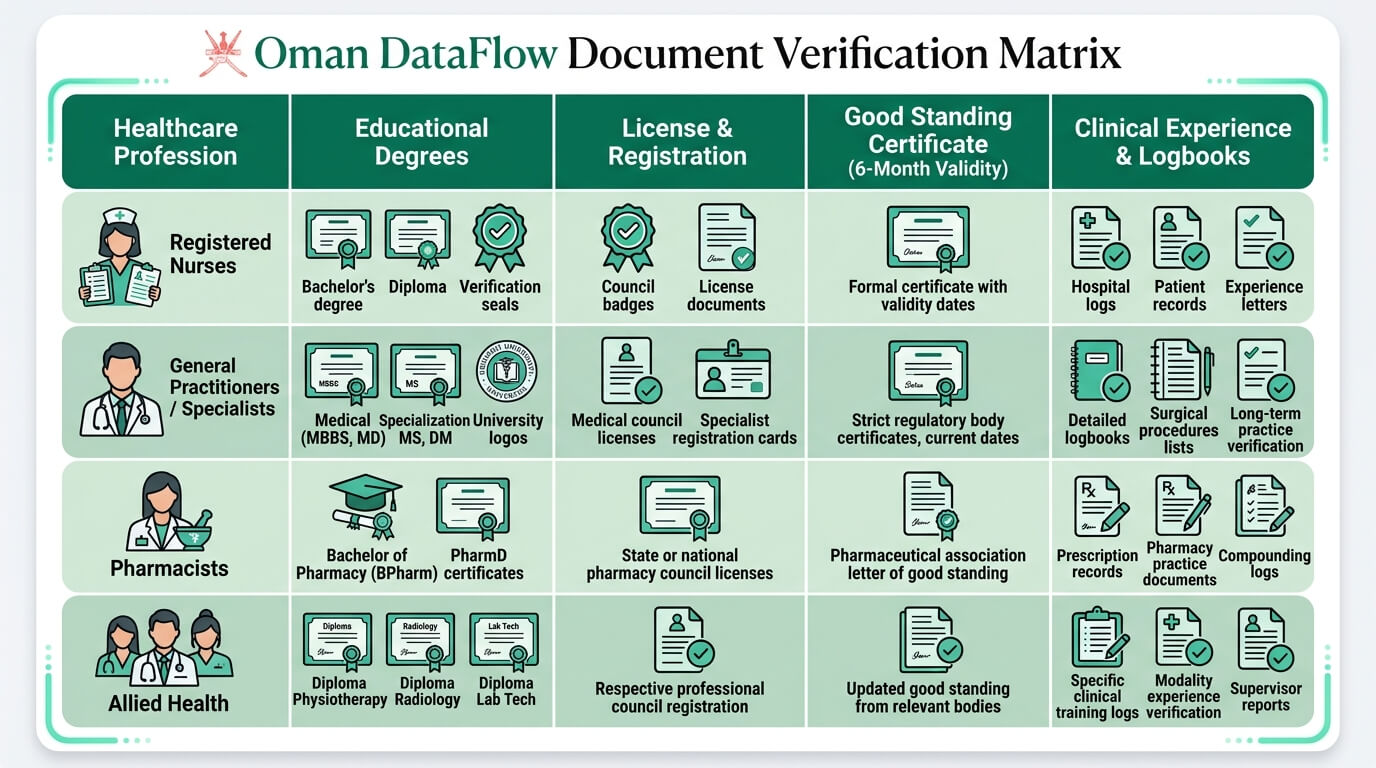
| Professional Category | Primary Degree Verified | Council Registration Required | Good Standing Certificate | Minimum Experience |
|---|---|---|---|---|
| Registered Nurses (RN) | B.Sc Nursing or GNM Diploma | State / National Nursing Council | Mandatory (Valid within 6 Months) | 2 Years Inpatient Bedside |
| General Practitioners (GP) | MBBS or Primary Medical Degree | National Medical Council | Mandatory (Valid within 6 Months) | 2 Years Clinical Practice |
| Specialist Physicians | Master Degree / MD / MS / Fellowship | Specialty Medical Board | Mandatory (Valid within 6 Months) | 3+ Years Post-Specialization |
| Pharmacists | B.Pharm / M.Pharm / Pharm.D | State / National Pharmacy Council | Mandatory (Valid within 6 Months) | 2 Years Hospital / Clinical |
| Allied Health Professionals | B.Sc / Diploma in Allied Discipline | Paramedical Council / Board | Mandatory (Valid within 6 Months) | 2 Years Diagnostic / Clinical |
Educational Credentials, Transcripts & Recognition Criteria
Educational verification represents the core pillar of the Primary Source Verification process. Candidates must supply color scans of the original final degree certificate or graduation diploma. Provisional certificates are accepted only when issued within the immediate prior six to twelve months and accompanied by formal letters from the university registrar explaining the graduation convocation timeline. Consolidated marksheets and official academic transcripts showing year-by-year coursework, clinical rotation hours, and examination results are mandatory. Where original credentials are in a language other than English or Arabic, certified legal translations prepared by a sworn legal translator must be uploaded alongside the original language documents. DataFlow verifies credentials directly with university registrars, controllers of examinations, and academic archives.
Professional Health Registration & Council Good Standing Certificate (GSC)
Healthcare practitioners must submit proof of their professional entitlement to practice medicine, nursing, or pharmacy. This requires color scans of the original registration certificate or license issued by the statutory licensing board in their home country or country of last practice. Additionally, an authentic Certificate of Good Standing (CGS) is mandatory. Crucially, Omani health authorities enforce a strict six-month validity rule for the Good Standing Certificate from the date of issue. The CGS must certify that the practitioner holds an unblemished ethical record, has never been suspended, censured, or investigated for professional negligence, and is in good professional standing. If a practitioner has practiced in multiple jurisdictions within the past three to five years, Good Standing certificates from each licensing authority must be verified.
Clinical Experience Certificates, Practice Continuity & Hospital HR Verification
Employment verification validates genuine clinical practice and procedural competency. Candidates must provide formal experience certificates printed on the official institutional letterhead of each employing hospital, clinic, or medical center. Experience letters must explicitly state: The candidate’s exact professional designation; Department or specialty unit; Full-time employment status; Exact start date and end date (day, month, year); Hospital bed strength and facility accreditation; Direct contact details of the authorized human resources manager or medical superintendent, including official institutional email addresses, direct telephone lines, and physical hospital address.
Crucially, Omani authorities scrutinize clinical practice continuity. Any gap in clinical practice exceeding six continuous months must be formally accounted for through written affidavits, maternity documentation, higher education certificates, or clinical attachment records. DataFlow contacts hospital HR departments directly via secured digital communications and institutional verification channels.
Letter of Authorization (LOA), Passport Identification & Legal Consent
Primary Source Verification requires explicit legal consent from the applicant to permit DataFlow to contact universities, regulatory councils, and prior employers. Candidates must execute the standard DataFlow Letter of Authorization (LOA). The LOA must be signed by the candidate with an authentic physical wet signature or an approved digital signature that matches the signature page of their international passport. In addition, candidates must upload a high-resolution color copy of the passport identification page, displaying full legal name, date of birth, nationality, passport number, issue date, and expiry date. The passport must have at least six months of remaining validity.
Section 4: End-to-End Verification Roadmap & Process Lifecycle
Step-by-Step Oman DataFlow Process: From Document Intake to Final Report
The verification journey follows a standardized four-stage lifecycle designed to ensure data integrity, thorough institutional outreach, and transparent milestone tracking. Understanding each operational milestone enables healthcare candidates to anticipate timelines and avoid common bottlenecks.
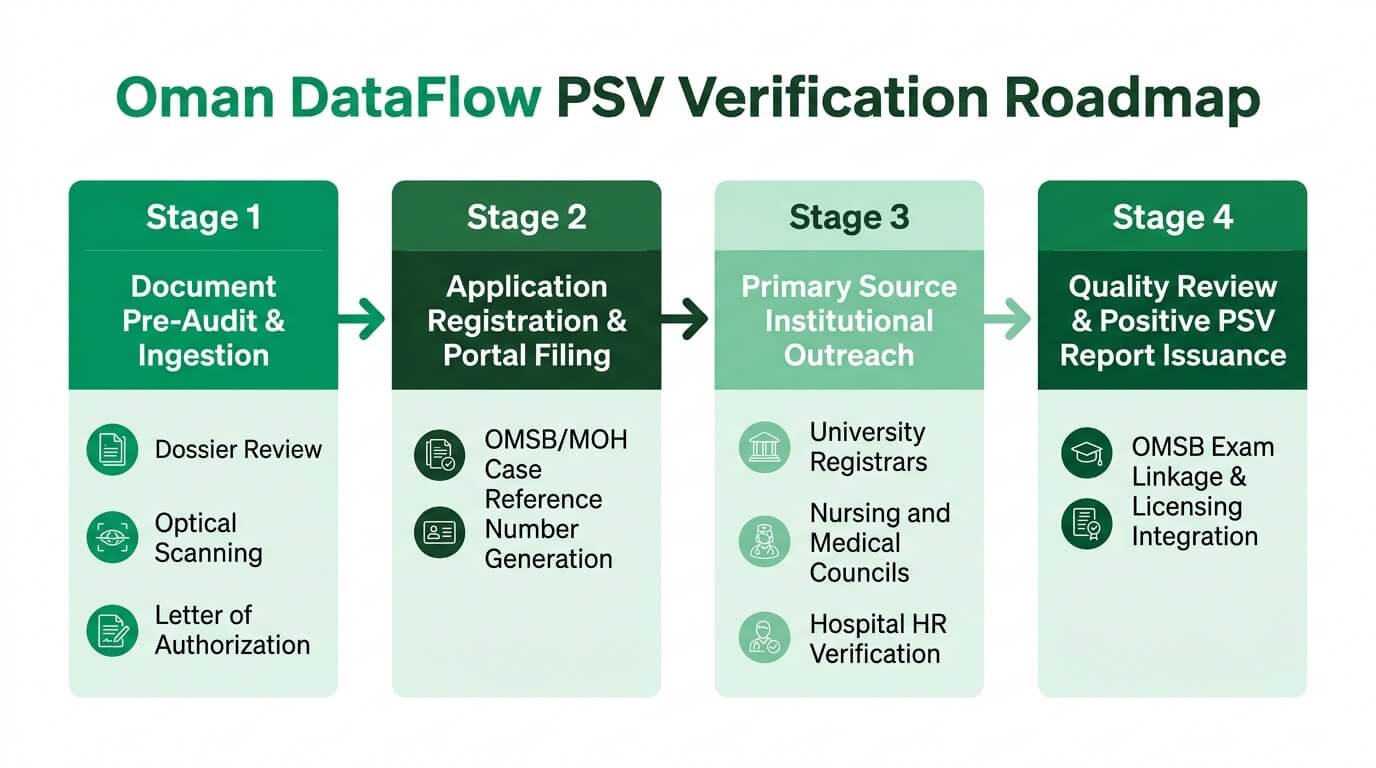
| Verification Stage | Responsible Entity | Key Actions & Verification Activities | Typical Timeline Window |
|---|---|---|---|
| Stage 1: Pre-Audit & Ingestion | OHC Regulatory Team | Dossier review, optical scan inspection, LOA execution, portal submission | 1 to 2 Business Days |
| Stage 2: Institutional Dispatch | DataFlow Group | Outbound communication to universities, nursing/medical councils, hospitals | 3 to 5 Business Days |
| Stage 3: Primary Source Verification | Issuing Institutions | Direct records search, transcript authentication, employment validation | 15 to 25 Business Days |
| Stage 4: Quality Audit & Report | DataFlow & OMSB/MOH | Forensic cross-checking, report generation, portal telemetry update | 2 to 3 Business Days |
Stage 1: Document Pre-Audit, Integrity Check & Scanning Specifications
Prior to initiating digital portal submission, Overseas Healthcare Consultant performs a comprehensive pre-audit of the candidate’s documentation package. Our regulatory specialists inspect every page for clarity, institutional stamp authenticity, name consistency across credentials, and registrar contact validity. All documents must be scanned in true 300 DPI optical color resolution, formatted in PDF or high-density JPEG formats, and maintained under 2 MB per file. Grayscale scans, mobile snapshots with background distortions, clipped edges, and uncertified photocopies are systematically identified and corrected. This pre-audit stage reduces document clarification requests by over 95 percent.
Stage 2: Oman DataFlow Dedicated Portal Account Setup & Application Registration
Once the dossier is fully certified, our team registers the application on the official Oman DataFlow dedicated gateway. The candidate profile is established with verified personal identifiers, contact email, and active mobile number. Each document category (Education, Health License, Good Standing, Employment) is registered under its respective regulatory classification. The Letter of Authorization is signed and uploaded. Upon submission, the portal generates a unique DataFlow Case Reference Number (e.g., DF-OM-XXXXXX), which serves as the primary tracking identifier throughout the verification lifecycle.
Stage 3: Primary Source Outbound Contact & Institutional Coordination
Following initial compliance clearance, DataFlow’s verification analysts initiate outbound contact with the issuing authorities. Official verification requests are dispatched to the registrar offices of universities, regulatory boards of medical and nursing councils, and human resources departments of past hospital employers. In instances where educational institutions or government hospitals require specialized internal verification requests or physical archival searches, OHC’s proactive institutional liaison team coordinates directly with institution officials to expedite response turnaround, ensuring that verification requests do not languish in bureaucratic queues.
Stage 4: Real-Time Application Tracking & Verification Milestones
Throughout the verification lifecycle, the application transitions across standardized status milestones visible within the portal. These include: Application Received, Under Initial Document Review, Outbound Verification Dispatched, Response Awaiting from Issuing Authority, In Quality Review, and Final Report Completed. The standard verification lifecycle spans approximately 20 to 35 business days, contingent upon institutional response speed. OHC continuously monitors portal telemetry and alerts candidates immediately upon milestone updates.
Section 5: TrueProfile Portability & Cross-Gulf Report Transfer
TrueProfile Portability: Transferring Existing Gulf PSV Reports to Oman
Healthcare professionals who have previously worked in or applied for licenses in other GCC jurisdictions—such as Dubai (DHA), Abu Dhabi (DOH/HAAD), the United Arab Emirates Ministry of Health (MOH UAE), the Kingdom of Saudi Arabia (SCFHS/Mumaris+), or the State of Qatar (QCHP/DHP)—hold a significant strategic advantage. Through the TrueProfile.io digital credential passport system powered by DataFlow, previously verified credentials can be transferred directly to the Oman Medical Specialty Board without requiring repeated primary source verification.
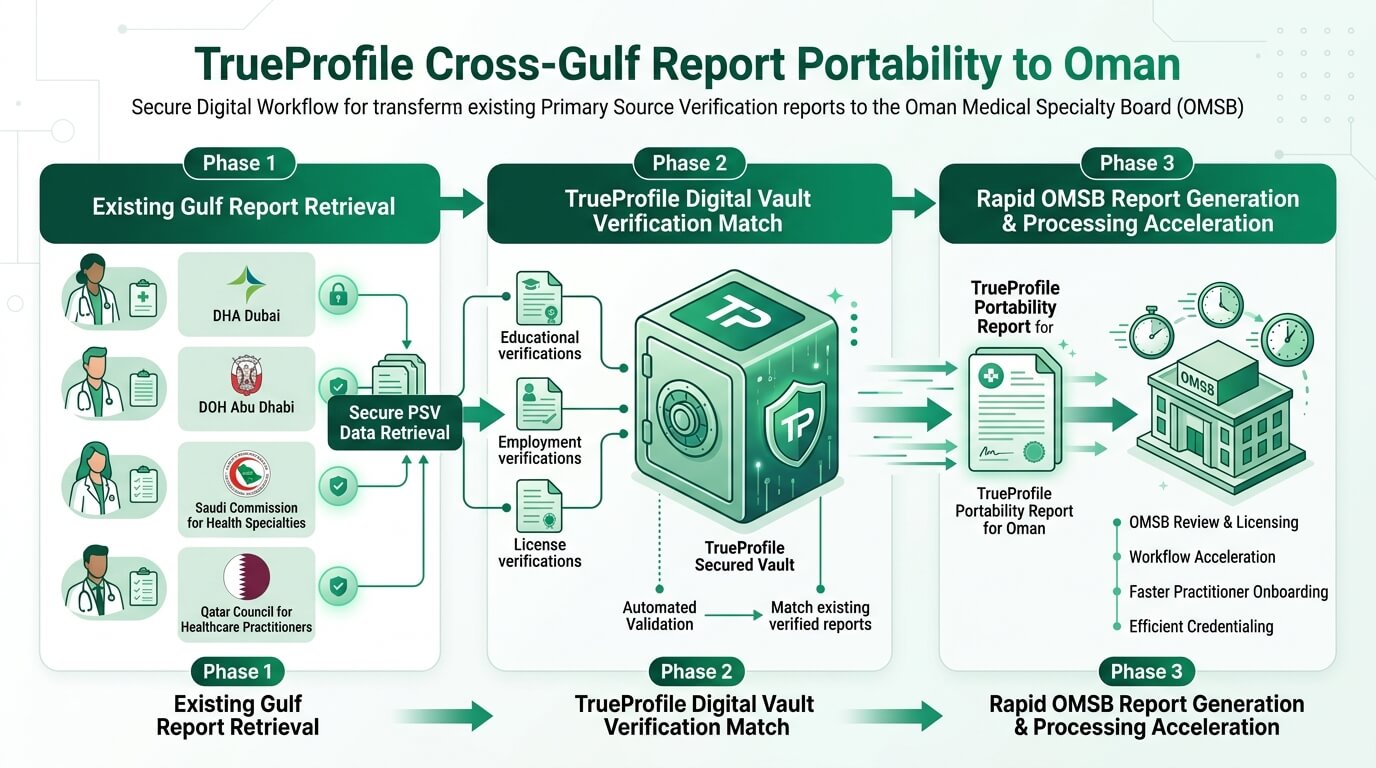
How to Port DHA, HAAD/DOH, SCFHS or QCHP Reports to OMSB DataFlow
Transferring a previous verification report requires linking the candidate’s existing DataFlow report number or TrueProfile digital credential with the new Oman DataFlow portal account. The candidate selects the TrueProfile transfer option during application initiation and inputs the historical case reference number. DataFlow securely retrieves the verified educational degrees, professional licenses, and employment credentials from the central digital vault, re-evaluating them against Oman-specific regulatory criteria and issuing an updated OMSB DataFlow report.
Turnaround Acceleration & Re-Verification Exemption Rules
TrueProfile report porting dramatically accelerates overall processing timelines, often reducing turnaround from several weeks to just a few business days for previously verified components. However, candidates must be aware of critical regulatory exceptions: First, any new clinical experience accumulated since the previous verification must undergo fresh primary source verification. Second, the Certificate of Good Standing must always be fresh and issued within the mandatory six-month window. Third, if the previous verification report contained an ‘Unable to Verify’ flag on any component, that specific credential will require fresh verification or remediation under Oman regulatory guidelines.
Section 6: Discrepancy Prevention & Remediation Protocols
Resolving Discrepancies, Delays & Unable to Verify Reports
While the vast majority of applications proceed smoothly, unforeseen institutional hurdles can occasionally disrupt the verification lifecycle. Understanding the classification of verification outcomes and knowing how to respond proactively is essential to safeguarding your clinical career.
Understanding Verification Outcomes: Positive, Negative & Unable to Verify
Upon completion of institutional investigations, DataFlow categorizes each verified document under one of three definitive outcomes: A ‘Positive’ outcome confirms that the issuing authority independently verified the authenticity of the degree, license, or employment certificate without reservation. A ‘Negative’ outcome indicates that the issuing institution declared the document forged, altered, or non-authentic, resulting in an immediate and irreversible ban across all GCC health authorities. An ‘Unable to Verify’ (UTV) outcome arises when the issuing institution failed to respond to multiple outreach attempts within the stipulated SLA timeframe, or stated that historical records were destroyed or unavailable. A UTV report is non-favorable and prevents licensure approval until formally remediated.
Remediating Non-Responsive Universities & Closed Hospital Facilities
The primary cause of delays and UTV reports is institutional non-responsiveness. Government universities with substantial administrative backlogs, autonomous colleges that have changed university affiliations, and private hospitals that have closed, relocated, or undergone management restructuring often fail to reply to digital verification inquiries. To prevent a UTV outcome, candidates must take immediate proactive steps: contacting college registrar desks, providing alternate official administrative email addresses, submitting government registrar gazette notifications, or requesting verified institutional archival extracts.
OHC Institutional Concierge: Active Case Escalation & Resolution
Overseas Healthcare Consultant maintains a dedicated verification escalation desk. When institutional delays threaten application deadlines, our team steps in to actively coordinate between the candidate, the issuing academic registrar or hospital administrative authority, and the DataFlow case management team. We ensure that verification requests are tracked down in university dispatch logs, that authorized officials receive resubmitted inquiries, and that prompt responses are logged before case closure, converting potential delays into confirmed positive reports.
Section 7: Final Licensing Integration with OMSB & MOH Oman
Integrating Your Positive DataFlow Report with OMSB Examination & MOH Licensing
Securing a verified Positive DataFlow report represents a decisive milestone, but it is one integral component of the broader healthcare licensing framework in the Sultanate of Oman. The final report must be formally integrated with subsequent licensing phases, including computer-based Prometric examinations and clinical evaluation.
OMSB Prometric Exam Booking Linkage & Eligibility Generation
For healthcare professionals qualifying under the Oman Medical Specialty Board, obtaining a positive DataFlow report or generating an active DataFlow application is directly linked to Prometric examination scheduling. Candidates must link their DataFlow reference number with the OMSB portal to secure examination eligibility. Once eligibility is generated, candidates can schedule their computer-based examination (CBT) at an authorized Prometric testing center globally or within Muscat. OHC delivers specialized exam coaching exclusively tailored for Registered Nurses and Pharmacists to ensure first-attempt examination clearance.
Final Regulatory Review by the Directorate General of Private Health Establishments
For practitioners appointed to private healthcare facilities across Oman, the positive DataFlow report and successful Prometric exam score are submitted to the Directorate General of Private Health Establishments under MOH Oman. The regulatory evaluation committee reviews the complete file, conducts credential equivalency assessments, reviews clinical logbooks, and issues the official Professional License or Evaluation Certificate authorizing clinical practice in Oman.
Section 8: Overseas Healthcare Consultant (OHC) Advantage
Why Healthcare Professionals Choose OHC for Oman DataFlow Verification
For over a decade, Overseas Healthcare Consultant has stood as South Asia’s and the Gulf region’s premier medical licensing and regulatory advisory consultancy. Our specialized team of healthcare regulatory consultants, credentialing analysts, and clinical advisors brings unparalleled mastery to the Oman DataFlow verification process.
100% Document Pre-Submission Verification & Flawless Accuracy Audit
Our meticulous pre-audit protocols eliminate guesswork. We review every seal, signature, date, and transcript notation with forensic accuracy, ensuring that your application is 100 percent compliant prior to formal portal entry. By identifying formatting errors, missing authorizations, and potential institutional pitfalls in advance, we safeguard your professional reputation and eliminate avoidable delays.
Dedicated Verification Specialists & Proactive University Coordination
Unlike automated platforms or generic document agencies, OHC assigns a dedicated verification specialist to manage your case from inception to final report generation. Our specialists monitor daily portal updates, communicate directly with university registrars and hospital HR administrators, and provide you with transparent, real-time status briefings via dedicated WhatsApp and email channels.
Seamless Transition to RN & Pharmacist Exam Coaching & Licensing Advisory
At OHC, your journey does not end with verification. We offer an integrated, multi-disciplinary transition pathway. For Registered Nurses and Pharmacists, our expert faculty provides specialized clinical coaching and mock test series to conquer the OMSB Prometric examination. Across all disciplines, our team guides you through final license issuance, hospital credentialing, and relocation advisory.
Verified Candidate Verification Reviews
← Swipe or scroll horizontally to explore verified candidate reviews across Oman DataFlow verification →
“My Oman DataFlow for OMSB was completed in exactly 24 business days. OHC pre-audited my B.Sc nursing degree and council certificates thoroughly, preventing any university delays.”
“I ported my existing DHA DataFlow report to Oman using TrueProfile with OHC guidance. The process took only 6 days for educational approval. Incredible service and responsiveness!”
“My pharmacy degree verification was stalled due to an unresponsive registrar. OHC dedicated desk coordinated directly with the university and resolved it within 48 hours.”
“Flawless documentation management for my specialist surgeon application. Surgical logbooks, MD degree, and good standing certificate were all verified with 100% positive reports.”
“Their guidance on the 6-month Good Standing rule saved me from submitting an expired document. Professional, transparent, and highly knowledgeable team.”
Section 9: Clinical FAQs & Verified Expert Guidance
Frequently Asked Questions About Oman DataFlow PSV Verification
1. What is Oman DataFlow Primary Source Verification?
2. Which healthcare professions are required to undergo Oman DataFlow verification?
3. How long does the Oman DataFlow verification process typically take?
4. What documents are mandatory for an Oman DataFlow application?
5. How does the 6-month validity rule apply to the Certificate of Good Standing?
6. Can I transfer my existing DHA, HAAD, SCFHS, or QCHP DataFlow report to Oman?
7. What is TrueProfile portability and how does it benefit Oman applicants?
8. What is the Letter of Authorization (LOA) and why is an authentic signature required?
9. What happens if DataFlow issues an Unable to Verify (UTV) outcome for my credentials?
10. How can healthcare candidates prevent delays caused by unresponsive universities?
11. What is the difference between an OMSB DataFlow report and an MOH DataFlow report?
12. Can I schedule my OMSB Prometric examination before receiving my final DataFlow report?
13. How does OHC assist candidates with the Oman DataFlow verification process?
14. What are the clinical experience verification requirements for Registered Nurses in Oman?
15. Are provisional degree certificates accepted for Oman DataFlow verification?
16. Which healthcare professions can access OHC clinical coaching for licensing exams?
Ready to Begin Your Oman DataFlow PSV Verification?
Ensure 100% compliance with Oman Medical Specialty Board and Ministry of Health credentialing standards. Connect directly with our senior Gulf verification consultants today.