


Sultanate of Oman Medical Examination Gateway
Oman OMSB Prometric Exam: Blueprint, Passing Scores, Syllabus, Booking & Retake Rules
The definitive clinical guide for doctors, nurses, pharmacists, and allied health professionals seeking practice clearance under the Oman Medical Specialty Board (OMSB). Learn exam blueprints, passing cutoffs, international booking steps, and retake policies.
Discipline-Specific Cutoffs: 50% Nurses | 55% Pharmacists | 60% GP, Specialists & Dentists
Global Prometric Network: Take your computer-based exam in over 180 countries
Live Interactive Coaching: Exclusively for Registered Nurses and Pharmacists
Request Exam Eligibility Audit
Get your credentials audited for OMSB Prometric scheduling and blueprint guidance.
Sovereign Mandate
Oman Medical Specialty Board (OMSB) Royal Decree Authority
Passing Marks
50% Nurses | 55% Pharmacists | 60% GP, Specialists & Dentists
Duration & Questions
100 to 150 MCQs | 2.5 to 3.0 Hours Time Limit
Retake Rules
3 Attempts per Cycle | 30-Day Cooling-Off Interval
Score Validity
3 Years Official Validity for MOH Oman Registration
1. Overview of the OMSB Prometric Examination and Sovereign Mandate
The Sultanate of Oman maintains an internationally recognized standard of healthcare delivery, anchored by the strategic transformation goals of the national health policy under Oman Vision 2040. Across royal referral institutions such as the Royal Hospital, Khoula Hospital, and Sultan Qaboos University Hospital in Muscat, down through regional tertiary hospitals and modern private clinical centers in Salalah, Sohar, Nizwa, and Sur, clinical excellence is protected through rigorous professional credentialing. At the core of this regulatory mechanism lies the computer-based qualifying examination conducted under the statutory oversight of the Oman Medical Specialty Board (OMSB).
The OMSB qualifying examination serves as the mandatory initial clinical competence assessment for all foreign healthcare professionals seeking practice privileges in the Sultanate. Administered internationally through Prometric authorized test centers worldwide, this standardized computer-based test (CBT) verifies that healthcare practitioners possess the theoretical knowledge, diagnostic acuity, and clinical problem-solving competencies necessary to provide safe patient care within Omani healthcare facilities. Clearing the OMSB Prometric examination represents an essential prerequisite for proceeding to Ministry of Health (MOH) Oman licensing evaluation and hospital credentialing.
Statutory Governance of the Oman Medical Specialty Board (OMSB)
Established by Royal Decree, the Oman Medical Specialty Board operates under the supervision of the Minister of Health as the sovereign authority for postgraduate medical education, specialist training accreditation, and clinician competence evaluation. The Central Examination Committee of OMSB establishes and continually updates the standardized examination blueprints across all medical, surgical, dental, pharmacy, nursing, and allied health disciplines.
The board works in close collaboration with sovereign medical faculties and international assessment bodies to align examination content with current clinical practice standards and evidence-based protocols. While the Ministry of Health (MOH) Oman oversees institutional facility licensing, workforce deployment, and practice activation, OMSB retains exclusive sovereign authority over academic qualification equivalence and qualifying examination standards. Passing an OMSB qualifying assessment grants the applicant official academic clearance that is recognized across both public and private healthcare sectors in Oman.
OMSB comprises specialized scientific committees representing each medical and surgical discipline. These committees continually review global medical curricula, monitor international medical education standards, and classify foreign medical universities and specialty training programs into recognized qualification tiers. By maintaining stringent alignment with international clinical governance frameworks, OMSB ensures that every clinician practicing in Oman possesses verifiable competencies benchmarked against leading global standards.
Role of Prometric Computer-Based Testing (CBT) in Oman Healthcare Licensing
To ensure worldwide accessibility, uncompromising testing integrity, and standardized objective scoring, OMSB partners with Prometric, a global leader in computer-based assessment administration. Through Prometric secure international network of testing centers, candidates can schedule and take their OMSB qualifying examinations in dozens of countries across Asia, Europe, Africa, the Middle East, and North America, eliminating the need to travel to Oman for initial examination clearance.
Prometric testing centers provide advanced security environments, featuring biometric identity verification, continuous digital audio and video monitoring, secure browser delivery engines, and standardized test administration procedures. Examination questions are delivered as randomized multiple-choice questions (MCQs), ensuring that every candidate receives an equivalent, statistically balanced examination form mapped precisely to the official OMSB blueprint. Scores are calculated electronically and transmitted securely to OMSB, providing rapid verification of examination results.
| Regulatory Pillar | Institutional Authority | Administrative Function | Operational Deliverable |
|---|---|---|---|
| Sovereign Examination Authority | Oman Medical Specialty Board (OMSB) | Establishes curricular blueprints, sets passing cutoffs, audits question banks, grants academic clearance | Official OMSB Examination Clearance & Evaluation Letter |
| Global Assessment Delivery Partner | Prometric Testing Network | Provides secure worldwide test facilities, biometric verification, digital delivery, and automated scoring | Certified Prometric Score Report with Scaled Performance |
| Licensing Executive Authority | Ministry of Health (MOH) Oman | Conducts specialist oral viva evaluations, reviews facility sponsorship, issues clinical practice licenses | Official MOH Clinical Practice License & Institutional Registration |
| Primary Source Verification Partner | DataFlow Group / TrueProfile | Performs forensic verification of university degrees, health council licenses, and clinical employment records | Verified Oman DataFlow Primary Source Verification Report |
| Candidate Advisory & Preparation Authority | Overseas Healthcare Consultant (OHC) | Provides complete eligibility management, scheduling coordination, and live coaching for nurses and pharmacists | End-to-End Examination Success & Regulatory Navigation |
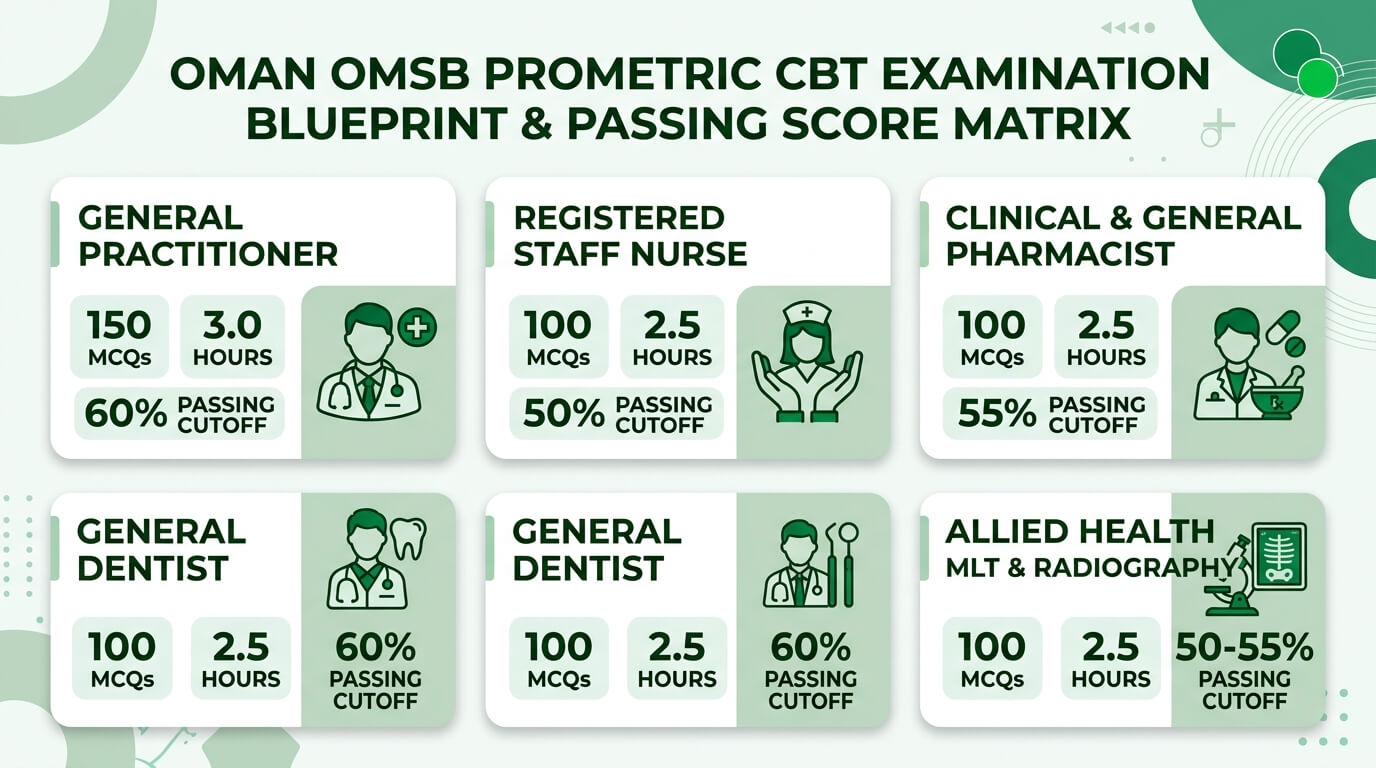
2. Discipline-Specific Examination Blueprints, Question Volumes and Passing Cutoffs
The Oman Medical Specialty Board maintains tailored examination blueprints for each healthcare profession, reflecting the distinct clinical responsibilities, diagnostic challenges, and patient care workflows encountered in Omani medical practice. Understanding the precise question volume, allocated examination duration, and mandatory passing cutoff for one specific discipline is vital for targeted preparation and time management on test day.
General Practitioners (GP) and Medical Specialists Examination Architecture
General Practitioner (GP) candidates must complete a comprehensive 150-question examination administered over 3.0 hours (180 minutes). The GP blueprint covers the broad spectrum of primary care and acute medicine, emphasizing ambulatory care, emergency stabilization, preventive health, chronic disease management, pediatrics, obstetrics and gynecology, and surgical triage. To achieve a passing result, GP candidates must obtain a minimum score of 60%.
Medical Specialists and Consultants complete specialty-specific computer-based examinations consisting of 100 to 150 multiple-choice questions over 2.5 to 3.0 hours, depending on the particular clinical subspecialty. Specialty examinations (such as Internal Medicine, General Surgery, Pediatrics, Obstetrics and Gynecology, Anesthesia, Orthopedics, Cardiology, and Dermatology) require a minimum passing score of 60%. For certain advanced specialist categories, passing the computer-based Prometric assessment serves as the academic qualifying gateway to a subsequent clinical oral viva examination conducted in Muscat before the OMSB scientific committee.
Registered Staff Nurses Examination Blueprint and Clinical Domains
The OMSB Registered Nurse qualifying examination is a 100-question computer-based assessment delivered over 2.5 hours (150 minutes). The examination is designed for candidates holding a Bachelor of Science in Nursing (B.Sc Nursing) or a Diploma in General Nursing and Midwifery (GNM) with verifiable acute hospital bedside clinical experience. The mandatory passing score for Staff Nurses is 50%.
The nursing examination blueprint is divided into six core clinical domains: Adult Medical-Surgical Nursing (35%), Maternal and Newborn Nursing (15%), Pediatric and Child Health Nursing (15%), Mental Health and Psychiatric Nursing (10%), Community Health and Ambulatory Care (10%), and Nursing Leadership, Ethics, and Patient Safety (15%). Questions heavily emphasize clinical decision-making, patient assessment, pharmacological administration, infection prevention, emergency triage, and perioperative nursing interventions.
General and Clinical Pharmacists Examination Blueprint and Weightage
The OMSB Pharmacy qualifying examination consists of 100 multiple-choice questions administered over 2.5 hours (150 minutes). It assesses graduates holding Bachelor of Pharmacy (B.Pharm), Master of Pharmacy (M.Pharm), or Doctor of Pharmacy (PharmD) qualifications. The mandatory passing threshold for pharmacists is 55%.
The pharmacy blueprint spans five critical therapeutic and pharmaceutical science domains: Pharmacology and Clinical Therapeutics (35%), Clinical Calculations and Pharmacokinetics (20%), Pharmacy Practice, Dispensing and Compounding (20%), Toxicology, Adverse Drug Reactions and Patient Safety (15%), and Pharmaceutical Chemistry, Quality Standards and Regulatory Ethics (10%). Candidates are evaluated on therapeutic drug monitoring, dosage adjustments in renal and hepatic impairment, antimicrobial selection, drug-drug interaction identification, and sterile compounding protocols.
Dental Practitioners and Allied Health Professionals Assessment Framework
General Dental Practitioners (BDS) take a 100-question examination over 2.5 hours covering restorative dentistry, periodontics, oral surgery, pediatric dentistry, orthodontics, oral medicine, dental radiology, and infection control. The passing threshold for dental candidates is 60%. Dental Specialists (MDS) complete focused examinations within their specific specialty domain requiring a 60% passing score.
Allied health professionals represent a vital component of Oman healthcare system. Medical Laboratory Technologists (MLT) complete a 100-question test (2.5 hours, 50% to 55% passing cutoff) covering clinical biochemistry, hematology, microbiology, immunology, and blood banking. Diagnostic Radiographers take a 100-question assessment (2.5 hours, 50% passing cutoff) covering radiation physics, radiographic positioning, CT and MRI imaging protocols, radiation protection, and patient care. Physiotherapists complete a 100-question examination (2.5 hours, 50% passing cutoff) evaluating musculoskeletal rehabilitation, neurological physiotherapy, cardiopulmonary therapy, and clinical exercise physiology.
| Clinical Discipline | Total MCQs | Exam Duration | Passing Cutoff | Core Examination Domains | Assessment Structure |
|---|---|---|---|---|---|
| General Practitioner (GP) | 150 MCQs | 3.0 Hours (180 min) | 60% (Scaled) | Internal Medicine, Pediatrics, OB/GYN, Surgery, Emergency Care, Preventive Medicine | Computer-Based Test (Prometric CBT) |
| Medical Specialist (Internal Medicine) | 100-150 MCQs | 2.5-3.0 Hours | 60% (Scaled) | Cardiology, Pulmonology, Nephrology, Gastroenterology, Critical Care, Endocrinology | Prometric CBT + MOH Clinical Viva |
| Medical Specialist (General Surgery) | 100-150 MCQs | 2.5-3.0 Hours | 60% (Scaled) | Gastrointestinal, Trauma, Critical Care, Surgical Oncology, Vascular, Perioperative Care | Prometric CBT + MOH Clinical Viva |
| Registered Staff Nurse | 100 MCQs | 2.5 Hours (150 min) | 50% (Scaled) | Adult Medical-Surgical (35%), Maternal/Child (30%), Mental Health (10%), Ethics/Safety (25%) | Computer-Based Test (Prometric CBT) |
| General & Clinical Pharmacist | 100 MCQs | 2.5 Hours (150 min) | 55% (Scaled) | Pharmacology & Therapeutics (35%), Calculations & PK (20%), Practice & Safety (45%) | Computer-Based Test (Prometric CBT) |
| General Dental Practitioner (BDS) | 100 MCQs | 2.5 Hours (150 min) | 60% (Scaled) | Operative Dentistry, Oral Surgery, Periodontics, Prosthodontics, Radiology, Ethics | Computer-Based Test (Prometric CBT) |
| Medical Laboratory Technologist | 100 MCQs | 2.5 Hours (150 min) | 50% – 55% | Clinical Biochemistry, Hematology, Microbiology, Blood Banking, Quality Control | Computer-Based Test (Prometric CBT) |
| Diagnostic Radiographer | 100 MCQs | 2.5 Hours (150 min) | 50% (Scaled) | Radiographic Techniques, CT/MRI Principles, Radiation Protection, Patient Safety | Computer-Based Test (Prometric CBT) |
| Physiotherapist | 100 MCQs | 2.5 Hours (150 min) | 50% (Scaled) | Musculoskeletal, Neurological, Cardiopulmonary Rehabilitation, Clinical Kinesiology | Computer-Based Test (Prometric CBT) |
3. Candidate Eligibility Verification and Global Prometric Scheduling Workflow
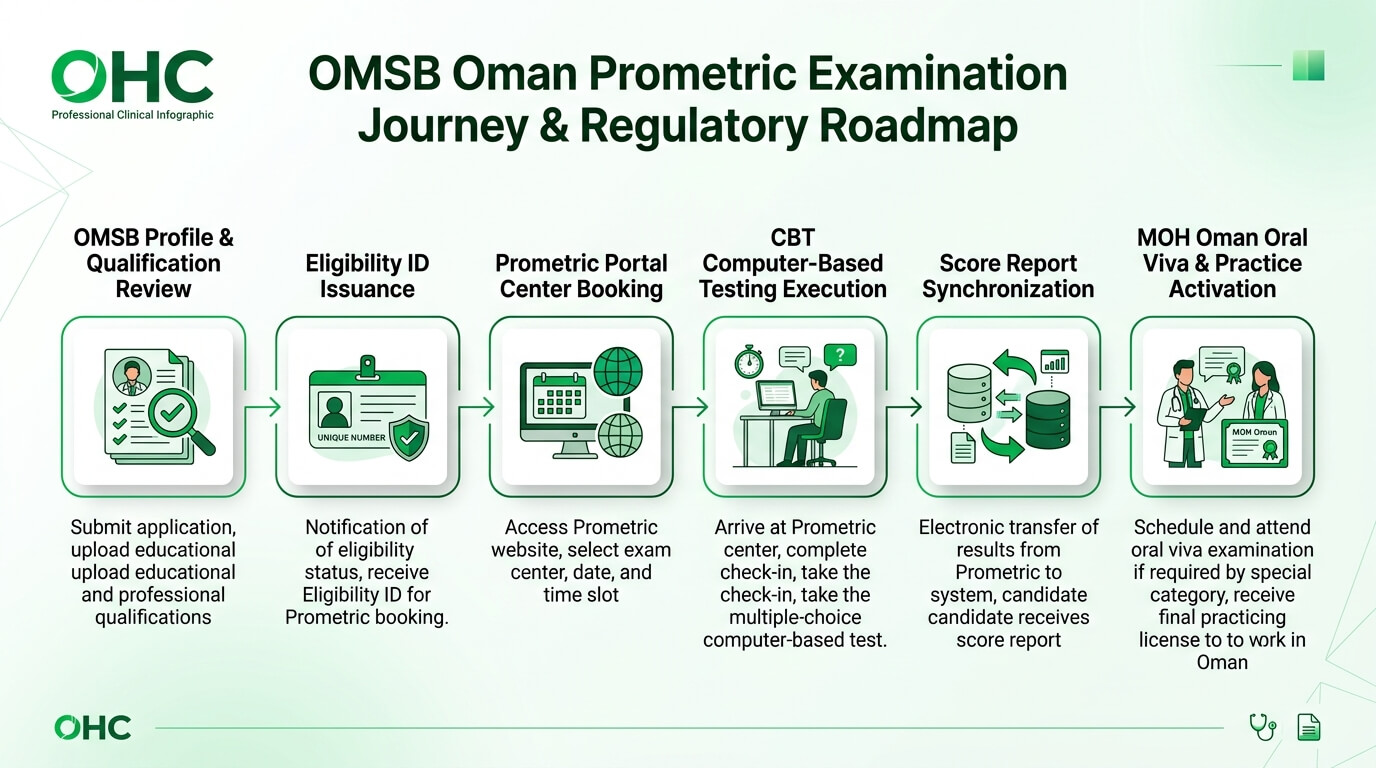
Scheduling an OMSB Prometric examination requires following a structured multi-stage administrative workflow. Unlike general academic tests, healthcare licensing examinations require formal candidate verification to confirm that basic educational and registration prerequisites are satisfied prior to test appointment reservation.
Obtaining the OMSB Eligibility ID via Electronic Dossier Review
Before booking a testing slot on the Prometric portal, the candidate must initiate their credential evaluation file with the Oman Medical Specialty Board. This process begins by creating an electronic candidate profile on the OMSB licensing portal, entering verified personal and educational details, uploading scanned copies of primary medical degrees, state health council registrations, and official experience credentials.
Upon preliminary review and qualification validation, OMSB generates an official Eligibility ID (also referred to as an OMSB Candidate ID or Scheduling Number). This unique alphanumeric identifier authorizes the candidate to register for their designated specialty examination within the Prometric booking system. Candidates must verify that their full legal name on the OMSB eligibility profile matches their valid international passport exactly, character for character, as even minor typographical discrepancies can prevent admission to the examination room on test day.
Scheduling Test Appointments across International Prometric Centers
With an active Eligibility ID in hand, candidates access the official Prometric scheduling portal and select the Oman Medical Specialty Board (OMSB) testing program. The scheduling engine enables candidates to locate authorized testing centers across major metropolitan hubs globally, view real-time calendar seat availability, and choose an optimal date and time slot.
Candidates receive an official Prometric Appointment Confirmation document via email immediately upon reservation. This document contains the unique 16-digit Confirmation Number, the exact testing center address and reporting directions, the scheduled appointment time, and detailed candidate instructions. Overseas Healthcare Consultant assists candidates throughout this scheduling workflow, ensuring that testing dates harmonize with ongoing Primary Source Verification timelines.
Mandatory Identification Standards and Test Center Candidate Protocols
Prometric testing centers uphold strict identification and security protocols to safeguard examination integrity. Candidates must present one primary, government-issued form of identification that must be an original, valid (unexpired) International Passport. The passport must display a clear photograph, the candidate signature, and an exact match to the candidate first and last names registered on the Prometric appointment confirmation.
Secondary forms of identification, such as national identity cards or driving licenses, are generally not accepted as primary credentials for international test takers sitting Gulf medical licensing exams. If a candidate passport has expired or has been renewed under an updated spelling, the discrepancy must be officially updated and reconciled in the OMSB database prior to test day to avoid immediate entry denial without recourse.
| Workflow Phase | Action Item | Responsible Party | Verification Milestone |
|---|---|---|---|
| Phase 1: Profile Creation | Submit electronic candidate details and scanned credentials on OMSB portal | Candidate / OHC Advisory | OMSB Candidate Profile Established |
| Phase 2: Eligibility Clearance | OMSB verifies basic qualification criteria and authorizes examination category | OMSB Examination Committee | Official OMSB Eligibility ID Issued |
| Phase 3: Center Selection | Select preferred international Prometric testing center location, date, and time slot | Candidate / OHC Scheduling | Prometric Slot Reserved |
| Phase 4: Appointment Confirmation | Review confirmation document, verify name matching against passport | Candidate / OHC Officer | 16-Digit Prometric Confirmation Generated |
| Phase 5: Test Day Execution | Report to testing center 30 minutes early with valid passport and confirmation letter | Candidate / Prometric Staff | Biometric Check-In & Examination Administration |
| Phase 6: Result Transmission | Score report calculated and securely synchronized with OMSB licensing system | Prometric / OMSB Database | Official Examination Result Letter Available |
4. In-Depth Curricular Domains, Question Formats and Clinical Case Vignettes
The OMSB Prometric examination employs modern psychometric assessment methodologies designed to measure true clinical competence rather than mere rote memorization. Questions are developed by expert clinical panels and reviewed for curricular relevance, linguistic clarity, and psychometric reliability.
Anatomy of Prometric Multiple Choice Questions (MCQs) and Clinical Scenarios
Each examination item consists of a clinical stem (the scenario or case presentation), a focused lead-in question, and four or five answer choices containing one definitively correct key and carefully constructed plausible distractors. More than 70% of questions in the physician, nurse, and pharmacist examinations are formatted as clinical vignettes describing realistic patient presentations.
A typical clinical vignette presents patient age, gender, chief complaint, vital signs, physical examination findings, diagnostic laboratory data, and imaging results. The candidate is tasked with determining the most likely diagnosis, selecting the initial investigation of choice, identifying the most appropriate immediate therapeutic intervention, or recognizing potential medication contraindications. This clinical scenario model requires candidates to synthesize multidimensional data and apply structured diagnostic reasoning.
Cognitive Complexity Levels: Recall, Application, and Analytical Judgment
OMSB examination questions are categorized across three distinct cognitive complexity tiers in accordance with Bloom revised taxonomy:
Level 1 (Recall and Foundational Knowledge): Approximately 20% to 25% of the examination tests foundational recall, such as standard laboratory reference ranges, normal vital signs by pediatric age group, anatomical landmarks, and fundamental pharmacological classifications.
Level 2 (Clinical Application and Understanding): Accounting for 50% to 55% of the assessment, these questions require candidates to interpret clinical data, calculate drug dosages, recognize characteristic electrocardiogram patterns, and select appropriate evidence-based clinical guidelines for common medical and surgical presentations.
Level 3 (Analytical Synthesis and Critical Judgment): Representing 20% to 25% of the questions, Level 3 items present complex, ambiguous patient scenarios involving multiple comorbidities, atypical disease presentations, or conflicting therapeutic indications. Candidates must exercise advanced clinical judgment, prioritize competing treatment goals, and manage urgent acute clinical deteriorations.
Medical Specialists Oral Viva Examinations Conducted in Muscat
For medical and surgical specialists, passing the Prometric computer-based examination represents the theoretical qualifying milestone. Certain specialty titles, particularly in surgical subspecialties, anesthesia, obstetrics, and acute diagnostic fields, require a subsequent oral clinical viva examination conducted in Muscat.
The oral examination is administered by an expert scientific panel appointed by OMSB and the Ministry of Health. Candidates are evaluated on clinical case management, diagnostic algorithm navigation, emergency surgical decision-making, patient communication, and medical ethics. Overseas Healthcare Consultant prepares specialist candidates for this milestone by providing structured clinical case discussion guides, previous viva format orientation, and documentation support.
| Cognitive Level | Exam Proportion | Clinical Skill Assessed | Representative Question Style |
|---|---|---|---|
| Level 1: Recall & Principles | 20% – 25% | Foundational knowledge, normal physiological parameters, drug classes | Direct question identifying the mechanism of action or standard anatomical landmark |
| Level 2: Clinical Application | 50% – 55% | Data interpretation, diagnostic selection, standard therapy implementation | Clinical vignette presenting vital signs and symptoms requiring initial pharmacotherapy choice |
| Level 3: Critical Synthesis | 20% – 25% | Complex management, conflicting comorbidities, acute clinical emergencies | Multi-stage scenario with decompensating patient requiring immediate prioritization of interventions |
| Specialist Oral Viva | Mandatory for Select Specialties | Verbal diagnostic reasoning, surgical decision-making, professional ethics | Interactive clinical scenario defense before OMSB senior consultant panel in Muscat |
5. Retake Policies, 30-Day Cooling-Off Intervals and Score Validity Standards
Navigating regulatory examination policies requires a thorough understanding of attempt limitations, waiting intervals, and result validity windows enforced by the Oman Medical Specialty Board. Being aware of these rules helps candidates manage their preparation timeline strategically and avoid unexpected career interruptions.
Understanding the Three-Attempt Limit per Eligibility Cycle
The Oman Medical Specialty Board enforces a strict limit of three (3) examination attempts within a single eligibility cycle. If a candidate does not achieve the required passing score on their initial sitting, they are permitted a maximum of two additional retake attempts under that eligibility approval.
Every sitting at an authorized Prometric center counts as an official attempt. Candidates who schedule an appointment but fail to appear without formal advance cancellation also forfeit that attempt. Because attempts are strictly limited, candidates should never sit for an examination underprepared or merely to test the questions. Overseas Healthcare Consultant works closely with candidates to verify readiness through comprehensive mock assessments before scheduling any examination.
The Mandatory 30-Day Cooling-Off Interval and One-Year Lockout Policy
Between consecutive examination attempts, OMSB mandates a minimum thirty (30) day cooling-off period. This regulatory interval is designed to ensure that candidates engage in structured remedial study and address knowledge deficits before re-attempting the assessment. Prometric scheduling systems automatically restrict appointment dates that fall within thirty days of a previous unsuccessful test date.
In the unfortunate circumstance that a candidate exhausts all three allowed attempts without achieving a passing score, OMSB imposes a formal administrative waiting period of one (1) year. During this twelve-month lockout, the candidate is barred from sitting for any OMSB qualifying examination in that specialty. Following the completion of the one-year waiting period, the candidate may apply for a new eligibility evaluation, provided they present evidence of continuous clinical practice and ongoing professional development.
Three-Year Examination Score Validity and MOH Oman Practice Activation
Upon achieving a passing score on the OMSB Prometric examination, the result remains officially valid for a period of three (3) years from the examination date. Within this three-year validity window, the candidate must complete Primary Source Verification through DataFlow, obtain an approved job offer from a licensed Omani healthcare facility, and submit their file to the Ministry of Health (MOH) Oman for clinical license issuance.
If a candidate does not activate their professional practice license within three years of passing the examination, the result expires, requiring the candidate to re-sit and pass the qualifying examination again. Overseas Healthcare Consultant helps candidates synchronize their examination timelines with DataFlow verification and employment placement to ensure seamless license activation well within the validity period.
| Regulatory Parameter | Statutory Rule in Oman | Administrative Impact | Strategic Advisory by OHC |
|---|---|---|---|
| Maximum Examination Attempts | 3 attempts per eligibility cycle | Exhausting 3 attempts triggers a mandatory lockout | Ensure comprehensive preparation and mock exam clearance before Attempt 1 |
| Retake Cooling-Off Window | Mandatory 30-day interval between sittings | Prometric portal blocks booking within 30 days of failure | Use the 30-day window for intensive remedial coaching and blueprint domain review |
| Three-Attempt Lockout Period | 1 year (12 months) administrative waiting period | Candidate cannot sit for OMSB exams during this time | Prevent lockout by utilizing structured OHC mentorship and verified study frameworks |
| Passing Score Validity | 3 years from the date of examination clearance | Must activate MOH license within this 36-month window | Coordinate DataFlow PSV and employer sponsorship to activate license without delay |
| Appointment Cancellation Window | Minimum 48 to 72 hours prior to scheduled test | Late cancellation forfeits the test attempt | Confirm travel, identification, and schedule well in advance of testing day |
6. Exemption Criteria for Board-Certified Medical Consultants and Specialists
The Oman Medical Specialty Board recognizes that senior clinical practitioners holding premier international postgraduate medical qualifications have already undergone rigorous objective assessment. Under the OMSB Professional Qualification Requirements (PQR) framework, clinicians who hold recognized Tier 1 qualifications may be granted formal exemption from the Prometric computer-based examination.
OMSB Tier 1 International Board Qualifications Exemption Matrix
OMSB maintains an established classification of Tier 1 postgraduate medical qualifications that qualify for Prometric examination exemption. These premier international credentials include:
United Kingdom and Ireland: Certificate of Completion of Specialist Training (CCST) or Certificate of Completion of Training (CCT) accompanied by Membership or Fellowship of the Royal Colleges (MRCP, FRCS, FRCOG, FRCA, FRCPCH) with inclusion on the GMC Specialist Register.
United States: American Board of Medical Specialties (ABMS) certification, following completion of an ACGME-accredited residency program.
Canada: Fellowship of the Royal College of Physicians and Surgeons of Canada (FRCPC) or College of Family Physicians of Canada (CCFP).
Australia and New Zealand: Fellowship of the Royal Australasian Colleges (FRACP, FRACS, RANZCOG, ANZCA) with Specialist Registration.
Western Europe: German Facharzt, French Diplome d’Etudes Specialisees (DES), or Swiss Foederatio Medicorum Helveticorum (FMH) specialist certifications.
Verification and Documentation Pathways for Exemption Clearance
To obtain an official examination exemption, eligible candidates must submit a formal exemption request along with their electronic credential dossier to OMSB. The application must include the original postgraduate board certificate, official letters of good standing from the awarding regulatory council, complete transcripts detailing residency training, and verifiable clinical experience credentials.
OMSB Central Evaluation Committee reviews the submitted documentation to confirm that the training program duration, clinical rotational scope, and exit examination meet Tier 1 equivalence standards. If approved, OMSB issues an official Examination Exemption Letter, allowing the candidate to bypass the Prometric CBT and proceed directly to DataFlow verification and Ministry of Health evaluation. Overseas Healthcare Consultant audits specialist dossiers to determine exemption eligibility before candidates register for any examination.
| Country / Regulatory Board | Recognized Tier 1 Qualification | Exemption Status | Verification Requirement |
|---|---|---|---|
| United Kingdom (GMC) | CCT / CCST + Royal College Fellowship (FRCP/FRCS) | Full Prometric CBT Exemption | GMC Specialist Register verification + Certificate of Good Standing |
| United States (ABMS) | American Board Certification (ACGME Accredited) | Full Prometric CBT Exemption | Official ABMS Board certification verification + State license validation |
| Canada (RCPSC) | Fellowship of the Royal College (FRCPC / FRCSC) | Full Prometric CBT Exemption | RCPSC Confirmation letter + Provincial registration in good standing |
| Australia / New Zealand | Fellowship of Australasian College (FRACP / FRACS) | Full Prometric CBT Exemption | AHPRA Specialist Registration + College Fellowship verification |
| Germany (Aerztekammer) | Facharzt Specialty Medical Qualification | Full Prometric CBT Exemption | Landesaerztekammer Certificate + Certificate of Good Standing |
| India (NBE / NMC) | MD / MS / DNB (Tier 2/3 Classification) | Examination Required (No Exemption) | Must sit and pass discipline-specific OMSB Prometric CBT (60% cutoff) |
| Arab Board | Arab Board Medical Specialization Diploma | Specialty Dependent Evaluation | Case-by-case evaluation by OMSB Scientific Committee |
7. Test Day Operational Procedures, Time Management and Center Logistics
Examination success depends not only on clinical knowledge but also on disciplined operational execution and familiarity with Prometric test center procedures. Arriving prepared, understanding security check-in protocols, and mastering the computer interface ensures that candidates can focus entirely on answering questions on test day.
Prometric Testing Center Arrival, Security Check-In and Biometrics
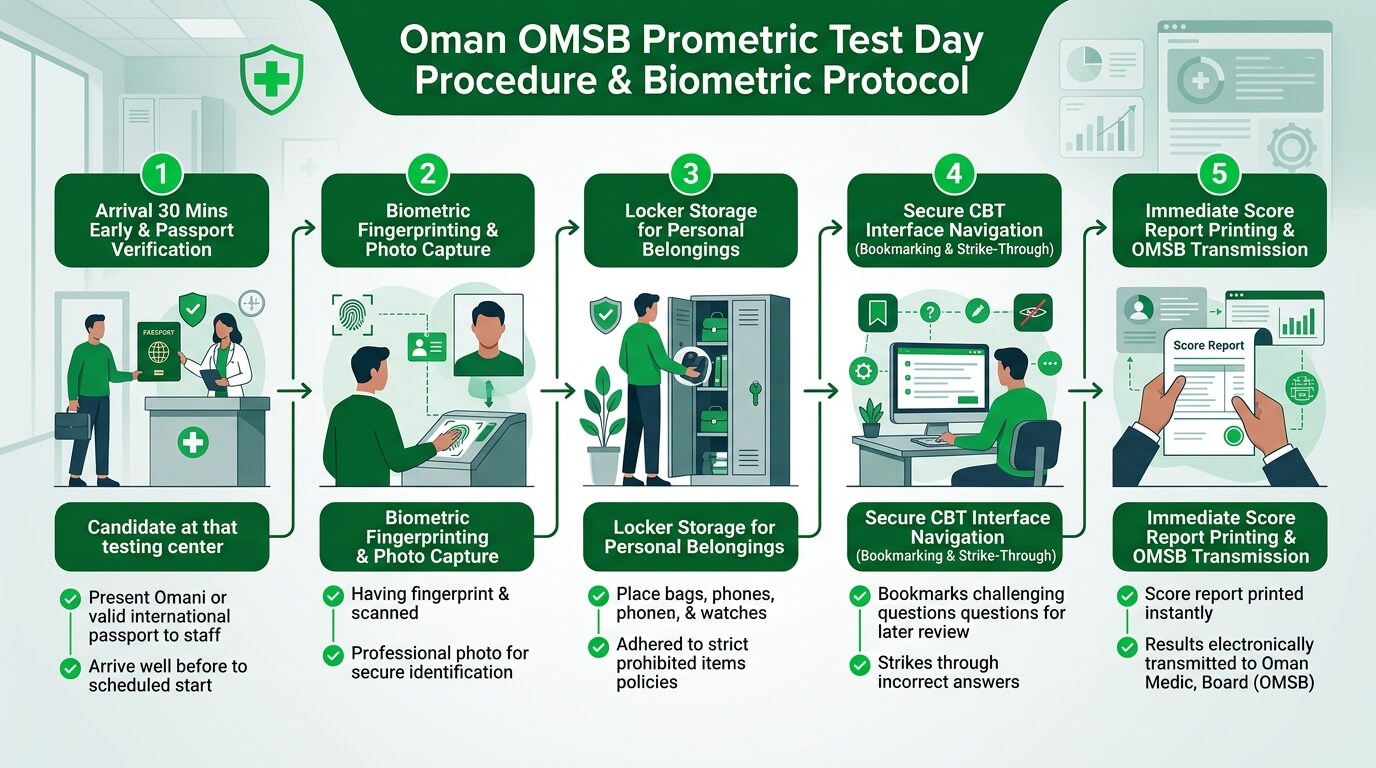
Candidates are required to report to the Prometric testing facility at least thirty (30) minutes prior to their scheduled appointment time. Arriving late may result in immediate forfeiture of the testing seat without refund or retake accommodations.
Upon arrival, candidates undergo a structured security check-in procedure. The test center administrator inspects the candidate original international passport to verify name matching, date of birth, and identity photo. Candidates then complete digital biometric authentication, including electronic fingerprint scanning and a digital facial photograph that appears on the candidate final score report. All personal belongings, including mobile phones, smartwatches, wallets, bags, study notes, and personal stationery, must be secured in designated lockers. Candidates are scanned with a handheld metal detector before entering the secure testing room.
Navigating the CBT Interface: Bookmarking, Scrolling and Strike-Through Features
The Prometric computer-based testing interface is designed for intuitive navigation, offering several built-in tools that assist candidates with pacing and review:
Item Bookmarking: Candidates can flag questions for subsequent review by clicking the Bookmark icon. A comprehensive review screen allows candidates to see at a glance which questions have been answered, which remain incomplete, and which have been bookmarked.
Strike-Through Functionality: By right-clicking on an answer option, candidates can visually eliminate implausible distractors, making it easier to focus on remaining plausible choices.
Highlighter Tool: Candidates can highlight critical clinical findings, vital signs, or laboratory abnormalities within lengthy vignette stems to maintain focus during complex question analysis.
Digital Countdown Timer: An on-screen digital clock continuously displays the remaining examination time, helping candidates maintain an optimal pace throughout the test.
Post-Examination Score Report Generation and Electronic Verification
Upon completing all questions or when the examination timer expires, the computer displays a brief optional end-of-test survey. Once the survey is completed, the candidate exits the testing room, and the test center administrator generates the official printed Prometric Score Report.
The score report clearly states the candidate name, test date, specialty examination title, scaled score, and an unambiguous PASS or FAIL result indicator. In addition to the physical paper score report, the official result is transmitted electronically to the OMSB database within 48 to 72 hours, enabling the candidate to proceed with subsequent licensing and verification milestones.
| Test Day Phase | Required Action & Protocols | Operational Guidance | Key Success Tip |
|---|---|---|---|
| Arrival & Staging | Arrive 30 minutes before appointment time | Locate testing center and parking the day prior | Avoid last-minute traffic stress; report calm and hydrated |
| Security Check-In | Present original unexpired international passport | Complete biometric finger scan & facial photo | Ensure name matches passport character-for-character |
| Locker Storage | Store all electronic devices, watches, and bags | Zero personal items permitted in testing room | Carry only your passport and locker key into test room |
| Interface Navigation | Use bookmarking, strike-through, and highlighting | Keep pace: ~60 to 72 seconds per MCQ | Answer every question; no negative marking is applied |
| Exam Completion | Submit examination and complete exit survey | Collect signed official Prometric score printout | Retain the score report safely for MOH licensing submission |
8. Why Choose Overseas Healthcare Consultant for OMSB Prometric Success
Securing healthcare licensure in the Sultanate of Oman is a life-changing professional journey that demands precision, regulatory mastery, and dedicated support. For over twelve years, Overseas Healthcare Consultant (OHC) has served as the premier healthcare licensing consultancy, guiding thousands of doctors, nurses, pharmacists, and allied health professionals through the complexities of Gulf licensing boards.
Twelve-Plus Years of Dedicated GCC Examination and Licensing Expertise
OHC brings unmatched institutional knowledge spanning all major Gulf health authorities, including OMSB and MOH Oman, DHA Dubai, DoH Abu Dhabi, MOH UAE, SCFHS Saudi Arabia, QCHP Qatar, and NHRA Bahrain. Our veteran regulatory advisors understand the nuanced credential requirements, qualification equivalencies, and administrative processes of each regulatory body.
Every applicant working with OHC is assigned a dedicated case officer who conducts an exhaustive pre-submission document audit, identifies potential credential gaps before submission, coordinates eligibility clearance with OMSB, schedules Prometric testing appointments, and provides ongoing regulatory guidance until practice licensure is achieved. Our meticulous approach ensures a zero-defect application record and protects candidates from costly mistakes and procedural delays.
Live Interactive Clinical Coaching Exclusively for Nurses and Pharmacists
In strict adherence to clinical standards, OHC maintains clear educational integrity: our intensive clinical coaching programs are delivered exclusively for Registered Nurses and Pharmacists. These programs are designed and taught by senior clinical nursing educators and clinical pharmacy faculties with extensive Gulf experience.
The coaching curriculum features live interactive virtual lectures, high-yield clinical scenario discussions, extensive question bank walkthroughs, and timed computer-based mock examinations that mirror the exact Prometric testing environment. For physicians, dentists, and allied health professionals, OHC provides structured blueprint orientations, comprehensive syllabus materials, practice question frameworks, and booking management support.
Complete Regulatory Management from Eligibility Audit to License Issuance
Achieving licensure in Oman requires synchronizing multiple independent regulatory processes: OMSB credential evaluation, DataFlow Primary Source Verification, Prometric examination booking, and Ministry of Health practice licensing. Managing these milestones independently can be overwhelming and prone to administrative complications.
OHC delivers a complete, seamless end-to-end service. We manage DataFlow verification, track report progress, handle TrueProfile cross-GCC transfers where applicable, coordinate Prometric scheduling, and prepare candidates for MOH viva assessments and institutional placement. By entrusting your Omani licensing journey to OHC, you gain a dedicated partner committed to your professional success in the Sultanate.
| Service Dimension | Independent Candidate Journey | Overseas Healthcare Consultant Partnership |
|---|---|---|
| Credential & Eligibility Audit | High risk of submitting ineligible degrees or experience gaps | Pre-submission audit ensures 100% PQR compliance before filing |
| Prometric Booking Management | Navigating scheduling portals alone; risk of name discrepancies | Precision booking coordination, center selection, and confirmation audit |
| Clinical Coaching Quality | Generic, unverified question banks with questionable answer keys | Live interactive clinical coaching exclusively for nurses and pharmacists |
| DataFlow & TrueProfile Synergy | Risk of duplicate verification and missed GCC transfer pathways | Seamless synchronization of PSV reports and TrueProfile portability |
| Regulatory Case Management | Unassisted troubleshooting when encountering administrative delays | Dedicated personal case officer offering continuous guidance via WhatsApp and phone |
| Track Record & Trust | Uncertain outcomes and vulnerability to regulatory changes | 12+ years of GCC medical council excellence and thousands of verified successes |
Verified Candidate Experiences & Examination Clearance
Read how healthcare professionals cleared their Oman OMSB Prometric examinations with OHC’s dedicated guidance.
“The live coaching for the OMSB Nursing exam was incredible. The clinical scenario questions and mock tests reflected the exact exam interface. I cleared on my first attempt with 78%!”
“OHC handled my OMSB profile, eligibility generation, and Prometric booking in Mumbai smoothly. Their clinical pharmacy mock sessions were spot on. Highly recommended for pharmacists!”
“As a General Practitioner, I appreciated the precise blueprint breakdown and high-yield study resources provided by OHC. Their guidance saved me months of confusion.”
“I ported my Saudi DataFlow report through TrueProfile and scheduled my OMSB Prometric test with OHC. Everything was synchronized perfectly without a single day lost.”
“Outstanding service! They audited my postgraduate specialist qualifications, verified my exam exemption criteria, and coordinated with OMSB directly. True GCC healthcare experts.”
9. Frequently Asked Questions About the OMSB Prometric Examination
Clear, authoritative answers to the most common questions healthcare practitioners ask about the Oman OMSB Prometric examination.
Begin Your Oman Healthcare Career with Confidence
Ensure your credentials, Prometric exam scheduling, and DataFlow verification align perfectly with OMSB and MOH Oman standards. Speak with an OHC licensing advisor today.