


Qatar QCHP / DHP DataFlow Verification: Complete Primary Source Verification (PSV) Guide, Document Requirements & Status Tracking
Secure your verified Primary Source Verification (PSV) report for the Ministry of Public Health (MOPH) Department of Healthcare Professions (DHP) with total accuracy. Overseas Healthcare Consultant delivers forensic document pre-auditing, Letter of Authorization (LOA) validation, global institutional liaison, and seamless TrueProfile cross-GCC report transfers for Doctors, Nurses, Pharmacists, and Allied Health specialists.
Forensic Pre-Submission Audit: Strict 300 DPI multi-point inspection of educational degrees, council licenses, and clinical experience letters before upload.
Direct Registrar Liaison: Active regional case officers coordinating directly with overseas university registrars and hospital administrations to eliminate delays.
TrueProfile Cross-GCC Portability: Rapid electronic transfer of positive DataFlow reports from DHA, DoH/HAAD, SCFHS, or OMSB directly to Qatar DHP.
Dispute & Appeal Resolution: Expert legal-grade remediation for ‘Unable to Verify’ holds or negative discrepancy findings to protect licensing eligibility.
Apply for DataFlow PSV
Speak with our senior verification officers for an immediate credential evaluation.
1. Understanding Qatar Healthcare PSV: The Statutory Role of MOPH DHP and DataFlow Group
The State of Qatar maintains one of the most rigorous, highly regulated healthcare ecosystems in the world. Guided by the overarching public health directives of the Qatar National Vision 2030, the nation has established world-class clinical institutions, including Hamad Medical Corporation (HMC), Primary Health Care Corporation (PHCC), Sidra Medicine, and an elite network of private medical centers and specialized clinics across Doha, Al Rayyan, Al Wakrah, and Lusail. To safeguard patient safety and ensure that every foreign-trained healthcare professional meets the highest standards of clinical integrity, the sovereign authorities enforce mandatory Primary Source Verification (PSV) prior to the issuance of any professional license.
Historically administered under the Qatar Council for Healthcare Practitioners (QCHP), sovereign regulatory governance over professional licensing and credential validation is formally vested in the Ministry of Public Health (MOPH) Department of Healthcare Professions (DHP). Through an exclusive sovereign partnership with the DataFlow Group – the leading international specialized verification provider – the State of Qatar requires all foreign medical doctors, registered nurses, clinical pharmacists, dentists, and allied health professionals to submit their educational qualifications, professional council registrations, and clinical employment certificates to exhaustive primary source investigation. Obtaining a positive DataFlow PSV report is a mandatory statutory milestone required to acquire an official DHP Evaluation Letter and practice medicine within Qatar.
Statutory Governance of MOPH Department of Healthcare Professions (DHP)
The Department of Healthcare Professions (DHP) within the Ministry of Public Health serves as the singular statutory body responsible for setting healthcare practitioner standards, defining professional qualification requirements (PQR), issuing practice licenses, and monitoring professional discipline across the State of Qatar. The DHP Registration and Licensing Committee mandates that foreign credentials cannot be accepted based merely on notarized photocopies, apostilles, or consular attestations. Instead, every credential must be independently validated directly with the original issuing body.
Through this strict regulatory mandate, MOPH DHP ensures that fraudulent degrees, forged council registrations, altered clinical experience letters, or unaccredited institutional certificates are identified and eliminated before an applicant enters the clinical workforce. DataFlow operates as the specialized forensic investigative arm of MOPH DHP, contacting registrars, human resources directors, and medical boards worldwide to verify credentials at their root origin. Navigating this process requires meticulous preparation and complete procedural transparency.
Why Primary Source Verification (PSV) is Mandatory for Sovereign Licensing
Primary Source Verification (PSV) represents the gold standard in international healthcare credentialing. Unlike conventional verification methods that rely on secondary documentation or diplomatic stamps, PSV involves direct communication between DataFlow investigators and the authorized records custodians at the university, regulatory council, or clinical facility where the credential was originally conferred.
In Qatar, PSV is mandatory because patient outcomes depend directly on the genuine competence, authenticated clinical experience, and ethical standing of the healthcare workforce. A single unverified document or unvalidated employment gap introduces severe clinical risks. Consequently, MOPH DHP will not proceed with an application for licensure, Prometric exam result linkage, or Evaluation Letter issuance until the DataFlow Group concludes its forensic investigation and transmits a verified, positive PSV report directly into the sovereign DHP licensing database.
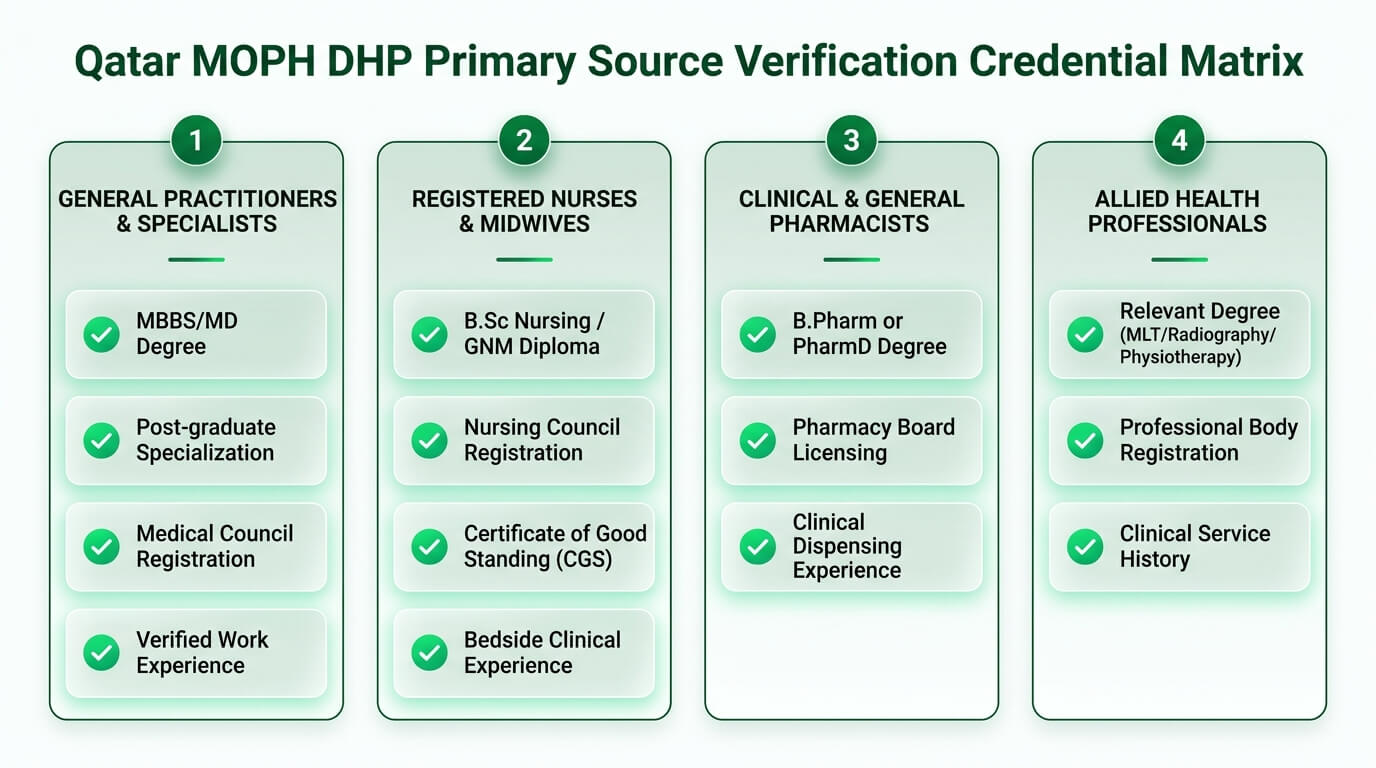
| Clinical Practitioner Category | Mandatory Verified Credentials | Primary Source Verification Channel | Regulatory Impact on DHP Licensing |
|---|---|---|---|
| General Practitioners & Medical Specialists | Basic Medical Degree (MBBS/MD), Postgraduate Specialization, Home Medical Council Registration, Clinical Experience Letters | Direct institutional contact with university registrars, national medical councils, and hospital administrations | Mandatory prerequisite for DHP eligibility review, Evaluation Letter issuance, and clinical practice privileges |
| Registered Nurses & Specialized Midwives | Nursing Degree (B.Sc) or Diploma (GNM), Professional Nursing Council Registration, Recent Clinical Bedside Experience Certificates | Verification with university examination boards, state nursing councils, and hospital nursing directorates | Essential milestone for DHP licensing approval, hospital onboarding across HMC and private healthcare networks |
| Clinical & General Pharmacists | Pharmacy Degree (B.Pharm, M.Pharm, PharmD), Pharmacy Council Registration, Retail/Hospital Pharmacy Clinical Experience | Direct registrar outreach at pharmacy colleges, state pharmacy boards, and licensed healthcare organizations | Required for professional registration, pharmaceutical dispensing authorization, and hospital clinical pharmacy roles |
| General Dentists & Dental Specialists | Dental Degree (BDS), Master Specialization (MDS), Dental Council Registration, Clinical Practice Records | Independent verification with dental university registrars, national dental syndicates, and clinical healthcare centers | Mandatory statutory clearance for DHP dental license activation, oral surgery privileges, and private clinic operations |
| Allied Healthcare Professionals | Discipline Degree/Diploma (Medical Laboratory, Radiography, Physiotherapy), Professional Council Registration, Clinical Service Records | Registrar communication with paramedical institutes, professional boards, and hospital diagnostic departments | Prerequisite for clinical technologist credentialing, diagnostic practice rights, and institutional healthcare placement |
2. Mandatory Verification Scope: Educational Degrees, Health Licenses and Employment Credentials
The scope of Primary Source Verification enforced by MOPH DHP is thorough and non-negotiable. Applicants must present a complete portfolio encompassing their foundational education, postgraduate qualifications, regulatory licenses, and clinical practice history. Understanding the specific evidentiary criteria for each credential category prevents avoidable submission errors and minimizes verification turnaround times.
Academic Degree and Post-Graduate Diploma Verification Protocols
For all healthcare professions, the foundational academic degree is the primary credential subjected to DataFlow verification. For physicians, this includes the Bachelor of Medicine and Bachelor of Surgery (MBBS) or Doctor of Medicine (MD); for nurses, the Bachelor of Science in Nursing (B.Sc) or General Nursing and Midwifery (GNM) diploma; for pharmacists, the Bachelor of Pharmacy (B.Pharm) or Doctor of Pharmacy (PharmD); and for allied health staff, the respective technical degree or diploma.
DataFlow investigators verify that the degree was awarded by a legitimate, accredited university recognized by the national education authority and healthcare regulatory body in the country of origin. The investigation validates the applicant’s full legal name, enrollment date, graduation date, student registration number, degree title, major discipline, and language of instruction. If an applicant claims specialist standing, all postgraduate degrees, master programs, clinical diplomas, and specialist board certifications must undergo separate, concurrent primary source verification.
Health Professional Regulatory Council Registration and Good Standing Attestation
In addition to academic qualifications, healthcare practice in Qatar requires verification of active professional standing. Applicants must submit their primary professional registration or license issued by the statutory medical, nursing, dental, or pharmacy council in their home jurisdiction and any jurisdiction where they have practiced within the past five years.
DataFlow liaises directly with the registrar of the issuing professional board to confirm that the license was granted through legitimate examination or statutory registration, remains in good standing, has never been suspended or revoked, and is free of ethical, criminal, or professional misconduct investigations. Furthermore, MOPH DHP requires a Certificate of Good Standing (CGS) issued within the previous six months, confirming that the practitioner is authorized to practice without clinical restrictions.
Clinical Employment Experience Records and Institutional Verification Rules
Clinical employment verification is frequently the most challenging component of the DataFlow process. MOPH DHP enforces strict clinical currency rules: applicants must demonstrate continuous, recent clinical experience within their designated specialty. Career breaks or unverified clinical gaps exceeding two consecutive years may disqualify an applicant from direct licensure or mandate refresher training.
Experience certificates submitted for DataFlow PSV must be printed on official hospital or clinical facility letterhead, bearing the full organizational address, corporate telephone number, official institutional email address (domain-based, not generic webmail), and the signature and stamp of the Medical Director, Head of Human Resources, or Chief Nursing Officer. DataFlow contacts the human resources administration or clinical directorate to verify the exact job title, employment start date, completion date, clinical scope of practice, full-time versus part-time status, and ethical conduct during tenure.
| Credential Category | Required Documentation | Forensic Data Verified by DataFlow | Common Verification Bottlenecks |
|---|---|---|---|
| Basic Healthcare Degree | Final Degree Certificate, Consolidated Academic Transcript, University Roll Number | Institutional accreditation, degree legitimacy, graduation date, enrollment authenticity, and student identification numbers | University archival delays, seasonal registrar closures, institutional verification protocols requiring physical visits |
| Postgraduate Specialization | Postgraduate Degree Certificate, Board Fellowship, Residency Completion Certificate | Accreditation of training hospital, residency duration, specialty classification, and genuine clinical completion | Decentralized residency records, hospital mergers, foreign specialty board response delays |
| Professional Council License | Valid Practice License, Professional Registration Certificate, Council Identity Card | Statutory council authority, registration number, issue and expiry dates, unencumbered license status | State medical council bureaucratic backlogs, offline manual ledger records, council verification protocols |
| Certificate of Good Standing | Recent CGS issued within 6 months by home medical/nursing/pharmacy licensing board | Confirmation of zero disciplinary actions, absence of clinical malpractice sanctions, active practice eligibility | Delays in council CGS issuance, postal tracking delays, expiration of 6-month validity window during processing |
| Clinical Experience Letters | Official Service Certificate, Relieving Letter, Detailed Clinical Experience Breakdown | Exact job designation, clinical employment dates, full-time bed-side clinical hours, moral and professional conduct | Hospital administration turnover, closed medical centers, generic email addresses rejected by verification guidelines |
3. Document Submission Standards, Letter of Authorization (LOA) and Intake Criteria
A major cause of prolonged DataFlow processing delays and file rejections is poor document intake quality. DataFlow investigators and overseas institutional registrars require clean, unadulterated, forensic-grade digital scans to authenticate records against historical archives. Adhering to exacting submission criteria from day one protects applicants from avoidable administrative holds.
Technical Scanning Criteria and Certified Legal Translation Protocols
All documents uploaded to the Qatar DataFlow portal must be original documents scanned directly in full color at a minimum resolution of 300 DPI (dots per inch). Photocopies, black-and-white scans, camera photographs taken from mobile phones with perspective distortion, cropped margins, or documents with reflections and glare will be rejected during preliminary intake screening.
Furthermore, all certificates issued in languages other than English or Arabic must be accompanied by an official, certified legal translation. The translation must be executed by a sworn, accredited legal translator, bearing the translator’s official stamp, signature, and formal declaration of accuracy. Both the original non-English document and the certified translation must be uploaded together as a single consolidated digital file.
The MOPH DHP Letter of Authorization (LOA): Execution and Forensic Validation
The Letter of Authorization (LOA) is a legally binding instrument that empowers the DataFlow Group to act on the applicant’s behalf in requesting confidential academic, regulatory, and employment records from international issuing authorities. Without a properly executed LOA, universities and hospitals are legally prohibited under privacy and data protection legislation (such as GDPR and national privacy laws) from releasing records.
Applicants must generate, print, and sign the official MOPH DHP Letter of Authorization. The signature on the LOA must match the signature in the applicant’s international passport exactly. Digital signatures, typed names, font-based signatures, or unsigned forms will result in immediate file rejection. Additionally, the LOA must be signed within the current date window to confirm active legal consent.
Comprehensive Pre-Submission Document Verification Checklist
| Document Dossier Item | Mandatory Technical Specification | Forensic Quality Criteria | Action to Take if Discrepancy Found |
|---|---|---|---|
| International Passport | Full color scan of bio-data and address pages (minimum 6 months remaining validity) | All four corners visible; clear machine-readable zone (MRZ); unblurred passport photograph | Renew passport if remaining validity is under 6 months; update names on certificates via legal affidavit if altered |
| Foundational Degree Certificate | Color scan of original final certificate issued by accredited university | Official university seal, Chancellor/Registrar signatures, embossed stamps fully discernible | Obtain duplicate degree certificate from university if original is damaged or illegible |
| Consolidated Academic Transcript | Complete mark sheets or semester-wise transcripts detailing all courses and clinical hours | Institutional grading legend, credit breakdown, total clinical hours clearly documented | Request official consolidated transcript from college registrar before submission |
| Home Regulatory License | Active, unencumbered professional registration card or certificate | Registration number, category of practice, issue date, and validity dates clearly visible | Renew expired licenses immediately; obtain provisional certificate if full registration is undergoing renewal |
| Certificate of Good Standing (CGS) | Official CGS issued by medical, nursing, dental, or pharmacy council within 6 months | Addressed to MOPH Qatar or general licensing authority; confirms zero disciplinary sanctions | Apply for fresh CGS if existing certificate exceeds 5 months to ensure validity through processing window |
| Clinical Experience Certificates | Official letters on hospital letterhead covering mandatory experience periods | Contains hospital address, official landline, corporate domain email, authorized clinical signatory | Request updated experience letter from hospital HR specifying exact clinical duties and dates if generic |
| Signed Letter of Authorization (LOA) | Printed, physically wet-signed copy of official MOPH DHP authorization form | Signature matches international passport bio-data page precisely; clear date of signing | Re-sign document with physical pen and re-scan at 300 DPI if rejected for electronic signature |
4. Step-by-Step Qatar DataFlow Application Workflow and Case Management
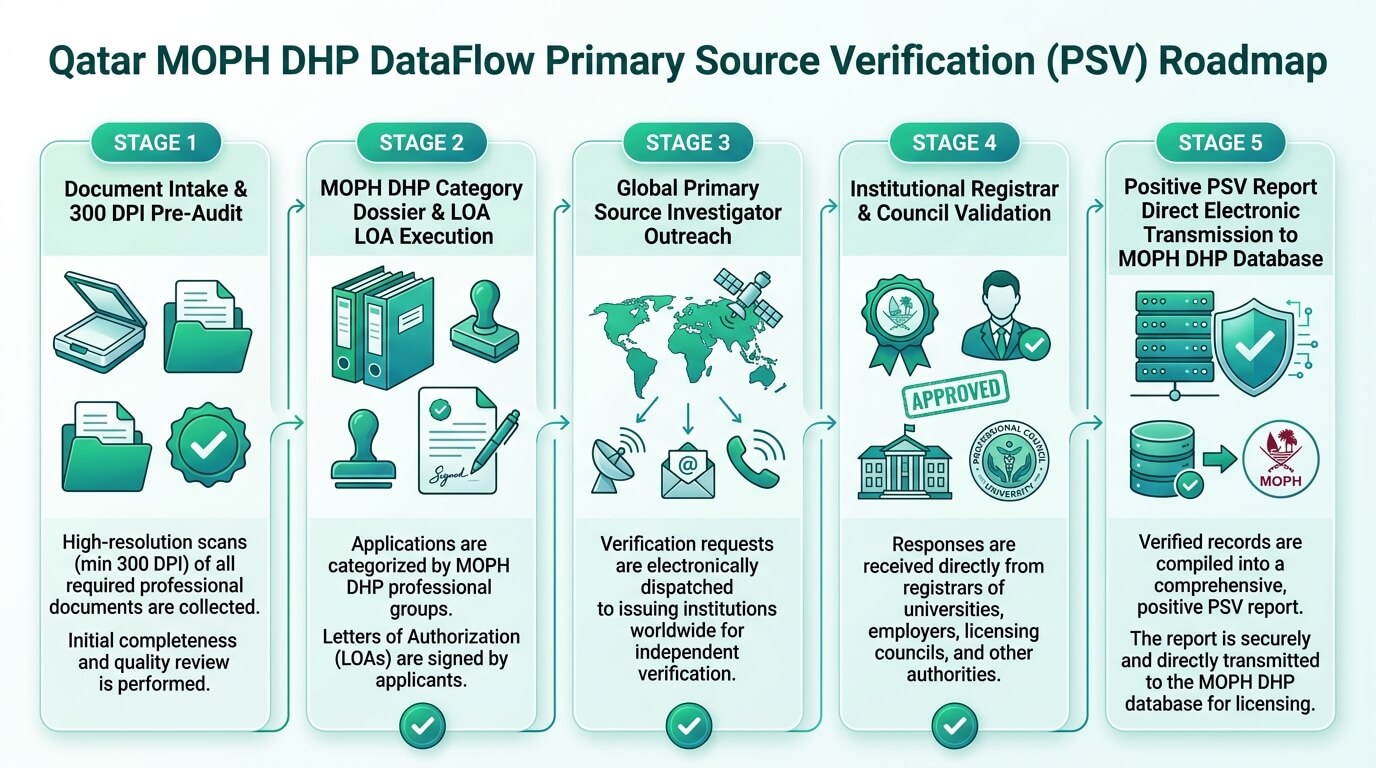
Navigating the Qatar DataFlow verification process involves an orderly sequence of procedural stages. Understanding each milestone enables candidates to track their application proactively, anticipate institutional requirements, and respond promptly to investigator inquiries.
Dossier Setup & Account Registration
Creation of official applicant account on the Qatar DataFlow portal. Selection of MOPH Department of Healthcare Professions as the regulatory target.
Document Upload & LOA Execution
Uploading original 300 DPI color scans of degrees, council licenses, experience certificates, and passport. Uploading the physically signed MOPH LOA.
Forensic Intake Screening
DataFlow compliance officers audit scan resolutions, verify document completeness, and confirm passport signature alignment on the Letter of Authorization.
Primary Source Investigator Outreach
Verification requests are dispatched to university examination controllers, state medical councils, and clinical facilities worldwide.
Report Issuance & DHP Synchronization
Responses are compiled into a comprehensive PSV report, transmitted electronically directly to the sovereign MOPH DHP licensing database.
Decoding Case Statuses: From ‘Under Verification’ to ‘Report Issued’
Throughout the verification journey, candidates can monitor their case status using their unique DataFlow Case Reference Number and barcode. Interpreting status updates accurately reduces anxiety and highlights when intervention is required.
| DataFlow Portal Status | Operational Meaning | Underlying Investigative Action | Recommended Candidate Action |
|---|---|---|---|
| Application Submitted | Dossier uploaded and recorded in the system | Awaiting initial intake screening by DataFlow compliance specialists | Confirm that confirmation email has been received; record Case Reference Number |
| Under Intake Review | Compliance officers auditing document quality and completeness | Verifying scan resolution, document completeness, and Letter of Authorization signature | Monitor email for any Insufficiency notifications; respond within 48 hours if notified |
| Under Verification | Active primary source outreach initiated with issuing bodies | Official verification requests transmitted to universities, councils, and hospitals worldwide | Notify alma mater and past clinical employers that official DataFlow inquiry has been dispatched |
| Additional Info Required | An issuing authority or DataFlow officer requested clarification | Issuing body requires student roll number, maiden name, verification clearance receipt, or additional proof | Log in immediately; upload requested clarification or receipt to prevent administrative hold |
| Verification In Progress | One or more components successfully verified; remaining pending | Partial institutional confirmations received; follow-ups underway with slower responding institutions | Allow investigator to conclude remaining checks; contact OHC if a specific institution stalls |
| Report Completed / Issued | Investigation finalized; comprehensive PSV report compiled | DataFlow generates final report and transmits electronic copy directly to MOPH DHP database | Download applicant copy of report; verify all components are marked ‘Positive’; proceed to DHP licensing |
5. Cross-GCC Verification Portability: Transferring Reports via TrueProfile.io
A significant advantage for experienced healthcare professionals who have previously practiced in other Gulf Cooperation Council (GCC) countries is credential portability. Practitioners who hold an existing positive DataFlow report verified under another regulatory authority do not need to repeat the time-consuming and redundant verification process from the beginning.
Portability Protocols from DHA, HAAD / DoH, SCFHS and OMSB to Qatar MOPH
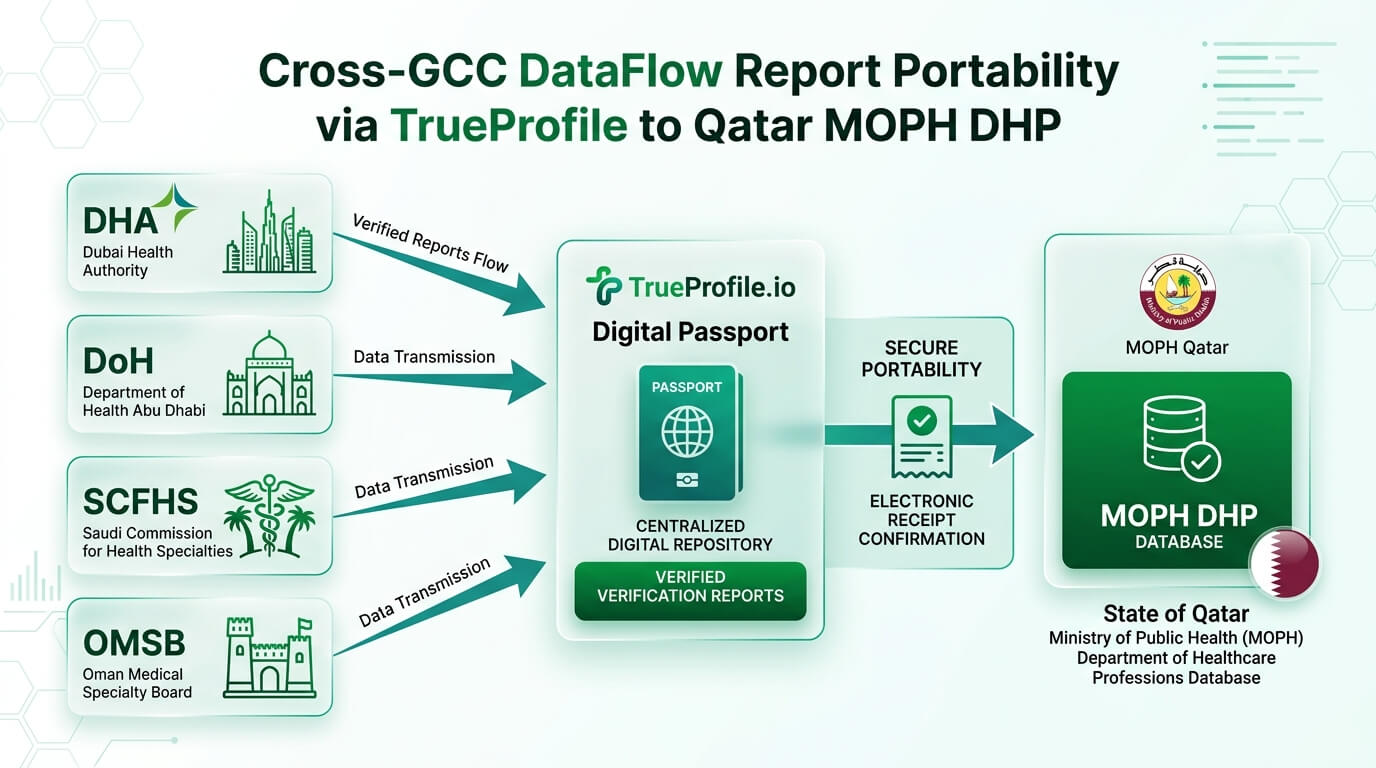
Under international healthcare credentialing agreements, Primary Source Verification reports conducted by the DataFlow Group for the Dubai Health Authority (DHA), Department of Health Abu Dhabi (DoH / HAAD), Ministry of Health and Prevention UAE (MOH), Saudi Commission for Health Specialties (SCFHS), or Oman Medical Specialty Board (OMSB) can be ported directly to the Ministry of Public Health (MOPH) Department of Healthcare Professions in Qatar.
Report portability is managed through TrueProfile.io, the digital identity and credential passport platform powered by the DataFlow Group. When an existing report is transferred, the primary source verification data for validated degrees, historical licenses, and past employment are carried over automatically. The applicant only needs to submit any new qualifications, updated licenses, or recent clinical experience acquired since the original report was issued.
Step-by-Step Report Porting and Electronic Receipt Linkage
To initiate a report transfer, the applicant accesses their TrueProfile account using the email address linked to their previous DataFlow verification. The applicant selects the existing verified credentials, chooses ‘Transfer Report to Ministry of Public Health (MOPH) Qatar’, and authorizes the data transmission. TrueProfile generates a fresh transfer confirmation receipt and transmits the electronic verification record directly into the Qatar DHP licensing system.
| Originating GCC Regulatory Authority | Portability Mechanism to Qatar DHP | Verified Credentials Eligible for Transfer | Additional Requirements for Qatar Licensure |
|---|---|---|---|
| Dubai Health Authority (DHA) | TrueProfile.io Direct Report Transfer | Basic Medical/Nursing/Pharmacy Degree, Postgraduate Diplomas, Historical DHA Experience | Submit current Certificate of Good Standing; verify any clinical experience gained after DHA report date |
| Department of Health Abu Dhabi (HAAD / DoH) | TrueProfile.io Direct Report Transfer | All academic degrees, initial council registrations, UAE hospital clinical service records | Provide recent CGS; verify subsequent employment; ensure LOA is signed for Qatar DHP jurisdiction |
| Ministry of Health UAE (MOH / EHS) | TrueProfile.io Direct Report Transfer | Undergraduate and postgraduate degrees, UAE medical practice credentials | Update clinical experience dossier; submit valid Good Standing; link transfer receipt to DHP file |
| Saudi Commission for Health Specialties (SCFHS) | TrueProfile.io Cross-GCC Report Porting | Foundational academic degrees, Mudarib/Specialist certificates, Saudi hospital service | Transfer positive PSV report; verify post-Saudi clinical employment; submit home council CGS |
| Oman Medical Specialty Board (OMSB) | TrueProfile.io Cross-GCC Report Porting | Degrees, specialty qualifications, Sultanate of Oman hospital clinical records | Verify recent clinical practice currency; provide updated Certificate of Good Standing to MOPH DHP |
6. Verification Timelines, Turnaround Milestones and Fast Track Express Service
Predicting and managing verification turnaround times is crucial for candidates coordinating international relocation, employment contract start dates, and hospital credentialing deadlines in Qatar. Processing durations are primarily dictated by the responsiveness of overseas issuing authorities.
Standard Operational Timelines vs Expedited Fast-Track Processing
Under standard processing, the typical turnaround time for a complete Qatar DataFlow verification ranges between 25 and 35 working days from the date all documents are validated during intake. The timeline depends heavily on the geographic location of the issuing institutions and their administrative procedures.
For healthcare professionals with urgent hospital deployment schedules, emergency recruitment mandates, or impending contract deadlines with Hamad Medical Corporation or private healthcare operators, DataFlow offers an expedited Fast Track / Express verification service. Fast Track cases receive prioritized investigator assignment, daily direct outreach protocols, and dedicated escalation channels, typically compressing the turnaround time to 10 to 15 working days, provided the issuing institution responds promptly.
Mitigating Verification Bottlenecks with Overseas Issuing Authorities
The most frequent source of delay occurs not within DataFlow itself, but at the overseas institution. Academic registrar backlogs, university summer vacations, state medical council manual record searches, and hospital administrative turnover can stall a file indefinitely. Proactive applicants or their credentialing consultants mitigate these delays by notifying the registrar in advance, providing direct departmental contact numbers, and confirming whether the institution requires an internal verification clearance protocol.
| Verification Milestone | Standard Turnaround Window | Fast-Track Turnaround Window | Primary Determinants of Processing Speed |
|---|---|---|---|
| Intake Screening & Document Completeness Check | 2 to 4 Working Days | 1 Working Day | Quality of scans, 300 DPI compliance, precision of passport signature matching on LOA |
| Outreach & Dispatch to Issuing Bodies | 3 to 5 Working Days | 1 to 2 Working Days | Availability of verified corporate email addresses and registrar contact details in DataFlow database |
| Institutional Response & Primary Source Validation | 15 to 25 Working Days | 7 to 10 Working Days | Operational efficiency of foreign university registrar, council archives, hospital HR responsiveness |
| Forensic Review & Report Compilation | 3 to 5 Working Days | 1 to 2 Working Days | Consistency of returned data, absence of discrepancies, final supervisory quality audit |
| Electronic Transmission to MOPH DHP Database | 1 Working Day | Same-Day Transmission | Automated system synchronization between DataFlow servers and sovereign DHP licensing portal |
7. Managing Discrepancies, ‘Unable to Verify’ Statuses and Formal Appeals in Qatar
Receiving a negative DataFlow report or an ‘Unable to Verify’ notification is the most critical obstacle a healthcare professional can encounter. Such an outcome halts the MOPH DHP licensing process and can result in severe professional repercussions, including permanent blacklisting across Gulf health authorities. Understanding how discrepancies arise and how to resolve them systematically is essential.
Forensic Analysis of Common Discrepancy Triggers and Institutional Non-Response
A ‘Discrepancy’ report is issued when an issuing authority explicitly states that a document is counterfeit, altered, forged, or inconsistent with institutional records. Common discrepancy triggers include discrepancies in graduation dates, unrecorded degree roll numbers, altered job titles on experience certificates, or experience letters issued by unauthorized clinical personnel.
An ‘Unable to Verify’ status, by contrast, is issued when the issuing institution fails to respond to multiple official DataFlow inquiries over a statutory period (typically three consecutive outreach attempts over 20 to 30 days), or when an institution has permanently closed, suffered catastrophic archival destruction, or lacks archived records. While not inherently punitive, an ‘Unable to Verify’ result prevents DHP licensing until alternative evidence is validated.
Formal Dispute Submission and Re-Verification Protocols
When an adverse finding or administrative non-response occurs, applicants have the legal right to submit a formal dispute within a defined window. The dispute process requires submitting substantive, objective corroborating evidence, such as government health directorate verifications, tax records, pension contribution statements, university syndicate confirmations, or notarized affidavits from surviving institutional trustees. OHC assists candidates in orchestrating formal dispute dossiers, re-opening stalled investigations, and converting adverse findings into verified DHP approvals.
| Adverse Case Outcome | Root Cause Analysis | Impact on Qatar Licensure | Structured Remediation & Appeal Protocol |
|---|---|---|---|
| ‘Unable to Verify’ – Academic Degree | University registrar failed to respond to emails; physical campus closed for seasonal break; student records unarchived | DHP eligibility application placed on hold; Evaluation Letter cannot be issued | Submit physical registrar confirmation; present sealed transcript; request physical in-person verification visit |
| ‘Unable to Verify’ – Clinical Experience | Hospital closed permanently; management changed; HR records destroyed; institutional email non-functional | Clinical currency requirement unsatisfied; professional practice experience excluded from seniority calculation | Submit government health authority registration of hospital; provide tax records, provident fund slips, and clinical colleague affidavits |
| ‘Discrepancy’ – Name or Date Mismatch | Clerical typographical error in college ledger; name change after marriage without supporting marriage certificate | Severe risk of application rejection; potential allegation of submitting altered credentials | Obtain official university gazette notification, registrar correction letter, and legal sworn court affidavit of identity |
| ‘Discrepancy’ – Job Title Inconsistency | Experience letter stated ‘Clinical Specialist’ while hospital HR payroll recorded ‘Resident Medical Officer’ | Rejection of specialist classification; referral to DHP ethics committee for review | Submit formal institutional rectification letter signed by Chief Medical Officer explaining clinical role progression |
8. Why Partner with Overseas Healthcare Consultant for Qatar DataFlow Success
Primary Source Verification for the State of Qatar is an intricate forensic process where a minor clerical error or poor scan can derail career aspirations for months. Overseas Healthcare Consultant (OHC) serves as your dedicated, authoritative credentialing partner, bringing over 12 years of specialized GCC regulatory mastery to manage every aspect of your Qatar DataFlow journey.
Forensic Pre-Submission Audit
Comprehensive 300 DPI multi-point inspection of educational degrees, council licenses, and clinical experience letters before upload.
Dedicated Verification Officers
Assigned licensing specialists overseeing your MOPH DHP application file, monitoring institutional PSV, and securing timely clearances.
Active Institutional Liaison
Direct regional liaison teams contacting universities, regulatory boards, and clinical facilities worldwide to bypass bureaucratic holds.
TrueProfile Cross-GCC Porting
Rapid electronic transfer and synchronization of positive DataFlow reports from DHA, DoH/HAAD, SCFHS, or OMSB directly to Qatar DHP.
Twelve-Plus Years of Regulatory Mastery: Dedicated Case Officers and Zero-Defect Record
Every applicant partnering with OHC is assigned a dedicated Credential Verification Case Officer who conducts a comprehensive, forensic pre-submission audit of every document before upload. We inspect scan resolutions, verify university accreditation standing, validate professional council registries, audit hospital experience letter wording against MOPH DHP criteria, and ensure that the Letter of Authorization is flawlessly executed. This meticulous pre-check eliminates the root causes of administrative rejection, achieving a near-zero defect submission record.
Beyond simple document filing, OHC provides proactive, end-to-end case management. When an overseas university registrar, medical council, or clinical facility delays response, our regional liaison teams intervene directly. We maintain structured communication channels with administrative bodies across South Asia, the Middle East, Southeast Asia, and Africa, facilitating rapid institutional responses and resolving bottlenecks before they escalate into administrative holds.
Furthermore, if you hold an existing DataFlow report from Dubai, Abu Dhabi, Saudi Arabia, or Oman, our specialists orchestrate your TrueProfile cross-GCC report transfer, ensuring rapid synchronization with the Qatar MOPH database without redundant effort. With OHC, your Qatar healthcare career transition is managed with precision, confidentiality, and clinical-grade expertise.
Verified Candidate Testimonials
Real feedback from healthcare professionals verified across Qatar via OHC
9. Frequently Asked Questions About Qatar QCHP / DHP DataFlow Verification
Below are authoritative, direct answers to the most common questions asked by physicians, nurses, clinical pharmacists, dentists, and allied health professionals navigating DataFlow Primary Source Verification for the State of Qatar.
+
+
+
+
+
+
+
+
+
+
+
+
+
+
+
+