


Qatar QCHP / DHP Healthcare Professional Licensing: Requirements, DataFlow PSV, Prometric CBT and Registration Guide
Fast-track your clinical career in the State of Qatar. Overseas Healthcare Consultant delivers end-to-end guidance for Ministry of Public Health (MOPH) Department of Healthcare Professions (DHP) licensing, Qatar DataFlow Primary Source Verification, Prometric exam scheduling, and sovereign Evaluation Letter acquisition.
- ✓ Comprehensive Pre-Eligibility PQR Audit: Rigorous evaluation of basic degrees, specialist diplomas, council registrations, and hospital tenures against official DHP benchmarks.
- ✓ Direct Institutional Verification: Proactive coordination with universities, health councils, and hospital employers to eliminate ‘Unable to Verify’ delays in Qatar DataFlow.
- ✓ Prometric CBT Booking & Coaching: Precision exam slot scheduling and targeted live clinical coaching exclusively for Nurses and Pharmacists.
- ✓ Cross-GCC TrueProfile Portability: Fast-track porting of verified DHA, HAAD, and SCFHS DataFlow reports with compliant incremental add-ons.
Apply for Qatar Licensure
Speak with our senior regulatory consultants for an immediate evaluation of your credentials.
1. Statutory Role of MOPH and the Department of Healthcare Professions (DHP)
The State of Qatar maintains one of the most advanced, rigorously regulated healthcare systems in the world. Driven by the ambitious public health priorities of the Qatar National Vision 2030, the nation has invested heavily in creating world-class clinical infrastructure, anchored by premier public health institutions such as Hamad Medical Corporation (HMC) and the Primary Health Care Corporation (PHCC), alongside an elite and rapidly expanding network of private tertiary hospitals, diagnostic centers, and specialized clinics across Doha, Al Rayyan, Al Wakrah, and Lusail. To guarantee patient safety and ensure that clinical care meets the highest international benchmarks, clinical practice in Qatar is governed by strict statutory licensing regulations.
Transition from QCHP to the Ministry of Public Health Department of Healthcare Professions
Historically, medical licensing across the State of Qatar was administered under the banner of the Qatar Council for Healthcare Practitioners (QCHP). Following comprehensive institutional modernization, sovereign regulatory authority over all healthcare professions was consolidated directly under the Ministry of Public Health (MOPH) through the Department of Healthcare Professions (DHP). Whether an applicant is a foreign-trained physician, consultant surgeon, registered general nurse, specialized midwife, clinical pharmacist, or allied health professional, obtaining legal authorization to practice requires completing a rigorous multi-stage credentialing process overseen by the DHP.
Understanding the institutional evolution from QCHP to MOPH DHP is critical for international applicants navigating official government circulars and electronic application portals. Established initially to standardize healthcare registration across Qatar, the QCHP established the foundational guidelines governing professional qualification requirements (PQR), examination blueprints, and Primary Source Verification. Under recent governmental restructuring, the regulatory responsibilities of QCHP were fully transitioned to the Department of Healthcare Professions within the Ministry of Public Health. Today, the DHP operates as the sole sovereign entity empowered to establish registration criteria, approve university educational curricula, validate international licensing credentials, authorize Prometric qualifying assessments, and issue statutory Evaluation Letters.
Sovereign Licensing Mandate Across Public and Private Healthcare Sectors in Qatar
Under Qatar healthcare law, no individual is permitted to provide clinical care, perform surgical procedures, administer prescription medications, or conduct diagnostic examinations without an active, verified professional license or provisional practice authorization issued by the DHP. This statutory mandate applies universally across all healthcare facilities in the country, encompassing major government hospital systems (such as Hamad General Hospital, Women Wellness and Research Center, and Hazm Mebaireek General Hospital), specialized research institutions (such as Sidra Medicine), and private healthcare facilities throughout Doha.
Practicing clinical medicine without sovereign authorization constitutes a serious legal offense resulting in immediate practice prohibition and regulatory sanctions. To ensure complete statutory compliance, the licensing framework coordinates multiple specialized entities across verification, assessment, and registry management:
| Regulatory Authority / Entity | Sovereign Role in Qatar | Core Operational Function | Interaction in Licensing Lifecycle |
|---|---|---|---|
| Department of Healthcare Professions (DHP) | Supreme Healthcare Regulator (under MOPH) | Evaluates qualifications, approves scopes of practice, issues Evaluation Letters and practice licenses | Ultimate governing body reviewing dossiers, authorizing exams, and granting final licensure |
| DataFlow Group | Authorized Verification Partner for MOPH | Conducts global Primary Source Verification (PSV) directly with universities, councils, and hospital employers | Issues official DataFlow Case Reference Numbers and publishes verified PSV reports to DHP |
| Prometric Testing Centers | Global Computer-Based Testing Partner | Administers standardized qualifying computer-based assessments across disciplines worldwide | Tests core clinical competencies and transmits certified passing results directly to DHP |
| Hamad Medical Corporation (HMC) | Principal Public Healthcare Provider in Qatar | Operates major government hospitals and clinics, sponsoring institutional practitioners | Validates Evaluation Letters and coordinates final institutional facility registration |
| TrueProfile.io | DataFlow Digital Credential Platform | Enables cross-GCC verification portability and secure credential storage | Allows candidates with prior DHA, HAAD, or SCFHS reports to transfer verified records to Qatar |
2. Core Regulatory Milestones: From Initial Assessment to Practice Authorization
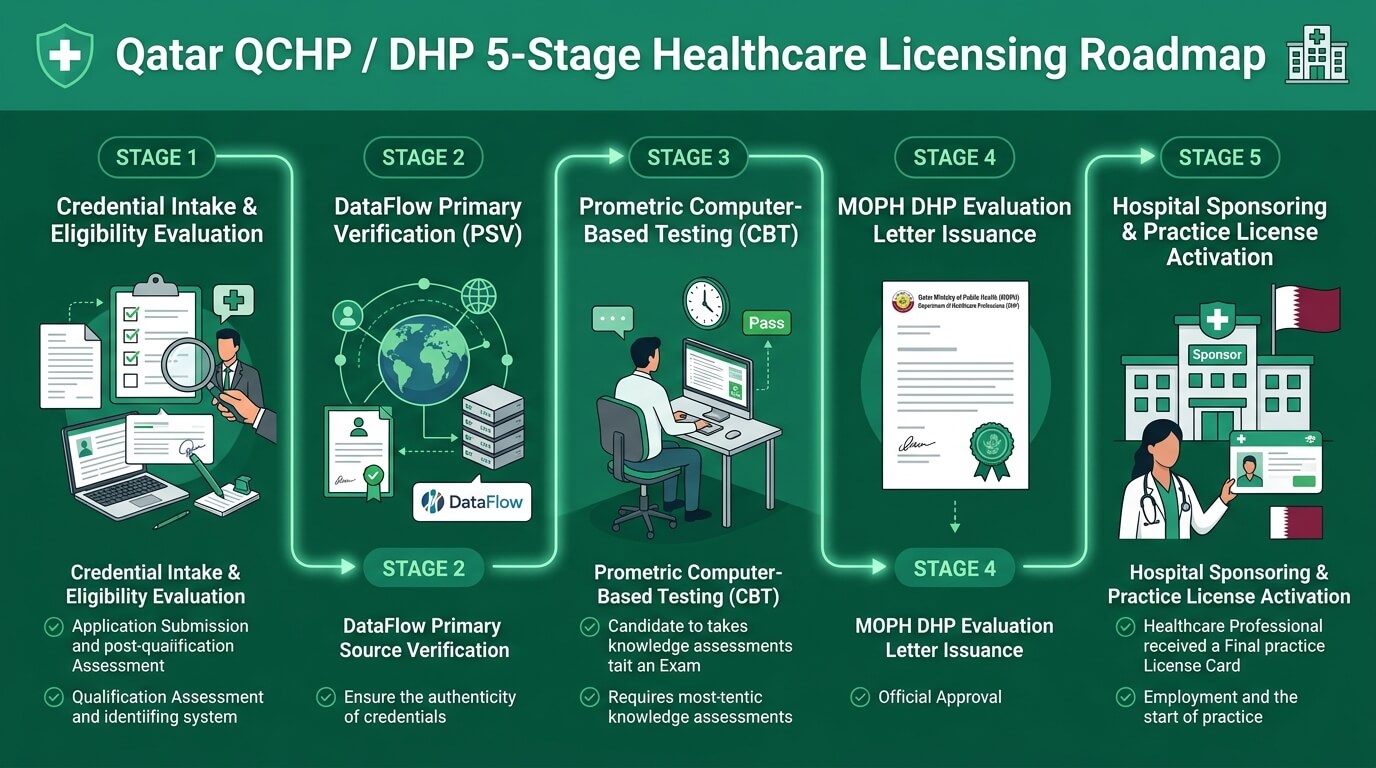
Achieving healthcare licensure in the State of Qatar requires navigating a sequential, multi-stage regulatory progression. Attempting to bypass preliminary stages – such as scheduling a qualifying examination before completing verification or submitting an application without institutional pre-screening – frequently results in procedural rejections and significant career disruption. Overseas Healthcare Consultant structures every client journey around a clear five-stage regulatory roadmap.
Pre-Eligibility Audit
Comprehensive credential audit evaluating basic degrees, specialist diplomas, and hospital service records against the official DHP PQR guidelines.
DataFlow PSV
Primary Source Verification of academic diplomas, council registrations, and clinical employment tenures directly with global issuing bodies.
Prometric CBT
Completion of standardized discipline-specific computer-based qualifying examinations at authorized international Prometric test centers.
Evaluation Letter
MOPH DHP committee reviews the unified dossier, verifies positive PSV and passing exam scores, and grants the statutory Evaluation Letter.
License Activation
Securing hospital employment in Qatar, completing mandatory medical fitness protocols, and activating the practicing license under facility sponsorship.
The Five-Stage Licensure Lifecycle: Pre-Eligibility, PSV, Prometric, Evaluation, and Licensing
The path to lawful clinical practice in Qatar encompasses five discrete, interconnected operational milestones:
Stage 1: Pre-Eligibility Assessment and Credential Audit. OHC senior documentation specialists evaluate the candidate basic academic qualifications, post-graduate degrees, professional regulatory council licenses, and clinical hospital employment records against the current DHP Professional Qualification Requirements (PQR) to confirm category eligibility.
Stage 2: Primary Source Verification (DataFlow PSV). Academic degrees, official transcripts, home-country health council registrations, Certificates of Good Standing, and continuous clinical employment tenures are lodged with the DataFlow Group for direct institutional verification with issuing authorities worldwide.
Stage 3: Qualifying Prometric Computer-Based Testing (CBT). Candidates complete discipline-specific computer-based examinations administered globally by Prometric. The assessment validates clinical knowledge, patient safety protocols, and evidence-based decision-making.
Stage 4: MOPH DHP Dossier Evaluation and Eligibility Issuance. Upon successful completion of DataFlow verification and passing the Prometric exam, the candidate complete digital application is submitted to the DHP Registration and Licensing Department. The sovereign committee reviews the unified file and issues an official Evaluation Letter (Eligibility Letter).
Stage 5: Hospital Sponsorship, Medical Fitness, and License Activation. The candidate secures clinical employment with a licensed hospital, medical center, or clinic in Qatar. The sponsoring healthcare facility submits the institutional sponsorship declaration and medical fitness certificate, activating the permanent clinical practice license.
Understanding the Verification Evaluation Letter and Facility Sponsorship Activation
The Evaluation Letter (Eligibility Letter) issued by the MOPH Department of Healthcare Professions represents the pinnacle of independent candidate qualification. It serves as definitive sovereign proof that the practitioner credentials have been verified via Primary Source Verification and that clinical competency has been certified through standardized examination. The Evaluation Letter confirms the exact clinical title and scope of practice awarded to the practitioner under Qatar healthcare standards.
The Evaluation Letter remains valid for a statutory window of up to two to three years from the date of issuance, providing international healthcare professionals with ample time to participate in hospital recruitment interviews, finalize employment contracts, and arrange family relocation. Once an employment agreement is executed with a licensed healthcare institution in Qatar, the employer facility applies to link the candidate Evaluation Letter to their institutional health facility license, triggering the immediate issuance of the physical and electronic practicing license.
3. Mandatory Document Dossier and Pre-Submission Attestation Standards
The integrity of your document submission directly dictates the efficiency and outcome of your Qatar credentialing process. Incomplete dossiers, uncertified language translations, illegible photocopies, and unverified employment records are the primary causes of verification clarification inquiries (RFIs) and application delays. OHC conducts exhaustive audits on all client files prior to electronic submission.
Academic Credentials
Original degree certificates, diplomas, and official university transcripts covering all academic years. Sworn translations for non-English or non-Arabic records.
Council License & CGS
Active registration certificate from national/state health professional councils, plus an official Certificate of Good Standing issued within the preceding 6 months.
Clinical Experience Proof
Documented hospital service letters printed on official facility letterhead, detailing continuous clinical practice, exact dates, and verified supervisor signatures.
Primary Academic Credentials, Transcripts and University Verification Criteria
All academic qualifications claimed for professional registration must be submitted as high-resolution, uncropped color scans of original parchment certificates. For medical doctors, this includes basic medical degrees (MBBS or equivalent) and all post-graduate clinical qualifications (MD, MS, Arab Board, Fellowship, or equivalent specialist diplomas). For nursing professionals, this encompasses General Nursing and Midwifery (GNM) diplomas, Bachelor of Science in Nursing (B.Sc Nursing), Post-Basic B.Sc Nursing, and Master of Science in Nursing (M.Sc Nursing) credentials. Pharmacists must submit Bachelor of Pharmacy (B.Pharm), Master of Pharmacy (M.Pharm), or Doctor of Pharmacy (PharmD) degree parchments.
In addition to graduation certificates, applicants must supply official university marksheets or consolidated academic transcripts detailing course curriculum and clinical training hours for every academic year. If academic records were issued in languages other than English or Arabic, sworn legal translations executed by an accredited translation authority must be provided alongside the original language documents.
Professional Council Registrations, Active Licenses and Certificates of Good Standing (CGS)
The Department of Healthcare Professions requires independent confirmation that every international applicant holds an active, unencumbered license to practice in their home jurisdiction or country of last employment. Applicants must submit official registration certificates issued by recognized regulatory councils, such as the National Medical Commission (NMC), State Nursing Councils, State Pharmacy Councils, or equivalent international health authorities.
A mandatory prerequisite for Qatar licensing is the submission of an official Certificate of Good Standing (CGS). The CGS must be issued by the governing regulatory council within the preceding six calendar months, confirming that the professional holds an active license without ethical reprimands, clinical sanctions, ongoing malpractice investigations, or disciplinary suspensions. If the issuing authority operates an online verification portal, OHC ensures that portal credentials and registry URLs are explicitly provided to accelerate DataFlow validation.
Documented Clinical Experience Certificates, Internship Records and Hospital Letterhead Criteria
Verification of post-qualification clinical experience is mandatory for establishing practitioner tier classification under the Qatar PQR. Experience certificates must be printed on official hospital or clinical facility letterhead, detailing the practitioner legal name, exact dates of employment (day, month, year), specific clinical department, professional job title, employment status (full-time continuous clinical engagement), and institutional contact details.
For medical practitioners, dentists, and physiotherapists, official documentation verifying full completion of a 12-month rotatory clinical internship is mandatory. Experience letters signed by non-authorized personnel, letters on plain paper, and documents missing official institutional seals will be rejected by DataFlow. OHC verifies that issuing hospital HR departments maintain active institutional email domains and verifiable telephone contacts prior to file lodgment.
4. Discipline-Specific Licensure Requirements: Doctors, Nurses, Pharmacists and Allied Health
Credentialing guidelines enforced by the Department of Healthcare Professions vary significantly across clinical disciplines. Understanding the specific evidentiary standards applicable to your professional category prevents redundant document submissions and ensures alignment with Qatar classification benchmarks.
Medical Practitioners, Consultants and Dental Specialists Credentialing Pathways
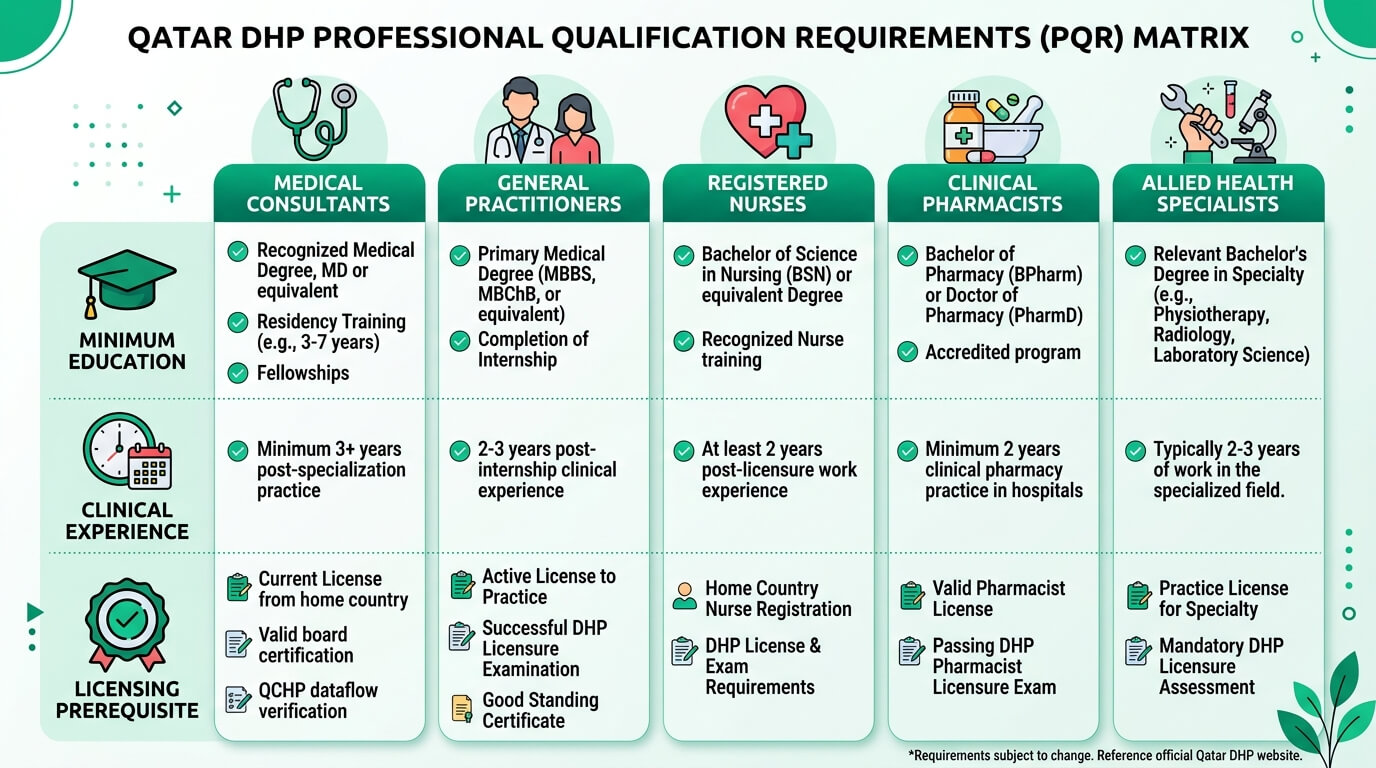
Physicians seeking licensure in Qatar are classified into General Practitioners, Specialist Physicians, and Consultant Physicians based on their academic tier and post-qualification clinical tenure. General Practitioners must possess an MBBS degree, a verified 12-month clinical rotatory internship, and a minimum of two years of continuous post-internship hospital experience. Specialist physicians must hold a recognized clinical postgraduate qualification (MD, MS, MRCP, FRCS, Arab Board, or Tier 1/2 recognized equivalents) plus the required years of dedicated specialty practice.
Consultant tier recognition requires premier international specialty qualifications (such as American Board Certification, Canadian Fellowship, UK CCT/CCST, or equivalent Tier 1 qualifications) alongside five or more years of post-specialist practice. Dental surgeons must verify BDS degrees and internship completion, while dental specialists (Orthodontics, Prosthodontics, Endodontics, Periodontics, and Oral Surgery) must demonstrate Master-level specialty training and documented clinical focus.
Registered Nurses, Midwives and Nursing Specialists Licensure Criteria
Nursing professionals comprise the backbone of healthcare delivery across Qatar hospitals, clinics, and school health networks. Licensure categories encompass General Nurses, Staff Nurses, Nurse Specialists, and Certified Midwives. Candidates holding a 3-year Diploma in General Nursing and Midwifery (GNM) require a minimum of three years of continuous clinical bedside experience in an accredited inpatient hospital.
Graduates of a 4-year Bachelor of Science in Nursing (B.Sc Nursing) or Post-Basic B.Sc Nursing program require a minimum of two years of verified post-registration clinical bedside nursing experience. Midwives must provide specialized obstetrical clinical logs confirming delivery experience, while Nurse Specialists must demonstrate postgraduate Master-level clinical degrees and targeted critical care or specialty unit service.
Clinical and General Pharmacists Licensing Standards in Qatar
The pharmaceutical regulatory framework in Qatar distinguishes between General Pharmacists (holders of 4-year or 5-year Bachelor of Pharmacy degrees) and Clinical Pharmacists (holders of PharmD or Master of Clinical Pharmacy degrees with accredited hospital residency training). General Pharmacists must demonstrate a minimum of two years of post-licensure dispensing experience in hospital pharmacies or community pharmacy networks.
Clinical Pharmacists must provide verified proof of advanced clinical pharmacotherapy rotations, inpatient rounding experience, and specialized medication therapy management. All pharmacy applicants must clear the qualifying Prometric computer-based assessment and verify their degrees and council registrations through DataFlow PSV.
Allied Health Professionals: Laboratory, Radiology, Physiotherapy and Clinical Support
Allied healthcare practitioners play essential roles across diagnostic, therapeutic, and rehabilitation services in Qatar. Licensed categories include Medical Laboratory Technologists, Diagnostic Radiographers, Ultrasound Technologists, Physiotherapists, Respiratory Therapists, Emergency Medical Technicians, and Anesthesia Technologists. Applicants must hold a Bachelor of Science degree in their respective clinical specialty from a recognized university, accompanied by at least two years of full-time clinical hospital experience.
| Clinical Discipline | Primary Qualification Standard | Mandatory Clinical Experience | Statutory Verification & Examination Requirements |
|---|---|---|---|
| Medical Consultants & Specialists | MBBS + Post-Graduate Clinical MD/MS/Board/Fellowship | 2 to 5+ years post-specialization depending on qualification tier | Degree + Specialist Diploma + Council Registration + GSC + Service Letters (Exam often waived for Tier 1) |
| General Practitioners (GPs) | MBBS + 12-Month Rotatory Clinical Internship | Minimum 2 years continuous full-time clinical hospital practice | MBBS Certificate + Internship Completion + Medical License + GSC + Prometric CBT |
| Registered Nurse Specialists | Bachelor of Science in Nursing (B.Sc Nursing, 4 years) | Minimum 2 years continuous bedside hospital nursing experience | B.Sc Nursing Degree + Transcripts + Nursing Council License + GSC + Prometric CBT |
| Staff Nurses / Technicians | Diploma in General Nursing & Midwifery (GNM, 3 years) | Minimum 3 years full-time clinical hospital nursing experience | Diploma Certificate + Full Marksheets + Council Registration + GSC + Prometric CBT |
| Clinical & General Pharmacists | Bachelor of Pharmacy (B.Pharm) or Doctor of Pharmacy (PharmD) | Minimum 2 years continuous pharmaceutical dispensing or clinical practice | Pharmacy Degree + Academic Transcripts + State Pharmacy License + GSC + Prometric CBT |
| Dental Surgeons & Specialists | BDS or Post-Graduate Master of Dental Surgery (MDS) | Minimum 2 years general practice; 3+ years for specialists | BDS Degree + Internship + Council License + GSC + Prometric CBT |
| Allied Healthcare Specialists | Bachelor of Science in Medical Laboratory, Radiology, or PT | Minimum 2 years verified clinical diagnostic or rehabilitation experience | B.Sc Degree + University Marksheets + Professional Council Registration + GSC + Prometric CBT |
5. Qatar DataFlow Primary Source Verification (PSV) Execution
Primary Source Verification administered by the DataFlow Group is the statutory cornerstone of the Qatar licensing process. General notarizations, apostilles, and commercial attestations are legally insufficient to establish credential validity. Every international applicant must undergo independent, direct verification directly with the issuing entities worldwide.
Direct Institutional Outreach and Verification Protocols Administered by DataFlow Group
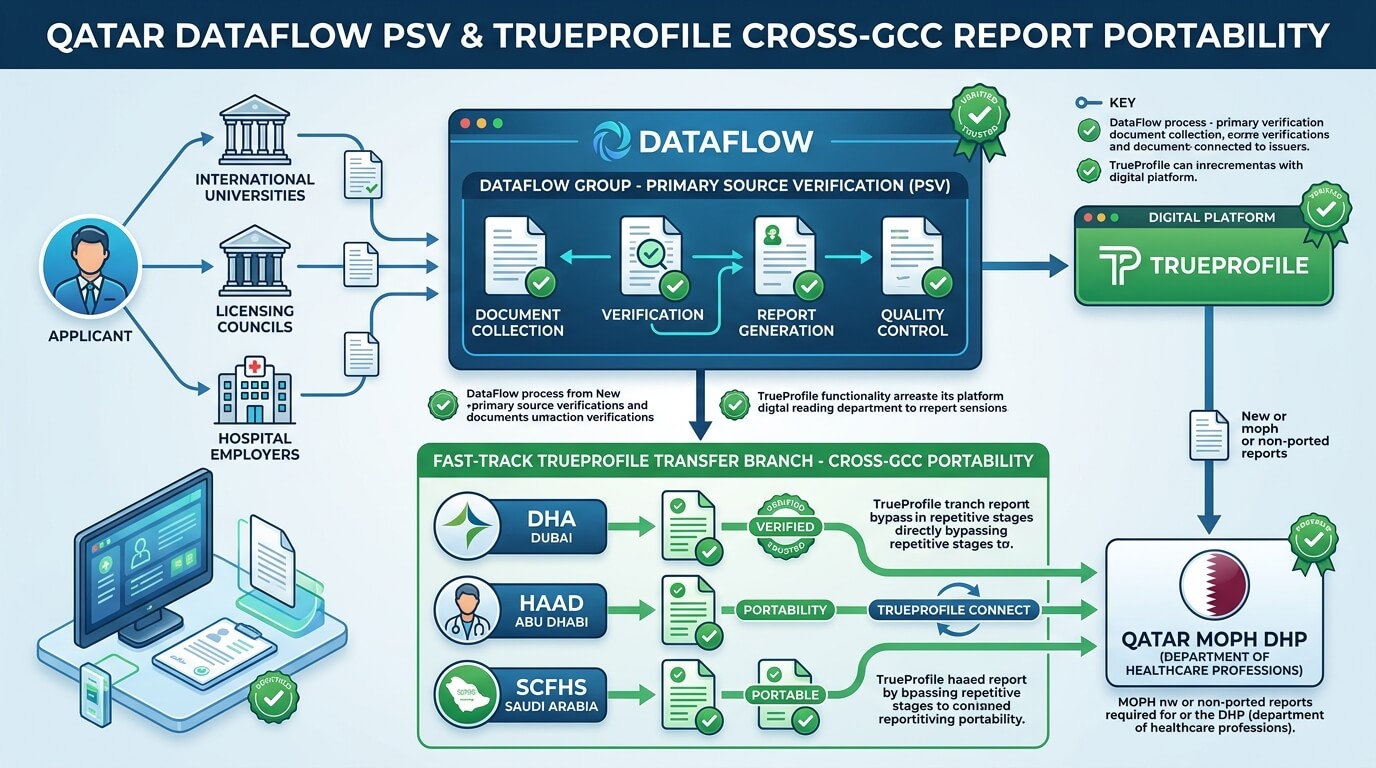
Upon submitting an application through the official DataFlow portal dedicated to the State of Qatar, verification officers initiate direct communication with designated registrars, government ministries of higher education, regulatory councils, and hospital human resources departments worldwide. The DataFlow Group maintains an extensive international network of institutional channels, ensuring that verification inquiries are transmitted to authenticated administrative offices rather than unverified intermediaries.
The primary objective of DataFlow verification is to establish three essential facts: first, that academic degrees and clinical diplomas were legitimately awarded to the candidate; second, that the applicant held an active, unrestricted license to practice without disciplinary sanctions; and third, that claimed hospital employment tenures represent authentic, full-time clinical service. When all issuing bodies return positive written confirmations, DataFlow generates an official Final Positive Verification Report.
Letter of Authorization (LOA) Compliance, Verification Timelines and Status Tracking
A critical legal instrument within the DataFlow intake workflow is the Letter of Authorization (LOA). The LOA is a statutory document empowering the DataFlow Group to communicate with international institutions on the candidate behalf. The LOA must be signed by the applicant with a physical, handwritten signature that precisely matches the signature page of their international passport. Font-based or digital electronic signatures are strictly rejected by DataFlow intake checkers.
The standard processing lifecycle for Qatar DataFlow verification spans approximately twenty-five to thirty-five business days, depending on how quickly the applicant educational institutions, health councils, and hospital employers respond to verification requests. Overseas Healthcare Consultant maintains active tracking on every lodged case, proactively liaising with issuing authorities to resolve clarification inquiries and prevent administrative stalls.
6. Cross-GCC Verification Portability: TrueProfile Report Transfer to Qatar
A significant advantage available to healthcare professionals with prior work experience in the United Arab Emirates or Saudi Arabia is cross-border report portability through TrueProfile.io, the digital credential platform operated by the DataFlow Group. Healthcare professionals who have already undergone Primary Source Verification for the Dubai Health Authority (DHA), Department of Health Abu Dhabi (DOH/HAAD), UAE Ministry of Health and Prevention (MOHAP), or Saudi Commission for Health Specialties (SCFHS) can leverage their existing verified reports for Qatar licensure.
TrueProfile Report Transfer
Transfer previously verified educational and licensing credentials from DHA, HAAD, or SCFHS directly to Qatar MOPH DHP without re-verification from scratch.
Incremental Verification Add-Ons
Conduct a document gap analysis to submit targeted add-on requests for recently acquired hospital experience letters and active Good Standing Certificates.
Transferring Verified DHA, HAAD and SCFHS Reports via TrueProfile.io
Instead of re-verifying foundational degrees, basic medical diplomas, and historical council registrations from scratch – which consumes extensive processing time – candidates can initiate an official TrueProfile Report Transfer to the State of Qatar Department of Healthcare Professions. The TrueProfile platform validates the authenticity of the previously verified documents and generates a Qatar-compliant transfer report containing a unique validation barcode.
By porting verified credentials through TrueProfile, candidates dramatically shorten verification turnaround times and eliminate redundant communications with home-country universities and licensing councils. This transfer protocol is particularly beneficial for senior physicians and nursing supervisors who possess complex multi-tier qualifications verified during previous Gulf employment.
Document Gap Analysis and Incremental Verification Add-Ons for Qatar Compliance
While TrueProfile securely transfers existing verification components, the Qatar Department of Healthcare Professions enforces specific regulatory parameters that may not have been included in previous UAE or Saudi verification packages. For example, Qatar typically requires verified clinical experience letters covering practice up to the date of application, alongside an active Good Standing Certificate issued within the last six months.
Overseas Healthcare Consultant conducts a comprehensive Document Gap Analysis on your existing DataFlow reports. We identify exactly which credentials can be transferred through TrueProfile and seamlessly submit incremental verification add-on requests for your recent hospital employment and updated council licenses, delivering a complete, compliant Qatar verification dossier.
7. QCHP / DHP Prometric Computer-Based Examination Architecture
Standardized examination testing is mandatory for foreign-trained healthcare practitioners seeking clinical licensure in Qatar. Administered internationally through Prometric testing facilities, computer-based assessments evaluate applied clinical knowledge, patient safety protocols, therapeutic guidelines, diagnostic interpretation, and professional ethics across complex healthcare scenarios.
Standardized CBT Blueprints
100 to 150 multiple-choice clinical vignette questions covering diagnosis, patient safety, pharmacology, and emergency decision-making.
Booking & Retake Policies
Up to 3 attempts per eligibility period. Mandatory 30-day cooling-off interval between attempts. Passing scores valid for up to 3 years.
Targeted Coaching Scope
Live interactive clinical coaching exclusively for Registered Nurses and Pharmacists. Comprehensive syllabus and booking guidance for doctors.
Prometric CBT Blueprints, Discipline-Specific Question Formats and Passing Cutoffs
The Department of Healthcare Professions collaborates with Prometric to design standardized examination blueprints tailored to specific healthcare disciplines. The qualifying assessments consist of multiple-choice questions (MCQs) administered electronically in secure, proctored testing facilities worldwide. Questions are structured around patient vignettes detailing clinical history, physical examination findings, and diagnostic investigation panels, requiring candidates to formulate diagnoses, interpret laboratory anomalies, and choose initial management algorithms.
Passing score benchmarks and testing structures vary by discipline. General Practitioners and Specialists typically complete 100 to 150 questions over two and a half to three hours, with a passing threshold established at 60%. Registered Nurses complete 100 questions over two and a half hours with a passing cutoff of 50% for Staff Nurses and 55% for Specialists. Pharmacists complete 100 questions covering pharmacotherapy, pharmacy practice, pharmaceutical calculations, and drug safety with a passing score of 55%. Allied health specialists face 100 discipline-specific questions with passing cutoffs ranging between 50% and 55%.
Examination Booking Protocols, Retake Policies and Cooling-Off Periods
Candidates can register for the qualifying examination through Prometric secure portal. Applicants are typically granted up to three attempts to achieve a passing score within an eligibility cycle. In the event of an unsuccessful attempt, a mandatory cooling-off period of at least thirty calendar days must be observed prior to scheduling a retest, allowing candidates adequate time to review blueprints and refine their preparation.
Passing test scores are officially valid for professional registration in Qatar for a statutory window of up to three years from the date of examination completion. Test results are electronically transmitted directly from Prometric to the DHP registration database, enabling seamless integration into the practitioner unified licensing file.
8. Why Partner with Overseas Healthcare Consultant for Qatar Licensure Success
Navigating Qatar healthcare professional licensing alongside DataFlow Primary Source Verification, TrueProfile transfers, Prometric examination scheduling, and DHP electronic portal submissions is an intricate, high-stakes regulatory process. A single documentation mistake or unresolved clarification inquiry can result in application rejections, delays, and lost employment opportunities. Overseas Healthcare Consultant serves as your trusted, full-stack regulatory partner, delivering unparalleled precision across every phase of your Qatar credentialing journey.
Rigorous Pre-Submission Auditing
Senior documentation analysts examine certificates, transcripts, licenses, and hospital letters to eliminate discrepancies before DataFlow intake.
Dedicated Documentation Officers
Assigned licensing specialists liaise with global university registrars, councils, and hospital HR teams to resolve bottlenecks and avoid stalls.
End-to-End Regulatory Excellence
Complete management covering pre-eligibility, DataFlow PSV, TrueProfile portability, Prometric scheduling, and final MOPH DHP Evaluation Letter acquisition.
Rigorous Pre-Submission Credential Auditing and Defect Elimination
Every academic certificate, transcript, health council license, and employment letter is meticulously scrutinized by our senior regulatory analysts against the latest Qatar Department of Healthcare Professions guidelines. We eliminate document defects, verify institutional coordinates, ensure handwritten LOA compliance, and format dossiers to achieve first-time verification acceptance.
Dedicated Regulatory Documentation Officers and Issuing Authority Liaison
When you partner with OHC, you are assigned a dedicated licensing consultant who directly oversees your DataFlow application, manages MOPH DHP synchronization, and tracks case milestones daily. In the event of unresponsive universities or issuing authority roadblocks, our team coordinates proactive follow-ups to ensure your case crosses the finish line smoothly.
Verified Healthcare Candidate Reviews and Seamless Gulf Career Pathways
With over twelve years of specialized experience and thousands of healthcare professionals successfully licensed across Qatar, the United Arab Emirates, Saudi Arabia, and Oman, OHC delivers proven regulatory expertise. From initial credential verification to final Evaluation Letter issuance and cross-GCC career mobility, OHC provides comprehensive support tailored to your professional success.
Verified Healthcare Candidate Testimonials
Read genuine feedback from physicians, nurses, pharmacists, and allied specialists who secured Qatar licensure with OHC.
9. Frequently Asked Questions About Qatar QCHP / DHP Licensing
Below are authoritative, direct answers to the most common questions asked by international doctors, nurses, pharmacists, and allied health professionals regarding Qatar QCHP and DHP healthcare licensing.
Fast-Track Your Qatar QCHP / DHP Licensure Today
Connect with our senior licensing consultants and document specialists. Eliminate delays, navigate DataFlow verification smoothly, and obtain your official MOPH DHP Evaluation Letter.