


Official Saudi Healthcare Licensing Guidance
Saudi Commission for Health Specialties (SCFHS) License: Complete Mumaris Plus Registration, Professional Classification & PSV Guide
Your master authority for navigating SCFHS healthcare licensing in the Kingdom of Saudi Arabia. From Mumaris Plus profile configuration and DataFlow Primary Source Verification to Prometric CBT assessment and Professional Classification (Tasnif), Overseas Healthcare Consultant delivers full-stack regulatory management for medical doctors, registered nurses, pharmacists, and allied health specialists.
DataFlow PSV & TrueProfile Support
SNLE & SPLE Clinical Coaching
Dedicated Documentation Specialist
Check Your SCFHS Eligibility
Receive an expert review of your qualifications, PQR tier, and DataFlow PSV requirements.
SCFHS Licensing at a Glance
Key regulatory parameters governing international healthcare classification and registration in the Kingdom of Saudi Arabia.
Governing Authority
Saudi Commission for Health Specialties (SCFHS), headquartered in Riyadh.
Digital Portal
Mumaris Plus (Mumaris+) centralized sovereign practitioner platform.
Primary Verification
DataFlow Group Primary Source Verification (PSV) & TrueProfile Transfer.
Clinical Assessment
Prometric Computer-Based Testing (SMLE, SNLE, SPLE) worldwide.
Statutory Outcome
Professional Classification (Tasnif) & Facility Practice Registration (Tasjeel).
1. Overview of SCFHS Healthcare Licensing in Saudi Arabia
The Kingdom of Saudi Arabia represents one of the most rapidly expanding and technologically sophisticated healthcare ecosystems in the Middle East. Driven by the ambitious national transformation goals of Saudi Vision 2030, the Kingdom is aggressively modernizing its healthcare infrastructure, transitioning public healthcare delivery into regional Accountable Care Organizations (Health Clusters), and expanding private medical cities across Riyadh, Jeddah, Dammam, Al-Khobar, Medina, and Mecca. Central to this monumental modernization is the strict enforcement of clinical quality, patient safety, and practitioner competency governed by the Saudi Commission for Health Specialties (SCFHS).
Every international medical doctor, dental practitioner, registered nurse, clinical pharmacist, and allied healthcare professional seeking clinical practice within the Kingdom must complete a rigorous statutory evaluation known as Professional Classification (Tasnif) and Professional Registration (Tasjeel) overseen by SCFHS. Unlike many jurisdictions where licensing is a single administrative step, practicing in Saudi Arabia requires an integrated sequence of primary credential vetting, computer-based clinical assessment, regulatory classification, and healthcare facility credential linking.
Statutory Authority of the Saudi Commission for Health Specialties
Established pursuant to Royal Decree, the Saudi Commission for Health Specialties functions as the supreme statutory regulatory body responsible for setting healthcare standards, accrediting medical training programs, classifying healthcare practitioners according to academic qualifications and clinical experience, and issuing professional practice licenses across all healthcare sectors in Saudi Arabia. Operating from its headquarters in Riyadh with regional branches across the Kingdom, SCFHS exercises comprehensive oversight over both public facilities – such as Ministry of Health (MOH) hospitals, military and university medical complexes – and private healthcare institutions.
The Commission administers its regulatory mandates primarily through the centralized Mumaris Plus (Mumaris+) digital platform. This end-to-end digital ecosystem consolidates practitioner profiling, primary source verification tracking, exam eligibility scheduling, professional classification evaluations, continuing medical education (CME) monitoring, and license renewals into a unified sovereign database. Understanding how to navigate Mumaris Plus and align your foreign qualifications with SCFHS executive regulations is essential for establishing a legitimate, legally protected clinical career in Saudi Arabia.
Key Medical Hubs and Healthcare Clusters in the Kingdom of Saudi Arabia
Under the Saudi Healthcare Transformation Program, healthcare delivery has been organized into autonomous Health Clusters (Tajammuat Sehiya) designed to provide integrated, community-centered healthcare networks. For overseas practitioners, this restructuring offers unprecedented clinical opportunities across diverse medical specialties, tertiary hospitals, trauma centers, and specialized research institutes.
| Healthcare Cluster / Region | Key Medical Complexes and Tertiary Centers | Dominant Clinical Focus Areas | Practitioner Opportunities |
|---|---|---|---|
| Riyadh First & Second Health Clusters (Central) | King Faisal Specialist Hospital & Research Centre, King Fahad Medical City, Prince Sultan Military Medical City | Tertiary oncology, organ transplantation, cardiology, pediatric subspecialties, advanced surgical care | Consultant physicians, intensive care nurses, clinical pharmacists, diagnostic radiographers |
| Makkah & Jeddah Health Clusters (Western) | King Abdulaziz Medical City, King Fahad Hospital Jeddah, International Medical Center, King Abdullah Medical City Makkah | Emergency medicine, mass-gathering medicine, maternal & child health, critical care, nephrology | Emergency physicians, critical care nurses, clinical pathology specialists, trauma surgeons |
| Eastern Province Health Cluster (Eastern) | King Fahd Hospital of the University, Johns Hopkins Aramco Healthcare, Dammam Medical Complex | Occupational health, trauma care, cardiology, family medicine, pediatric intensive care | General practitioners, industrial health nurses, specialized pharmacists, physiotherapists |
| Southern & Northern Health Clusters (Asir, Tabuk, Al-Jouf) | Asir Central Hospital, King Salman Armed Forces Hospital Tabuk, Prince Mutaib Hospital | Comprehensive primary care, general surgery, obstetrics, community nursing, regional telemedicine | General nurses, medical residents, community pharmacists, ultrasound technologists |
2. Unified Professional Qualification Requirements (PQR) Matrix
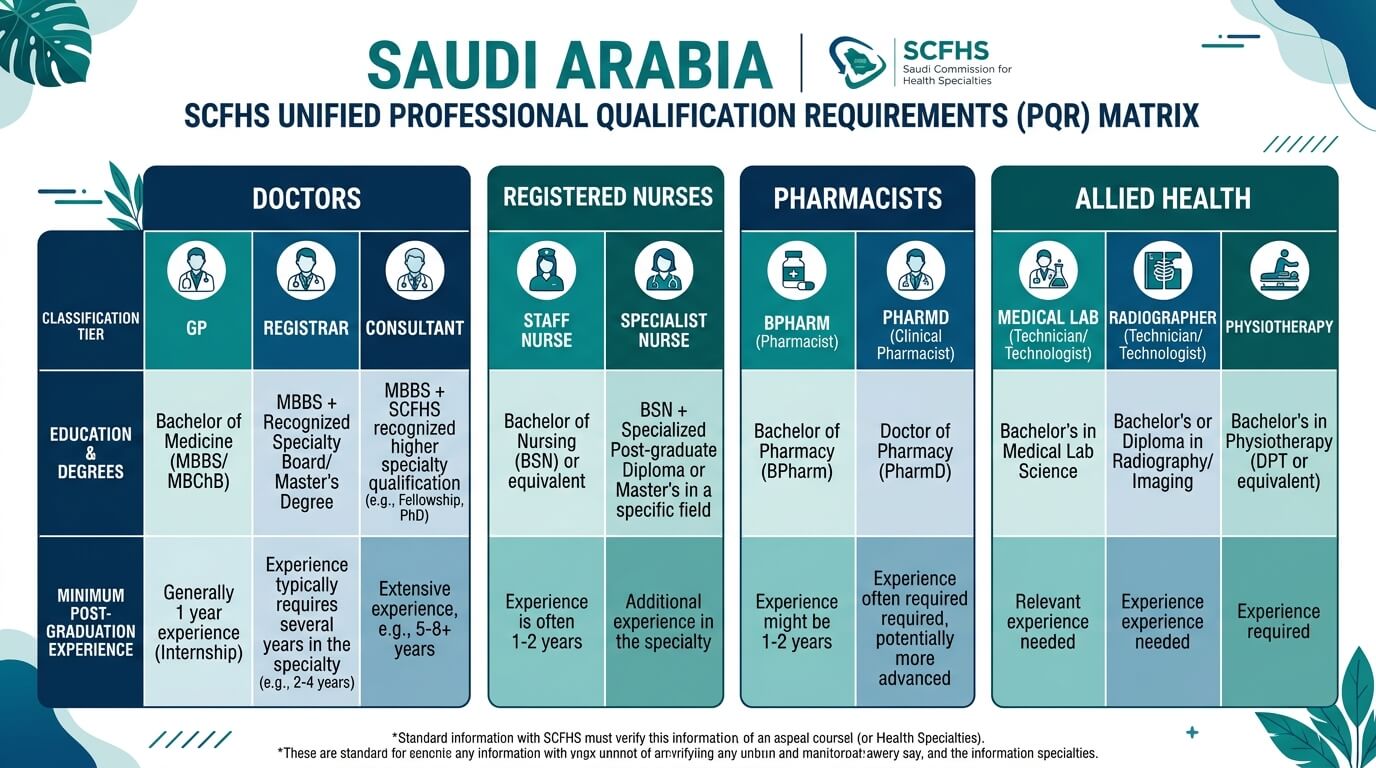
The Saudi Commission for Health Specialties enforces a meticulous Professional Qualification Requirements (PQR) framework known formally as the Executive Regulations for Professional Classification and Registration. This regulatory document establishes the precise baseline qualifications, minimum years of documented continuous clinical experience, internship durations, and specialist credentials necessary for each professional tier.
Foreign medical credentials must originate from regionally and nationally accredited universities recognized by the Saudi Ministry of Education and international evaluation authorities. Any gap in continuous clinical practice exceeding two calendar years triggers mandatory competency evaluations or supervisory requirements. Below is the comprehensive eligibility matrix across primary healthcare disciplines.
Physicians, Specialists, and Medical Consultants Classification
Medical doctors are classified into structured professional tiers based on their primary medical degree (MBBS/MD), post-graduate residency programs, recognized specialty fellowships, and cumulative post-qualification experience. The tier assigned on the SCFHS Classification Certificate determines the scope of clinical privileges granted upon hospital employment.
| Professional Classification Tier | Minimum Educational Qualification | Mandatory Post-Qualification Clinical Experience | Assessment and Examination Pathway |
|---|---|---|---|
| General Practitioner (GP) | Recognized primary medical qualification (MBBS, MBChB, MD) plus 1-year mandatory rotatory internship | Minimum 2 years of continuous clinical experience in an accredited hospital or healthcare center post-internship | SCFHS Saudi Medical Licensure Examination (SMLE) / Prometric CBT |
| Resident Doctor | Recognized primary medical degree plus structured clinical residency or certified clinical diploma (minimum 1-2 years) | Minimum 2 to 3 years of clinical practice in the relevant clinical department | SCFHS Prometric specialty assessment or accredited board evaluation |
| Registrar (Specialist) | Master’s Degree, Clinical Diploma, or recognized Part 1 Specialty Board (such as MRCP UK Part 1 & 2, Arab Board Part 1) | Minimum 3 years of continuous clinical experience post-postgraduate qualification | SCFHS Specialist Prometric assessment / Oral specialty evaluation |
| Senior Registrar | First-tier clinical specialty qualification: Complete Fellowship (MRCP/FRCS with CCT, Arab Board, American Board, MD/DM/MCh) | Minimum 2 to 3 years of clinical practice post-attainment of highest specialty board qualification | Documentary board peer review and SCFHS specialty committee classification |
| Consultant | Top-tier specialty qualification: CCST/CCT (UK), American Board (USA), Facharzt (Germany), DM/MCh (India) or equivalent Tier 1 board | Minimum 3 to 5 years of documented clinical consultant practice in an accredited tertiary hospital | Direct peer-review classification by SCFHS Central Specialized Medical Committee |
Registered Nurses, Nurse Specialists, and Midwives Requirements
Nursing professionals constitute the frontline backbone of Saudi Arabia’s expanding inpatient and outpatient facilities. The Commission classifies nursing candidates strictly based on whether their academic qualification is at the diploma, bachelor, or postgraduate master’s level, combined with active clinical bedside experience.
| Nursing Classification Category | Academic Degree and Institutional Standing | Mandatory Clinical Bedside Experience | Assessment Requirement |
|---|---|---|---|
| Nursing Technician / Staff Nurse | Recognized Diploma in General Nursing and Midwifery (GNM) – minimum 3 years duration | Minimum 2 years of verified continuous clinical hospital bedside experience post-registration | SCFHS Saudi Nursing Licensure Examination (SNLE) / Prometric CBT |
| Registered Nurse (RN) / Specialist Nurse | Bachelor of Science in Nursing (BSc Nursing) from an accredited university (minimum 4-year curriculum) | Minimum 2 years of documented post-qualification clinical hospital experience | SCFHS Saudi Nursing Licensure Examination (SNLE) Prometric CBT |
| Senior Specialist Nurse | Master of Science in Nursing (MSc Nursing) in a defined specialty (Critical Care, Oncology, Pediatric, Infection Control) | Minimum 3 years of specialized clinical nursing practice post-Master’s degree | Documentary classification evaluation by SCFHS Nursing Committee |
| Nurse Consultant | Doctor of Nursing Practice (DNP) or PhD in Nursing with recognized clinical subspecialty | Minimum 3 to 5 years of advanced clinical practice and nursing leadership post-doctorate | SCFHS Central Nursing Advisory Board review and committee approval |
Pharmacists, Clinical Pharmacists, and Allied Health Practitioners
Pharmacists and allied healthcare professionals (laboratory technologists, radiographers, physiotherapists, respiratory therapists) play a critical role in clinical support services across Saudi medical cities. SCFHS enforces rigorous qualification thresholds to guarantee standard operational safety.
| Healthcare Discipline | Recognized Qualification Baseline | Clinical Experience Mandate | Verification and Assessment Standard |
|---|---|---|---|
| General Pharmacist | Bachelor of Pharmacy (B.Pharm) or equivalent 4-5 year pharmaceutical curriculum | Minimum 2 years of hospital or retail dispensing experience post-registration | Saudi Pharmacist Licensure Examination (SPLE) / Prometric CBT |
| Clinical Pharmacist | Doctor of Pharmacy (PharmD) or Master’s in Clinical Pharmacy with accredited clinical residency | Minimum 2 to 3 years of documented hospital clinical pharmacy experience | SCFHS Clinical Pharmacy Prometric assessment and committee review |
| Medical Laboratory Technologist | Bachelor of Science in Medical Laboratory Technology (BSc MLT) or Clinical Laboratory Science | Minimum 2 years of continuous clinical diagnostic laboratory practice | SCFHS Laboratory Prometric CBT Assessment |
| Diagnostic Radiographer / Technologist | Bachelor of Science in Radiography / Medical Imaging Technology (BSc MIT) | Minimum 2 years of diagnostic imaging experience (X-ray, CT, MRI, Ultrasound) | SCFHS Radiography Prometric CBT Assessment |
| Physiotherapist | Bachelor of Physiotherapy (BPT) – minimum 4-year degree plus 6-month internship | Minimum 2 years of clinical rehabilitation or hospital physiotherapy experience | SCFHS Physiotherapy Prometric CBT Assessment |
| Respiratory Therapist | Bachelor of Science in Respiratory Care or Respiratory Therapy | Minimum 2 years of critical care ventilator and respiratory therapy experience | SCFHS Respiratory Care Prometric CBT Assessment |
3. Mumaris Plus Digital Portal Architecture & Account Setup
Mumaris Plus (Mumaris+) serves as the sovereign digital operating system for all healthcare practitioners interacting with the Saudi Commission for Health Specialties. Gone are the days of manual paper submissions or in-person visits to commission branch offices; every administrative action – from initial profile creation to credential classification, exam eligibility scheduling, and final registration – is executed within this encrypted portal.
Navigating Mumaris Plus requires absolute procedural precision. A single typographic discrepancy between your international passport, your degree certificate, and your Mumaris Plus profile can cause automated system rejects or extensive file reviews by commission officers. Overseas Healthcare Consultant provides meticulous pre-registration validation to guarantee seamless portal onboarding.
Step-by-Step Profile Creation and Identity Verification on Mumaris+
International applicants residing outside Saudi Arabia follow an international account creation pathway, whereas residents within the Kingdom authenticate via the National Single Sign-On (Nafath) portal. The account creation protocol involves several critical verification checkpoints:
- Identity Document Standardization: Enter your full legal name strictly as printed in the Machine Readable Zone (MRZ) of your international passport. Any variations in middle names or family name ordering must be harmonized across all submitted credentials.
- Dedicated Professional Email and Contact Protocol: Register with a permanent personal email address and mobile number. All official system alerts, verification reference numbers, and classification notices are linked irrevocably to this master identifier.
- Establishing Applicant Categorization: Select the appropriate international applicant pathway (‘New Practitioner outside the Kingdom’) to ensure proper system routing for international primary source verification.
- Portal Dashboard Initialization: Once verified via email confirmation, your personal Mumaris Plus account generates an internal Practitioner ID, which serves as your master tracking reference for all subsequent regulatory actions.
Uploading Professional Dossiers and Regulatory Documentation
Once the portal account is operational, candidates must assemble and upload their comprehensive professional dossier into the Mumaris Plus repository. Every uploaded document must comply with strict format, resolution, and legibility criteria:
| Document Category | Required Documentation Scope | Validation and Formatting Criteria | Common Procedural Pitfalls |
|---|---|---|---|
| Identity and Nationality | Valid international passport (minimum 6 months remaining validity), national identity card, recent passport-size photograph with white background | High-resolution color scan (minimum 300 DPI) in PDF format; clear visibility of all four document corners | Uploading black-and-white copies or cropped passport photo pages |
| Basic Degree and Transcripts | Primary qualification degree certificate, complete academic year-wise transcripts, and official internship completion certificate | Must include complete university stamp, registrar signature, and official graduation date matching transcripts | Missing internship certificate or omitting marksheets from early academic semesters |
| Postgraduate Credentials | Master’s degree, Diploma, Board certification, Fellowship certificates, and detailed curriculum breakdown where applicable | Must clearly indicate specialty title, training duration, and institutional accreditation standing | Submitting preliminary completion letters instead of final conferred diploma degrees |
| Clinical Experience Certificates | Official experience certificates on hospital letterhead from each employer covering the entire mandatory clinical duration | Letterhead must feature hospital registration number, exact dates of employment, clinical designation, and authorized medical director signature | Vague job descriptions, gaps exceeding two years, or missing employer contact details |
| License & Good Standing | Valid professional registration / license to practice from the home country nursing/medical council and official Good Standing Certificate (GSC) | GSC must be issued within the last 6 months; must verify clean disciplinary record and active standing | Submitting an expired Good Standing Certificate or an unverified provisional license |
4. Primary Source Verification (PSV) via DataFlow Group
Primary Source Verification (PSV) is the indispensable integrity safeguard of the Saudi healthcare licensing framework. Conducted exclusively by DataFlow Group – an internationally accredited specialized screening partner – PSV involves contacting the original issuing authorities (universities, nursing councils, medical boards, and hospitals) worldwide to verify directly that the credentials presented by the candidate are authentic, unaltered, and earned through legitimate study and practice.
A successful, clean DataFlow verification report is a non-negotiable prerequisite for obtaining your SCFHS Professional Classification Certificate. Understanding the verification workflow and maintaining strict document integrity protects applicants from costly delays and irreversible regulatory penalties.
Primary Source Verification Workflow and Document Scope
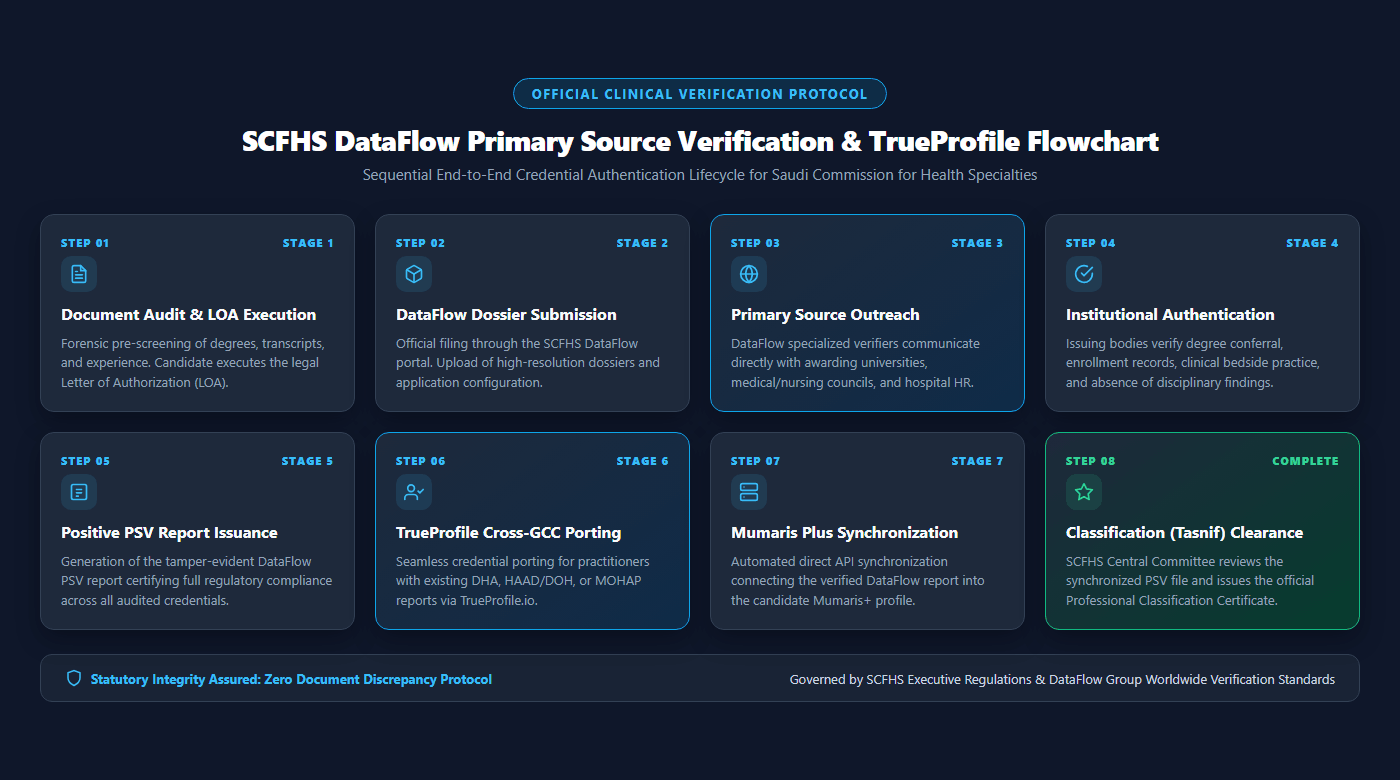
The DataFlow verification process for SCFHS proceeds through five coordinated operational stages:
- Application Configuration and Document Mapping: The candidate or OHC document specialist submits the verified dossier through the dedicated SCFHS DataFlow portal or initiates verification directly linked to the Mumaris Plus file.
- Letter of Authorization (LOA) Execution: The candidate signs a legally binding Letter of Authorization permitting DataFlow Group and SCFHS to contact educational institutes and healthcare employers.
- Primary Outreach to Issuing Sources: DataFlow’s multinational specialized verification team communicates directly with the registrar’s office of the awarding university, the state medical/nursing council, and the human resources division of past hospital employers.
- Independent Verification and Analysis: Issuing authorities confirm whether degrees were legitimately conferred, clinical experience was accurately completed in good standing, and no disciplinary sanctions exist.
- Final Report Issuance and System Synchronization: A final PSV report is published. A Positive report reflects complete verification. DataFlow directly syncs this result with your Mumaris Plus portal, unlocking the next regulatory milestones.
TrueProfile Integration and Cross-GCC Report Portability
A major strategic advantage for healthcare professionals who have previously worked in the UAE (under DHA, HAAD/DOH, or MOHAP), Qatar (QCHP), or Oman (OMSB) is the portability of verified credentials via TrueProfile.io. Because DataFlow Group serves as the verification partner across all Gulf cooperation health authorities, previously verified credentials do not require redundant verification from scratch.
Through a TrueProfile Transfer request, candidates can securely transfer their existing positive PSV report directly into the SCFHS system. This transfer protocol slashes verification turnaround times from several weeks down to just a few business days, provided that the previous report covers the specific degree and experience documents mandated by SCFHS. OHC evaluates existing GCC verification files to determine transfer feasibility and coordinates rapid cross-authority document porting.
5. SCFHS Prometric Computer-Based Testing Assessment
The Saudi Commission for Health Specialties requires healthcare practitioners across most clinical designations to demonstrate clinical competency through the Saudi Licensing Examination (SLE), administered internationally through Prometric computer-based testing centers. These examinations assess clinical decision-making, patient assessment methodologies, diagnostic protocols, pharmacological safety, and ethical medical standards.
Prometric assessments are administered worldwide across accredited testing centers in over 180 countries, allowing candidates to complete their clinical examinations in their home country prior to traveling to the Kingdom of Saudi Arabia.
Obtaining the SCFHS Eligibility Number for Exam Booking
A common source of confusion among foreign healthcare applicants is attempting to schedule a Prometric examination without first securing official authorization from the Commission. You cannot book an SCFHS Prometric exam directly on the Prometric portal without an official SCFHS Eligibility Number.
The protocol for generating an Eligibility Number requires the candidate to initiate a Professional Classification request on Mumaris Plus. Upon preliminary review of the candidate’s academic qualifications and identity dossier, SCFHS issues a unique Eligibility Number (typically valid for a defined window of up to 12 months). With this official code, the candidate logs into the Prometric global portal, selects an accredited testing facility in their home city or region, chooses an available date and time slot, and confirms their test reservation.
Exam Structure, Blueprint Standards, and Dedicated Coaching Support
Each clinical category possesses a dedicated examination blueprint designed by SCFHS advisory boards. The exam format consists entirely of multiple-choice questions (MCQs) utilizing clinical vignettes, situational patient management scenarios, and diagnostic interpretation.
| Examination Category | Exam Code / Title | Question Volume and Duration | Minimum Passing Standard | Coaching Availability |
|---|---|---|---|---|
| Medical Doctors (General) | Saudi Medical Licensure Examination (SMLE) | 300 MCQs (administered in multiple sections) – 6 Hours | Score scale benchmarked to 60% or higher scaled score | Syllabus guidance, blueprint orientation & mock practice |
| Registered Nurses (Staff & Specialist) | Saudi Nursing Licensure Examination (SNLE) | 150 MCQs – 3 Hours | Passing scaled score of 50% to 55% depending on tier | Comprehensive dedicated live coaching & test prep by OHC |
| General & Clinical Pharmacists | Saudi Pharmacist Licensure Examination (SPLE) | 150 MCQs – 3 Hours | Passing scaled score benchmarked to 50% or higher | Comprehensive dedicated live coaching & test prep by OHC |
| Medical Laboratory Technologists | SCFHS Lab Technologist Prometric CBT | 100 MCQs – 2.5 Hours | Scaled score passing benchmark (typically 50% – 55%) | Blueprint orientation & study resource guidance |
| Diagnostic Radiographers | SCFHS Radiographer Prometric CBT | 100 MCQs – 2.5 Hours | Scaled score passing benchmark (typically 50% – 55%) | Blueprint orientation & study resource guidance |
| Physiotherapists | SCFHS Physiotherapy Prometric CBT | 100 MCQs – 2.5 Hours | Scaled score passing benchmark (typically 50% – 55%) | Blueprint orientation & study resource guidance |
Institutional Quality Directive: In strict accordance with Overseas Healthcare Consultant standards, structured clinical coaching programs, live virtual tutoring, and comprehensive question-bank prep modules are exclusively offered for Registered Nurses (SNLE) and Pharmacists (SPLE). Candidates in medical doctor specialties and allied health fields receive blueprint orientation, syllabus breakdowns, and exam booking support, ensuring absolute transparency and educational excellence.
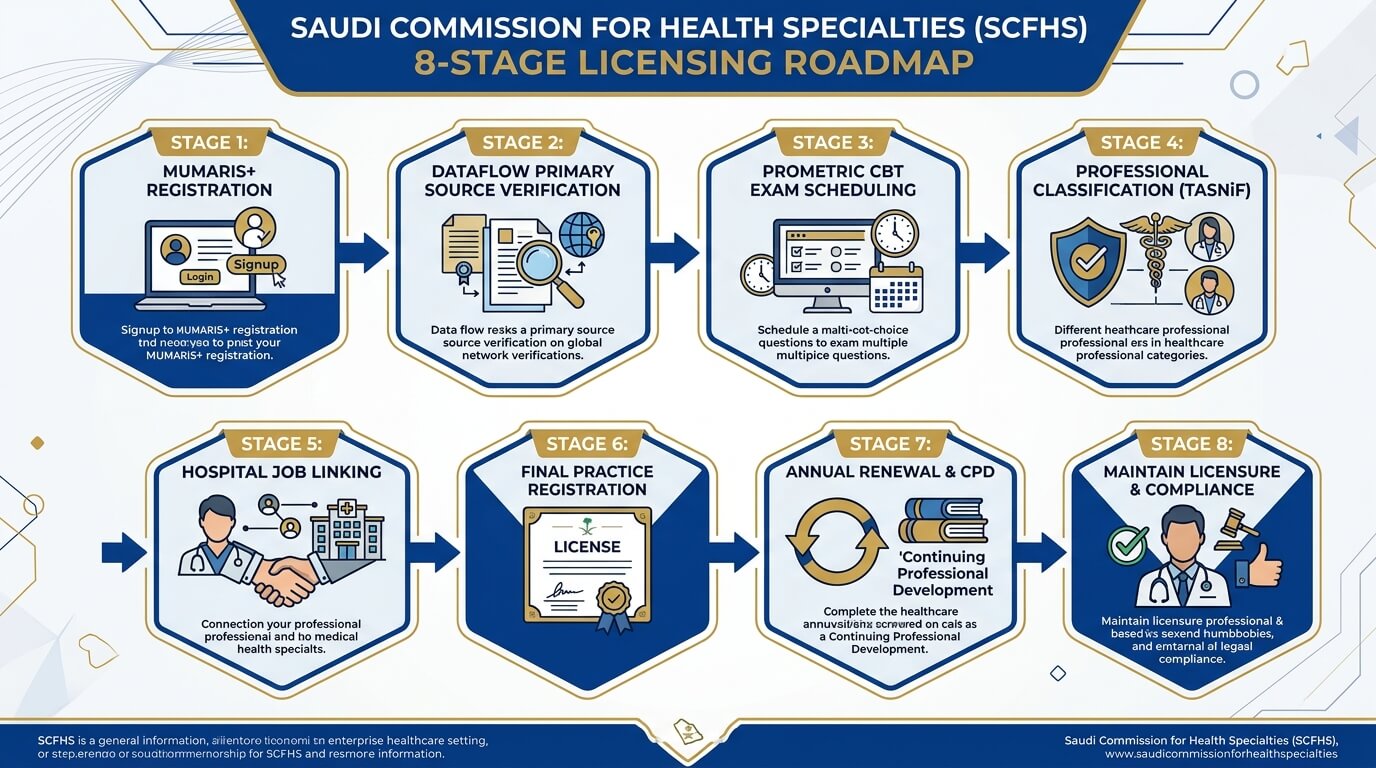
6. Step-by-Step Professional Classification and Registration Workflow
Achieving complete professional licensure to practice medicine, nursing, or allied health in Saudi Arabia is an organized, sequential journey spanning multiple regulatory milestones. Below is the statutory step-by-step roadmap from initial consultation to active clinical practice.
Multi-Stage Statutory Milestones from Application to Work Permit Activation
Pre-Eligibility Document Audit
Comprehensive pre-eligibility review of degrees, transcripts, internship records, experience letters, and home-country registration to verify PQR compliance.
Mumaris Plus Account Setup
Establishing and configuring your official Mumaris Plus profile, standardizing all personal and academic parameters to prevent clerical mismatches.
DataFlow PSV Verification
Submission of degrees, transcripts, and experience to DataFlow Group for primary source verification, or executing a rapid TrueProfile report transfer.
Classification Lodgment & Eligibility
Preliminary classification dossier is lodged through Mumaris Plus to request assessment and generate the official Prometric Eligibility Code.
Prometric CBT Assessment
Scheduling and sitting for your computer-based clinical assessment at an accredited Prometric testing center in your home country.
Classification Certificate (Tasnif)
Upon positive PSV and passing exam score, SCFHS committee reviews your file and issues the official Professional Classification Certificate.
Facility Job Linking
With Classification Certificate secured, your sponsoring hospital or medical group links your practitioner file to their institutional portal.
Practice License (Tasjeel) Activation
Following medical fitness screening, residency (Iqama) issuance, and employer endorsement, SCFHS activates your active clinical practice license.
7. Processing Timelines, Document Requirements & Verification Schedules
Navigating international credentialing requires realistic operational expectations. Processing lifecycles depend on several independent regulatory variables: the responsiveness of your alma mater and former hospital employers during DataFlow PSV checks, Prometric testing center slot availability, and SCFHS committee review schedules.
Standard Regulatory Lifecycles and Fast-Track Expedited Verification
Below is the detailed chronological schedule illustrating expected timelines for each phase of the Saudi licensing process:
| Licensing Phase | Standard Operational Timeline | Expedited / Fast-Track Pathway | Critical Milestones and Dependencies |
|---|---|---|---|
| Initial Document Audit & Mumaris+ Setup | 1 to 3 Business Days | Same-Day Priority Processing (OHC) | Complete document compilation and standardization |
| DataFlow Primary Source Verification (PSV) | 20 to 35 Business Days | DataFlow Express: 12 to 14 Business Days | Timely response from university registrars and hospital HR departments |
| TrueProfile Cross-GCC Report Transfer | 5 to 10 Business Days | Priority Transfer: 3 to 5 Business Days | Applicable if prior positive DHA, HAAD, or MOH report exists |
| Prometric Exam Eligibility Number Generation | 5 to 10 Business Days | Direct Committee Routing: 3 to 5 Days | Triggered upon initial Mumaris Plus classification review |
| Prometric Exam Administration & Scoring | Candidate Selected Date + 5 Days for Scoring | Immediate Booking Subject to Seat Availability | Results automatically transmitted by Prometric to Mumaris+ |
| Professional Classification Certificate Issuance | 7 to 15 Business Days | Priority Committee Review: 3 to 7 Days | Depends on concurrent completion of PSV and exam pass score |
| Employer Facility Linking & License Activation | 5 to 10 Business Days | Coordinated via Sponsoring Hospital HR | Requires signed employment contract and valid residency status |
Strategic Advice on Timelines: We strongly recommend initiating your SCFHS verification and Mumaris Plus classification process 3 to 4 months prior to your intended relocation date. Having a completed Professional Classification Certificate in hand drastically increases your hiring appeal to premier Saudi hospital groups.
8. Why Partner with Overseas Healthcare Consultant for SCFHS Licensing
The journey toward Saudi healthcare licensure demands flawless administrative execution, deep understanding of evolving statutory mandates, and constant vigilance against procedural bottlenecks. One improperly notarized experience certificate or unverified transcript can halt your file for months or result in an adverse classification finding that permanently impairs your GCC career prospects.
Overseas Healthcare Consultant (OHC) stands as the premier healthcare licensing consultancy across India, the United Kingdom, and the Gulf region. With an established track record assisting thousands of medical professionals, OHC delivers end-to-end management, absolute regulatory compliance, and unmatched personalized representation.
End-to-End File Management, Document Audit & Dedicated Representation
When you partner with OHC, you gain access to an institutional ecosystem dedicated entirely to your professional relocation success:
Forensic Document Audit
Our compliance analysts conduct a thorough pre-submission audit of your entire academic and clinical portfolio, identifying potential discrepancies, gaps in service, or missing verifications before documents reach official authorities.
Dedicated Document Officer
You are paired with an experienced licensing specialist who personally handles your Mumaris Plus profile creation, DataFlow tracking, liaison with issuing authorities, and committee correspondence.
Coaching for Nurses & Pharmacists
Our clinical educators provide high-yield, syllabus-focused preparation for the SNLE (nursing) and SPLE (pharmacy) examinations, featuring comprehensive question banks, mock exams, and test-taking strategies.
Proactive Exception Handling
Should an educational institution delay its response to DataFlow or an unexpected query arise on Mumaris Plus, OHC immediately intervenes through formal institutional channels to expedite resolution.
Healthcare Professionals Trust OHC for Saudi Licensing
Discover real journeys of physicians, registered nurses, and pharmacists successfully classified and licensed across Saudi Arabia.
“OHC made my SCFHS classification completely effortless. My dedicated document officer handled Mumaris Plus and DataFlow smoothly, resolving a major university transcript delay within days.”
“The SNLE coaching provided by OHC was exceptional! The question bank and live mock tests helped me clear the Prometric test on my first attempt with a 78% score. Highly recommended for nurses!”
“I needed to transfer my previous DHA DataFlow report to SCFHS. OHC managed the TrueProfile transfer in less than a week, saving me weeks of waiting and avoiding repeated verification.”
“Navigating Mumaris Plus from the UK seemed daunting until I engaged OHC. Their team organized every document, audited my experience letters, and secured my Consultant classification rapidly.”
9. Frequently Asked Questions About SCFHS Licensing in Saudi Arabia
Authoritative answers to the most common questions asked by international medical, nursing, and allied health professionals seeking licensure in the Kingdom of Saudi Arabia.